


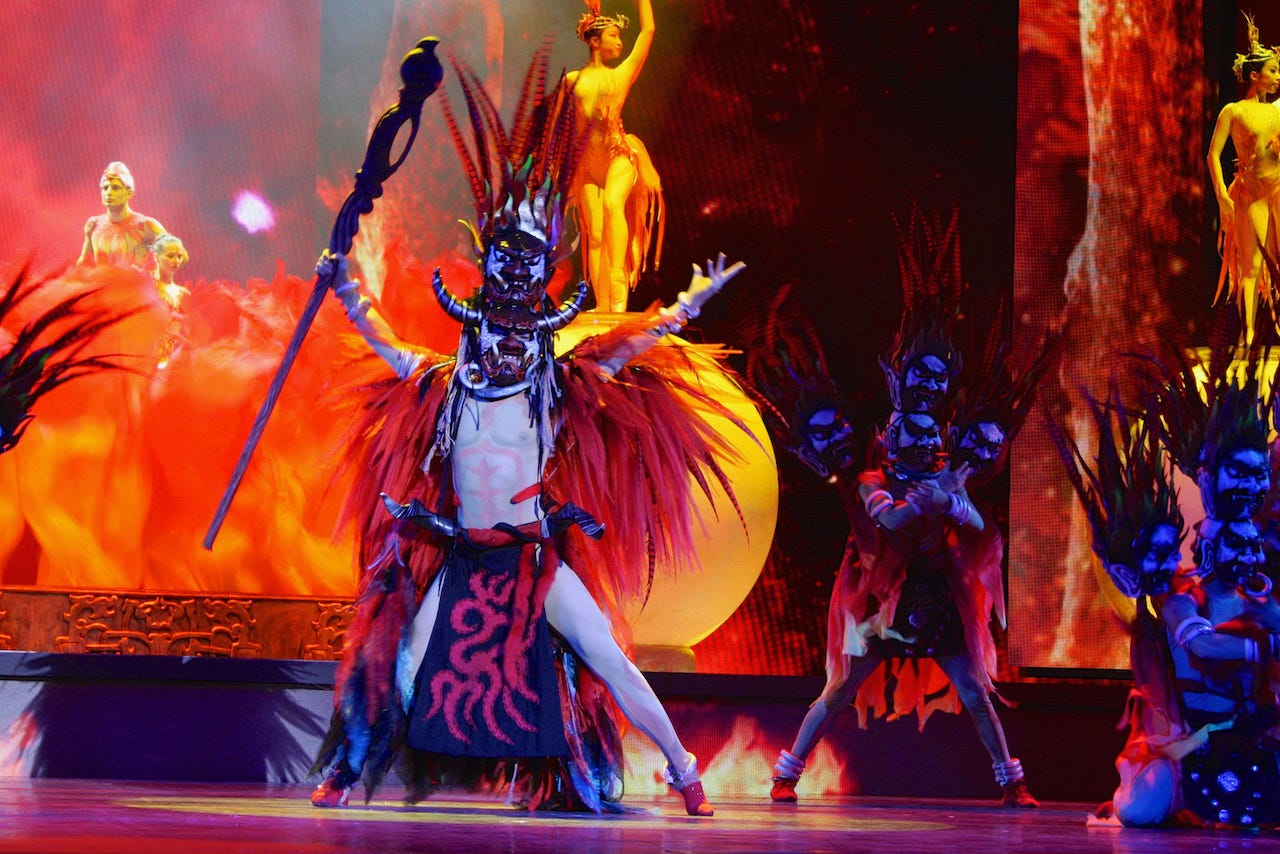
The first thing to know is that I wasn’t supposed to be at a matinee performance of Heavenly Zen—New Edition (天禅·新编). At least not like this. I had imagined, perhaps, a casual site tour, some handshakes, maybe a PowerPoint and some tea in a conference room. Instead, in mid-November 2014, I was ushered into a cavernous theater at OCT East in Shenzhen with fifteen other people and told to enjoy the show.
The show in question was called Phoenix Reborn (凤凰涅槃), a name that sounded suspiciously like both a stage production and a Chinese company’s corporate strategy report. The lights went down, the curtain rose, and suddenly we were staring at twenty dancers in feathered skirts exploding across the stage like a flock of peacocks on fire. Behind them, LED flames the size of apartment blocks roared to life. From my row in the front of an otherwise empty auditorium, I couldn’t decide whether I was supposed to applaud or take notes, so I just took pictures.


It wasn’t the scale that struck me. China had scale in abundance. It was the emptiness. Hundreds of plush red seats stretching to the back wall, filled only by our small group of developers, consultants, and whoever had been lucky enough to stand near us when the tickets were handed out. The performers didn’t seem to mind. They twirled and leapt as if the place were packed. For them, the audience didn’t matter. The show itself was the point, and if I am being honest, it was amazing.
But this wasn’t entertainment; it was a demonstration. A proof of concept. “Look what dreams can look like,” the client was saying. “Imagine what we could build, too.”
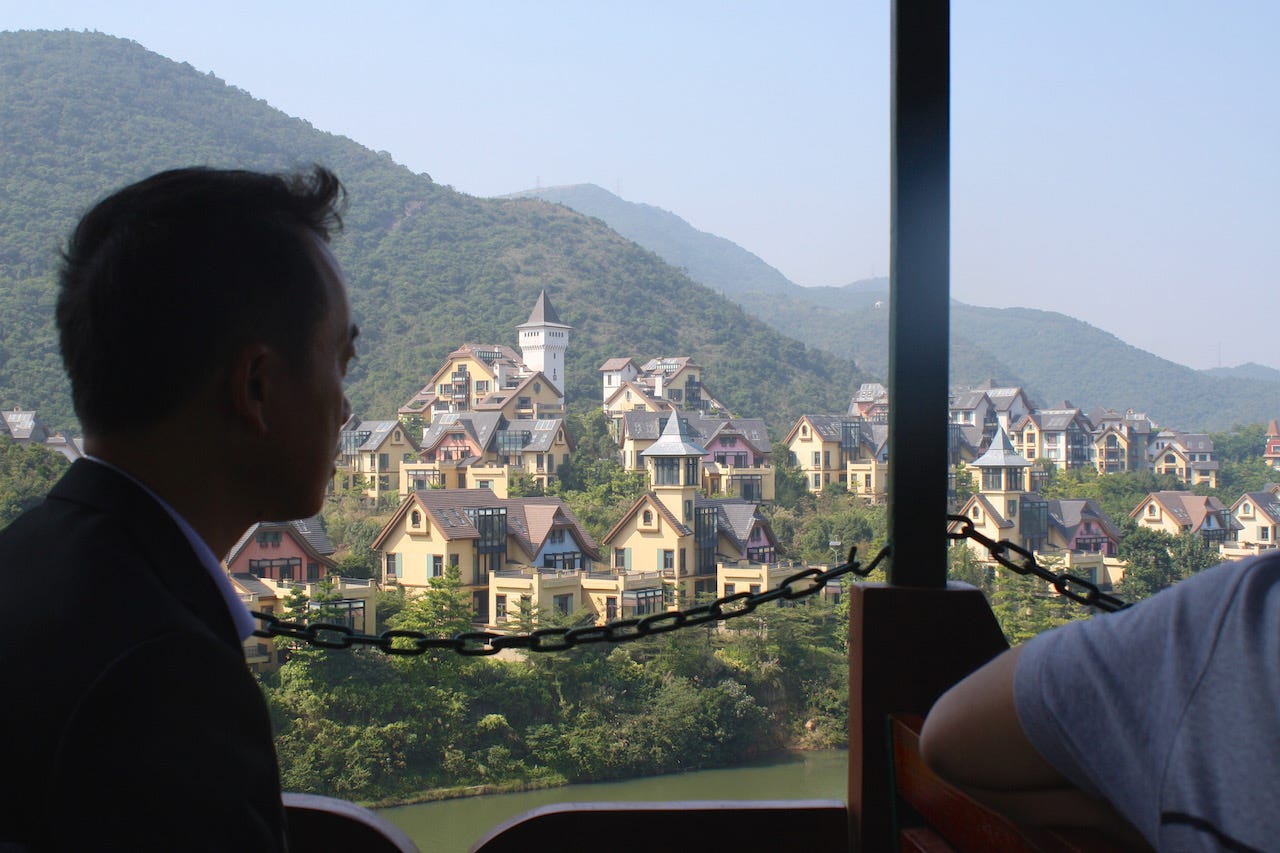
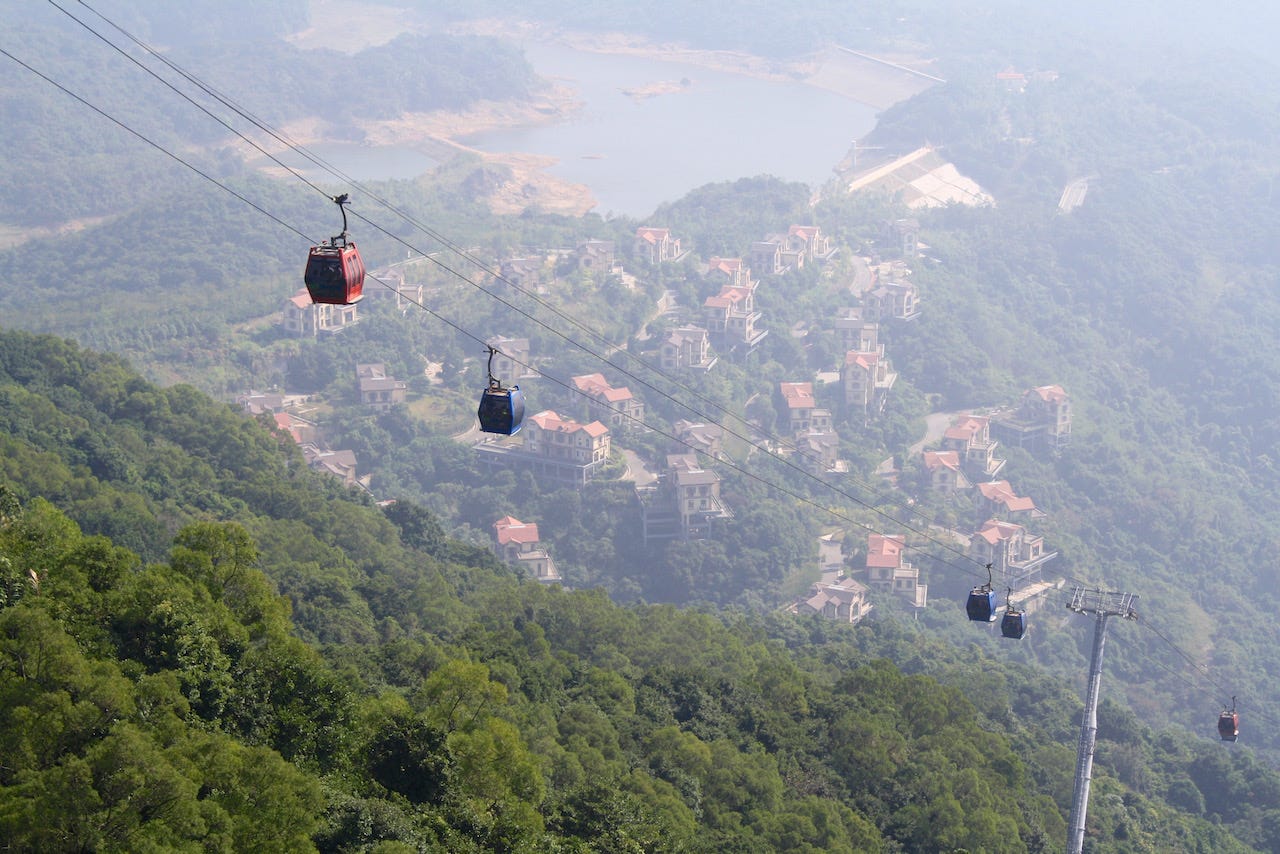
OCT East was their prototype for this kind of thinking. It wasn’t just an amusement park; it was also a place where people actually lived. Villas dotted the hillsides, everyday life staged against tulip fields, alpine villas, and waterfalls that could be switched on like applause. It was Europe and China and Las Vegas all shaken together and poured across a mountainside in Dameisha. For some visitors, it was a place to take wedding photos among Dutch-inspired flower beds. For my hosts that day, it was a sales reel: proof that if you arranged symbols in the right order, prosperity would surely follow.
I didn’t find it absurd at the time. By then, I’d been through enough of these site tours to know the choreography: the staged wonder, the client’s proud commentary, the careful pauses where I was supposed to look impressed. My role as the “foreign expert” was to nod sagely and suggest that, yes, this was absolutely replicable back in their city, provided they hired the right team.
But still, the phoenix burned itself into my memory. The dancers moved with the kind of conviction that only comes from years of rehearsal, even as the seats around them remained empty. It was the perfect metaphor for Chinese real estate in those years: futures being performed at full volume, whether or not anyone was watching.
It was the perfect metaphor for Chinese real estate in those years: futures being performed at full volume, whether or not anyone was watching.
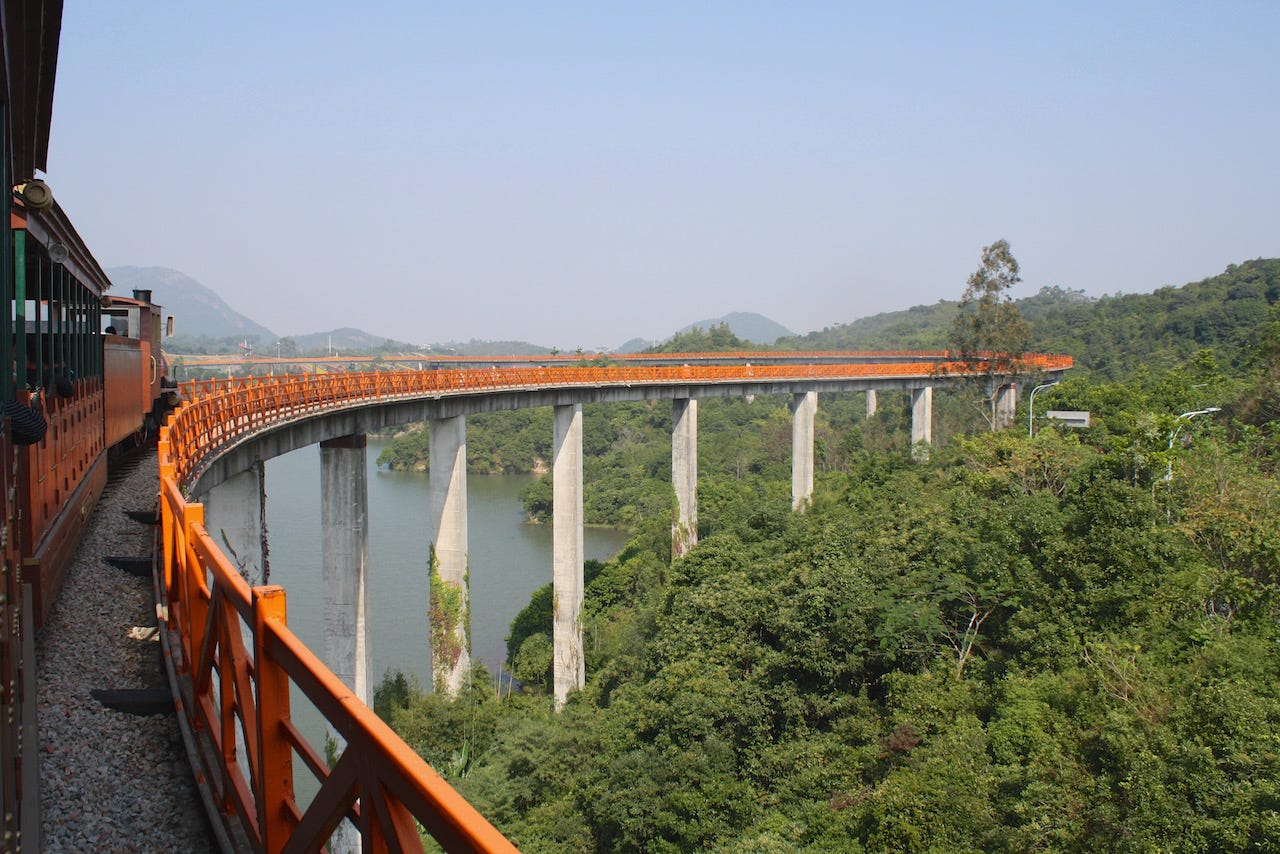
Outside the theater, the spectacle only multiplied. OCT East wasn’t built to entertain so much as to overwhelm. You could wander from a Dutch flower field to an Alpine village to a cliffside glass skywalk, all before lunch. A waterfall thundered down a concrete escarpment, as our host proudly declared it the biggest, real or fake, in all of China (it absolutely wasn’t). Nearby, a rollercoaster corkscrewed over a manmade canal, conveniently adjacent to a KFC. Minion, Angry Birds, and Pikachu plushies dominated the game stalls—though now I can only imagine they’ve all been replaced by Laofufus.


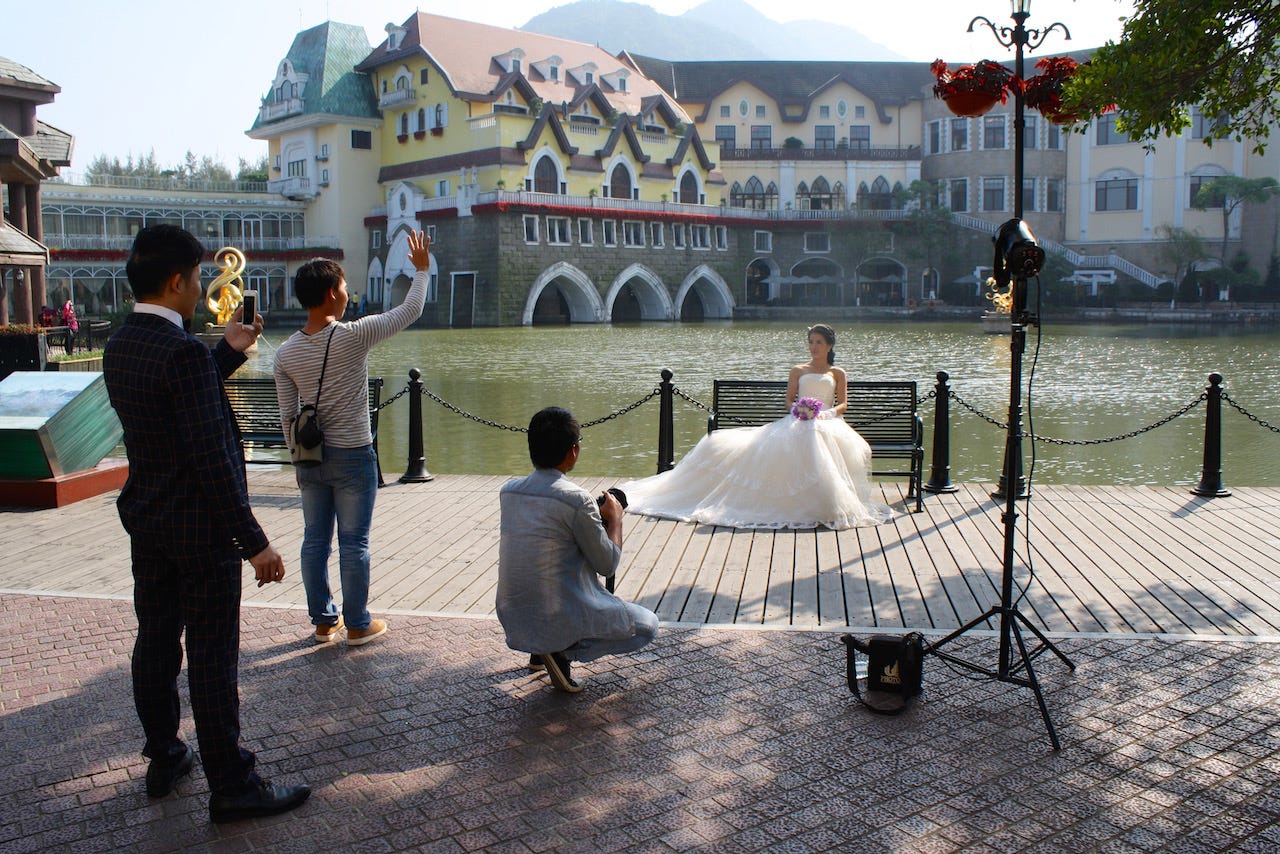
Couples in wedding regalia were everywhere, turning the park into a kind of bridal factory line. On one hill, a bride in a Cinderella-blue dress leaned against bamboo railings while her fiancé tried to look natural in plaid trousers. Down by the lake, another bride sat on a bench gazing into the middle distance while her photographer barked instructions and her future husband snapped photos on his phone. Each scene was framed against European façades that looked as if they’d been airlifted straight from Baidu Images.
For my hosts, all this was gold. “See?” they said. “Tourism, real estate, culture—all in one place.” OCT East was never just an amusement park; it was a development model. The villas on the hillside weren’t decorations. They were the point: aspirational housing sold against the backdrop of spectacle. Why simply build apartments when you could build an entire lifestyle? Buy here and you weren’t just purchasing square meters—you were buying your way into Europe, into leisure, into a future that promised sophistication and prosperity, all within commuting distance of Shenzhen.
My client that day wasn’t OCT. They were from a smaller city in Guangdong, nowhere near as wealthy or prominent as Shenzhen, Guangzhou, or even Zhuhai. But they were ambitious, and by 2014, ambition in China was practically a municipal requirement. Every city had to have its airport, its cultural center, its flagship development. They wanted their own phoenix, their own tulips, their own villas on misty hills.
“If we build it, they will come,” was the subtext, and sometimes the text. It was Field of Dreams rewritten in the language of 5A级景区 (top-level scenic attractions). Get the 5A designation and everything else —visitors, investors, national attention— would follow. This was the golden formula of the time: 文旅 (wenlü), culture plus tourism, fused into real estate. Culture gave projects legitimacy, tourism gave them traffic, and real estate gave them cash flow. It was a virtuous circle, provided you didn’t look too closely at whether anyone actually wanted to live in an artificial Swiss village two hours from anywhere.
The truth is, none of this struck me as particularly strange at the time. By 2014, I’d been through this routine in almost every province in China. One week, it was a “Yellow River Culture Park” in Henan, the next an “Ancient Tea-Town Reborn” in Sichuan. The details blurred, but the structure was always the same: a day of wonder, an evening of baijiu, a promise of collaboration.
Still, OCT East was something different. It wasn’t just another project; it was the stage set for a whole way of thinking. It suggested you could fabricate not just a park, but an entire reality, if you staged it well enough.
That night, as always, there was dinner: a round table, a lazy Susan stacked with plates of beef, prawns, and dishes the client insisted were excellent —though even better in their hometown. The baijiu appeared, as it always did. Toasts followed: to friendship, to cooperation, to the inevitable 5A scenic area designation. The room glowed with optimism, or maybe that was just the liquor.
We all knew our roles. The client beamed with pride, gesturing as if their city’s future were already built in miniature somewhere behind the restaurant kitchen. My job was to nod thoughtfully, to suggest that yes, this was entirely achievable, that with the right master plan and the right investment, their city too could bloom with tulips, waterfalls, and Alpine villages.
And then, like so many before it, the dream evaporated. Their project was never built. We did some work, but the client’s priorities shifted—as they always did. Two days later I was already in Dalian, then Zhengzhou.
Here’s the thing, though: I don’t remember the specifics of the deal, or even the client’s name. What I do remember vividly is the empty theater, the flames, the dancers, the brides. That’s what survives. Not the project, but the performance.
That’s what artificial dreams do. They linger not as infrastructure, but as images. They remain in your head long after the project file has been deleted. OCT East itself is a kind of national mood board. For couples, it offered a stage to pose inside prosperity. For developers, it promised that ambition could be packaged and sold as leisure. For me, it became a reminder that the line between theater and planning was thinner than I ever wanted to admit.
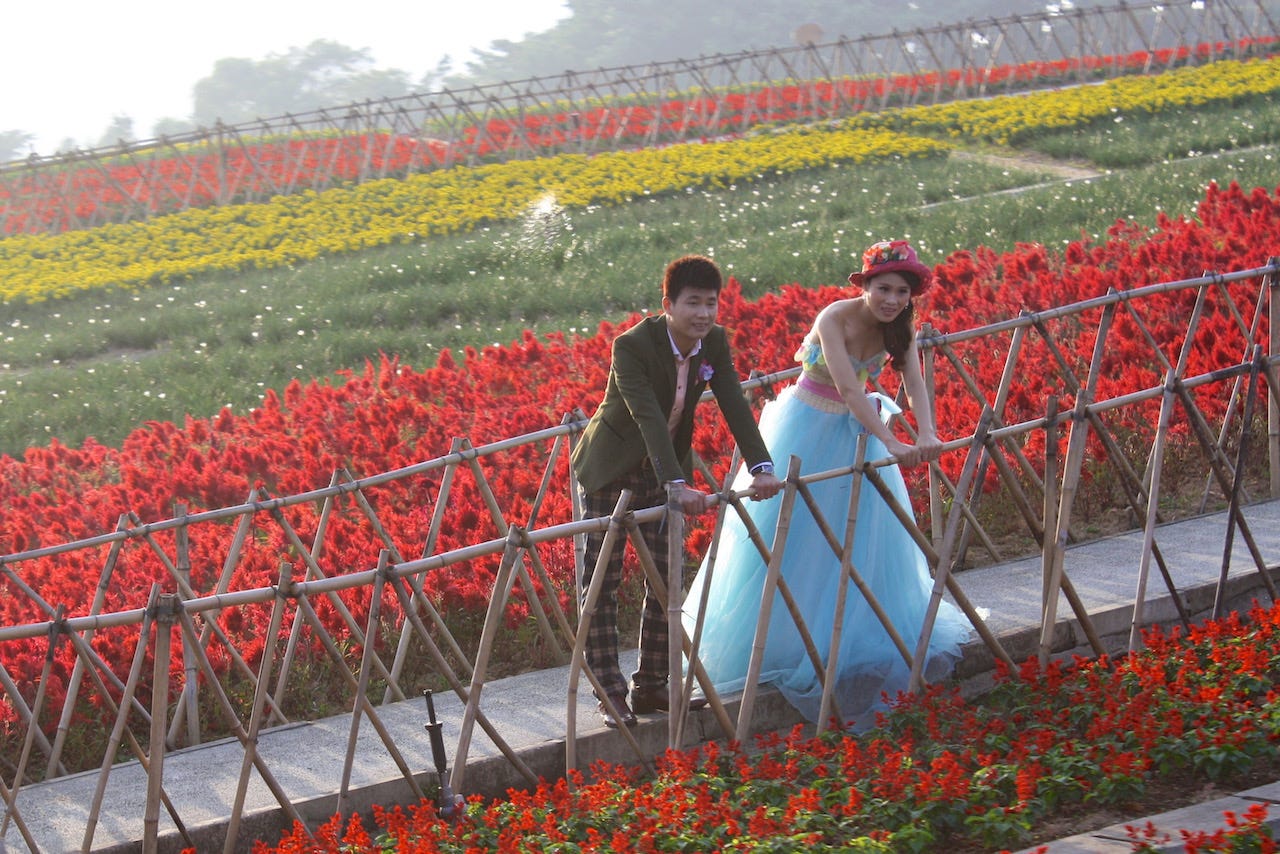
Travel usually worships at the altar of “authenticity,” as if the real were something pure, waiting to be uncovered beneath a layer of kitsch. But OCT East made me suspicious of that idea. Who decides what counts as authentic anyway? The flower fields weren’t Dutch (they weren’t even tulips), but they were real enough: real sprinklers, real gardeners, real couples staking their future happiness against windmills.
Maybe the question isn’t whether these places are authentic, but why we feel the need to judge them at all. I can list the environmental costs, the shaky economics, the architectural absurdities—but does that make the dreams themselves less valid? If a farmer who may never set foot in the Netherlands feels joy among non-tulips in Shenzhen, who am I to say that moment is less true than someone else’s postcard from Holland? Every city invents itself. Some do it with history, some with monuments, some with spectacle. Why should one way of dreaming be worth more than another?
Maybe the question isn’t whether these places are authentic, but why we feel the need to judge them at all.
Years later, the ticket from Heavenly Zen is still taped in my journal. Flimsy, stamped with a red seal, it looks less like a souvenir than an invitation to a dream that never quite happened.
That was the nature of Chinese real estate then: whole futures imagined, some lived in, most left behind. I think about that day often. The seats were empty, but the feeling was real.
And maybe that’s the clearest truth of travel itself: we move through other people’s dreams. Some are built of concrete, others of memory, others of imagination. We don’t have to decide which are authentic to know that, in the moment, they can still feel real enough to clap for.
Travel and culture are what I write about here, though China shows up often—it shaped me more than any other place. I’ve written a memoir that explores those years in depth (still to be published), but here I’ll keep sharing essays like this one. I would be grateful if you would pass this along to someone who might enjoy it.
Thanks for reading. Subscribing is free, but it’s reader support that makes it possible to create comprehensive stories — and to share them openly with everyone.
If you’d prefer to support through photography, I also sell prints. And if you spot a photo in a story that you like and isn’t listed, just reach out. I’m happy to do special runs at no extra cost.
I love it all. Yes even the weird out of place stuff. At one point in my life I wanted to own a tourist trap, perhaps a Flintstones Village in the desert.
Your pics of the dance are stunning. What a great memory.
Such an interesting perspective. I wonder if we are travelling through other people’s dreams or dreaming ourselves through other peoples lives? Where we travel is where they live everyday. Often we forget the dreamy quality of our own surroundings.