


My guide was standing beside the Aswan High Dam, talking about the Soviets. Behind him, the Lotus Flower rose seventy meters into the sky, five concrete petals built by Soviet architects to commemorate their role in the dam’s construction. When the West refused to fund the project in the 1950s, the Soviet Union stepped in with more than a billion dollars in loans and sent its own engineers and heavy equipment to get it built. My guide was proud of the engineering and its control over the Nile. He assured me that if I wanted to swim in the north I could, but that crocodiles, they had no way to pass.
Aswan itself was easy to like. The corniche ran along the east bank, offering views across to Elephantine Island. The souk behind it was busy with a local hum, narrow streets selling much more than spices, prayer mats, and Mo Salah football shirts. Fueled by street koshari a mash of rice, macaroni, lentils, and chickpeas mixed together I spent two days walking and taking photographs before hiring a driver to go south.


Abu Simbel is 280 kilometers into the desert, near the Sudanese border. Since 1997, when militants killed sixty-two people at the Temple of Hatshepsut in Luxor, tourist vehicles traveling the road have had to register with the Tourism Police and pass through checkpoints along the highway. The road closes to tourist traffic after five in the evening. You leave early, and you need to be accompanied by a driver and guide.
The drive is long, flat, and empty, three and a half hours of open desert where you can see the road ahead for miles without another car on it. The checkpoints were orderly, with only a few words exchanged between the driver and the officer, while our documents were all checked before being waved through.
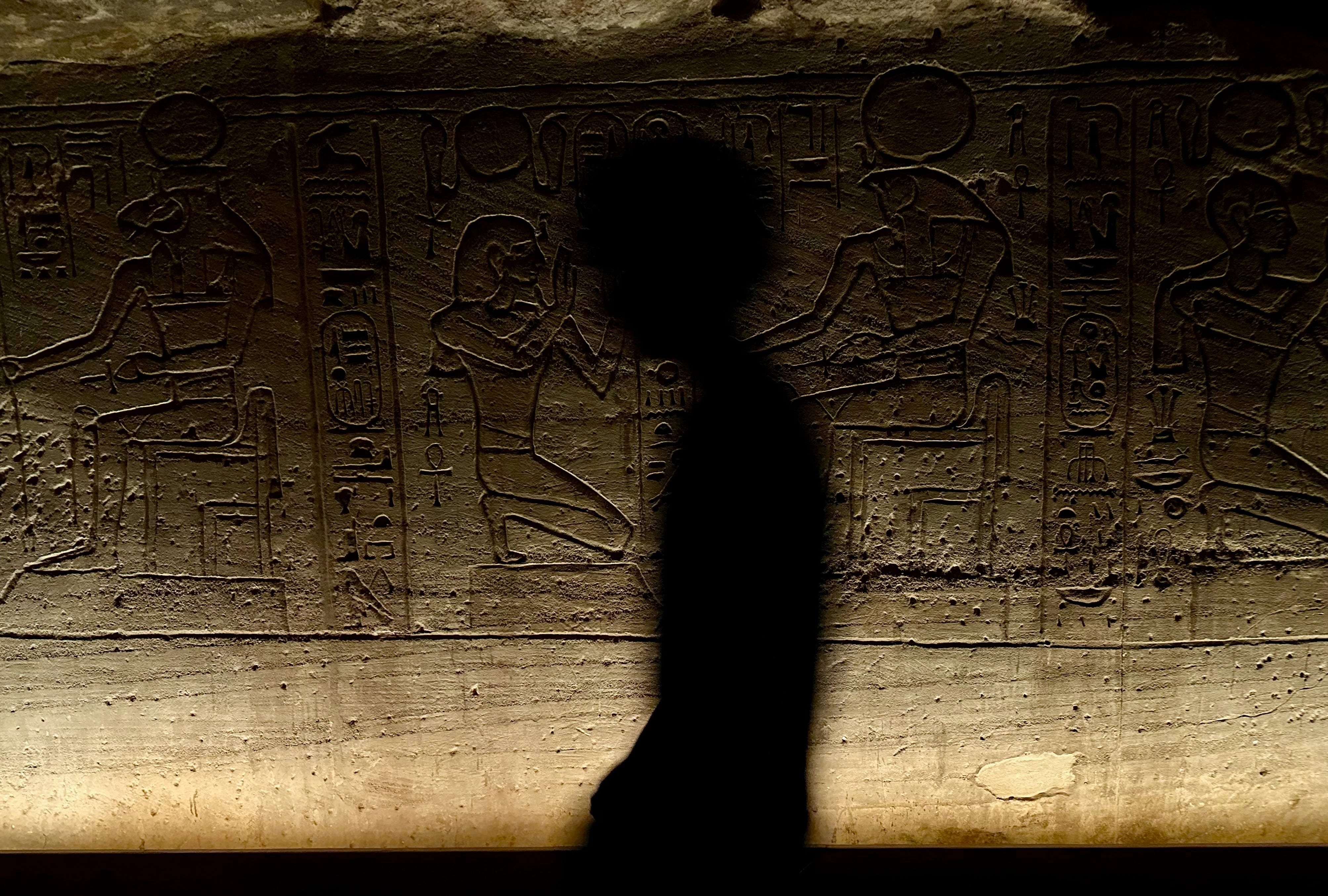
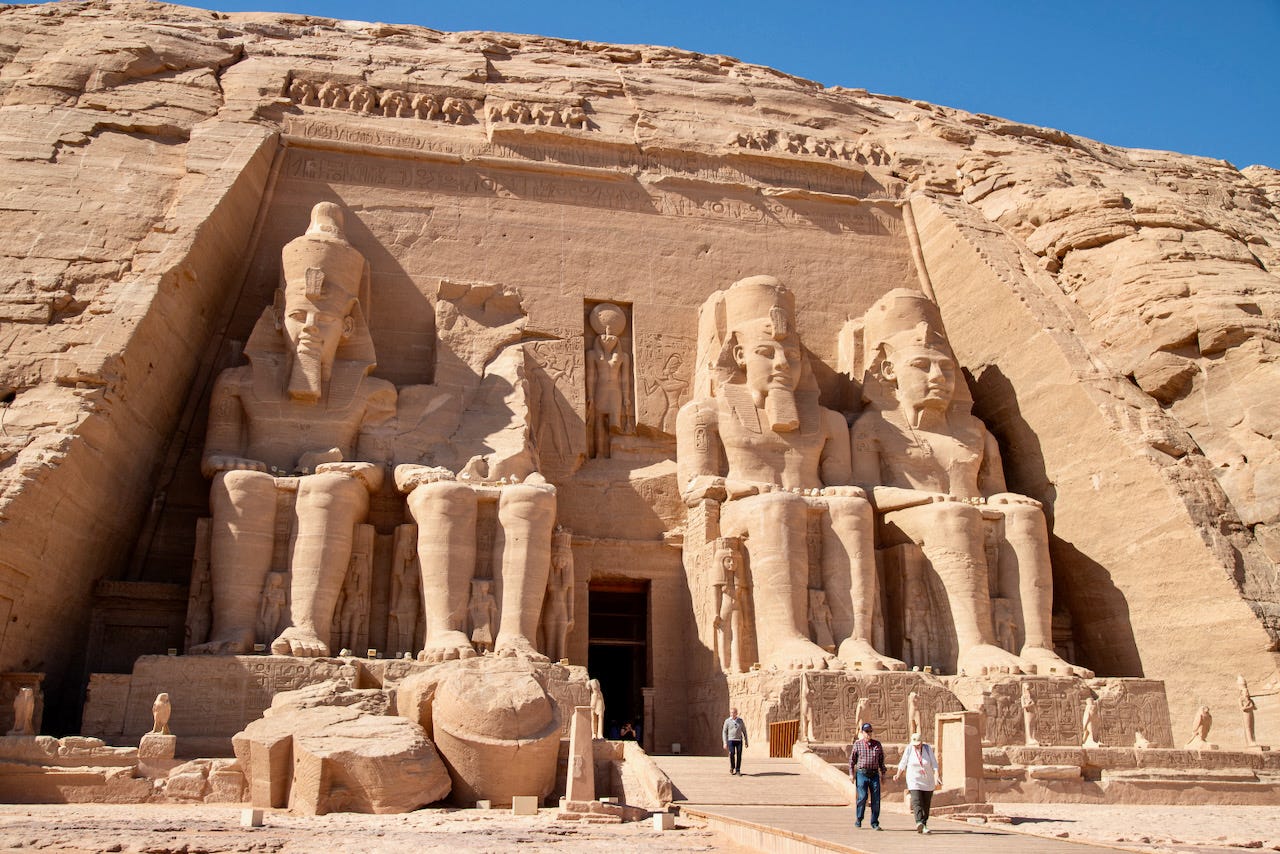
Ramesses II had the temples carved into the cliff face in the thirteenth century BC, four colossal statues of himself flanking the entrance, each about twenty meters high and visible from across the water in an era when the Nile still ran this far south. In the 1960s, when the Aswan High Dam threatened to submerge them, UNESCO cut the entire complex into blocks and reassembled it sixty-five meters higher on the cliff. The engineering of the rescue is as impressive as the original construction, and these two achievements tend to compete for attention.
After the temple, we went looking for lunch and found it down a side street in the town, a small place with a few tables out front. The man who ran it served us and then sat down across from my guide to talk. I ate fried fish with tahini — sesame paste thinned with lemon juice and garlic — rice, and a salad while a small boy ran between the tables. From my seat I could see trucks on the road carrying Sudanese men in the back. The border was twenty kilometers away, and Wadi Halfa, the first town on the other side, was sixty-five.
The next morning I hired a different driver to take me north to Luxor, a journey of about 245 kilometers that most tourists do on a Nile cruise, watching the same landscape pass from the deck of a boat with a drink in hand. I was doing it by car, which is a different experience.
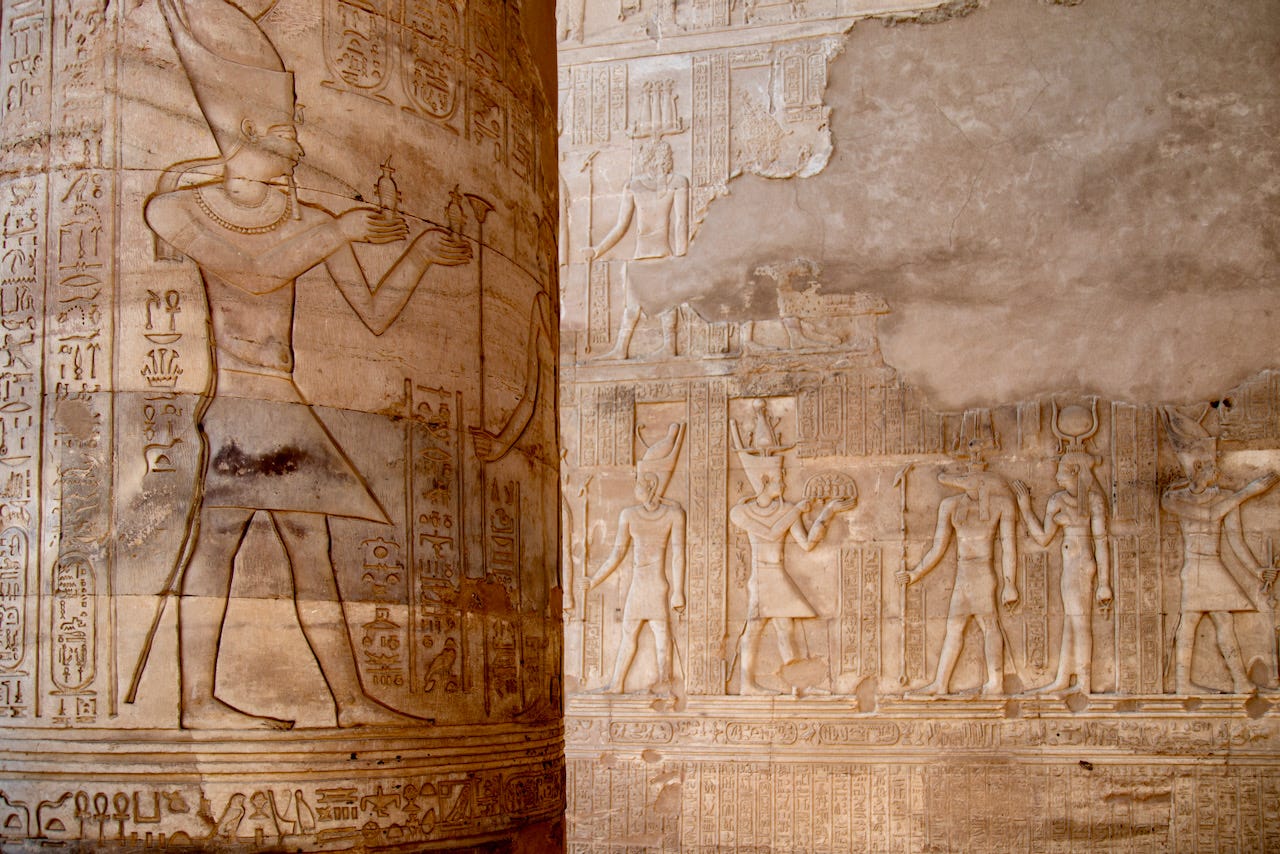
We set off while it was still dark. The first stop was Kom Ombo, about an hour north of Aswan, a double temple built during the Ptolemaic period and dedicated on one side to Sobek, the crocodile god, and on the other to Horus. The Nile cruise ships were docked along the bank with passengers eating breakfast on deck, but I had the temple to myself before they disembarked. The museum next door has mummified crocodiles from an era when they still swam this stretch of the river.
As we left Kom Ombo and started north, the driver glanced at my camera on the seat beside me. For this next stretch, he said, it was probably best not to take any photos. I told him I understood.
The road snaked through agricultural country along the Nile. Children darted out of sugarcane fields and banana groves that lined the right side of the road; everything was green after two days of desert between Aswan and Abu Simbel. We shared the road with tuk-tuks, pickup trucks, and donkey carts stacked with produce. Speed bumps appeared every hundred meters or so through the villages.
I noticed graffiti on some of the street signs — a four-fingered hand, spray-painted in black. I asked the driver about it. It was a symbol of the Muslim Brotherhood, he said. That was part of why he had asked me to keep the camera away. He had no idea if any of them were still around, but in his mind, it was better not to find out.
On the back of a tuk-tuk pickup cab, I saw a large stencil of Saddam Hussein’s face. I asked the driver about that too. Oh yes, he said, Saddam is quite admired here. He stood up for the Arabs. He said it as it was obvious, and reached for the stereo and moved on to the next song.
Driving through these small towns, slowed to cycling pace by the speed bumps, brought me closer to life along the Nile’s banks than anything else on the trip had. This was a different Egypt than the cities I had visited, and further still from that depicted in the temples.
At Edfu, we crossed the Nile and turned west, leaving the river road behind for a newer highway that cuts inland through the desert toward Luxor. The government has been upgrading this road as part of a national infrastructure push, and it was wider and faster than even the road down to Abu Simbel.
While the checkpoints along the Abu Simbel road had been formal and part of a system with a history and a reason behind it, the checkpoints on the Luxor-Aswan highway were something else — police officers standing beside cones in the road, stopping cars, collecting money, and waving them on. Fifty Egyptian pounds at each stop, the driver told me, and there were enough stops between here and Luxor that it added up to a meaningful share of his fare.
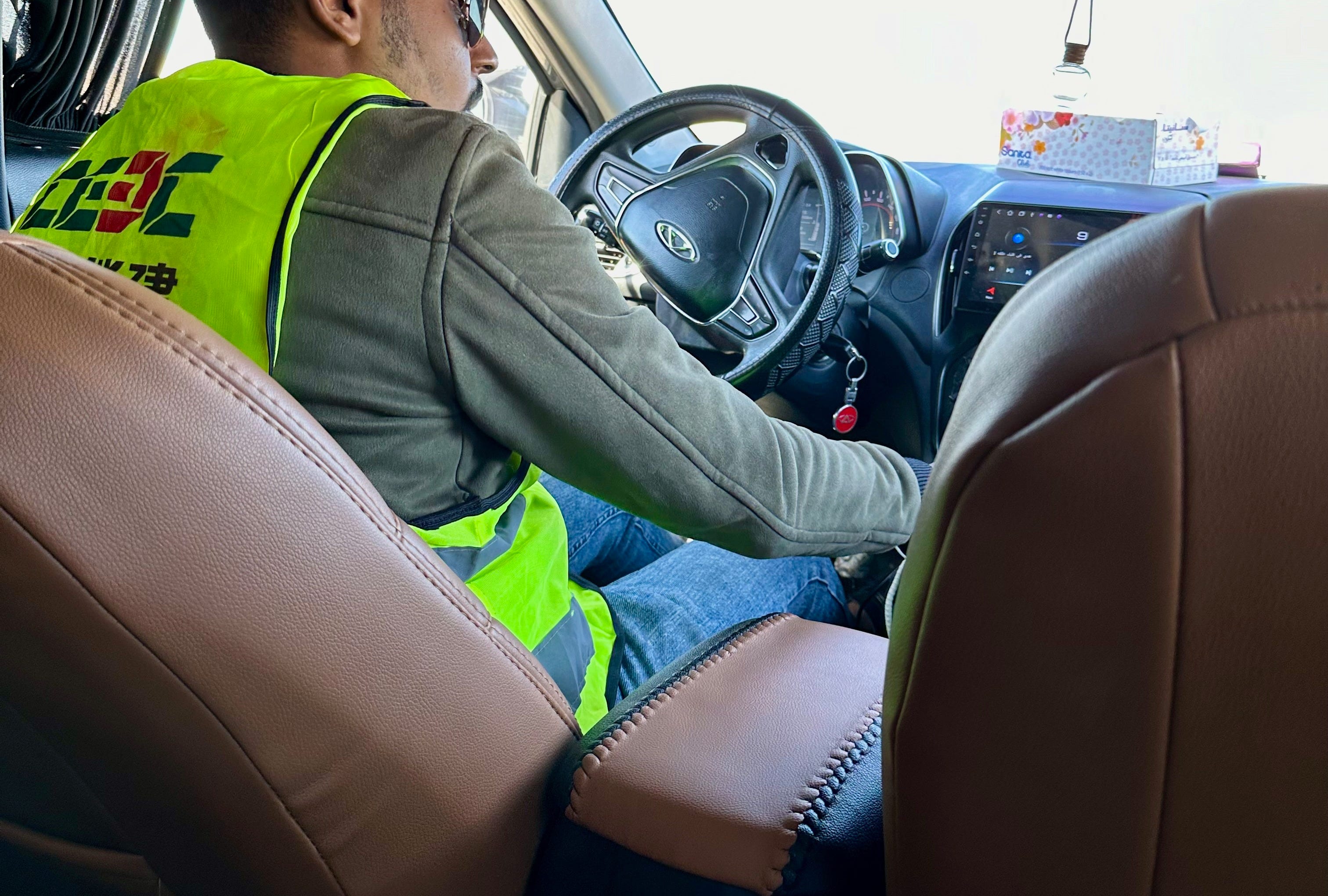
He reached into the center console and pulled out a high-visibility vest, neon yellow with Chinese characters printed on the back. It had the logo of China Energy Engineering Corporation, one of the state-owned companies building solar installations across Upper Egypt, including a 500-megawatt plant at Kom Ombo and a massive energy storage facility near Aswan, both adjacent to the highway we were driving on. I asked him about his new fashion. He explained that these informal checkpoints had sprouted up along the road, and by wearing the vest, he could tell the officers he was just a driver taking a worker to a site, and not have to pay the “toll”. I asked if it worked. So far, he said, he had had pretty good luck with it.
I was wearing a button-down and sunglasses, and it occurred to me that I could pass easily enough for someone being driven to a construction site. At the first checkpoint he pulled over, had a brief conversation with the officer, who leaned down and looked at me in the back seat. I raised my hand in a small wave and nodded. He waved us through.
This happened several more times over the next hour and worked every time. We stopped at a gas station along the highway, and the driver got out, still wearing the vest, and stood smoking a cigarette while I had a drink. I asked him what he was actually saying to them when they stopped us. He smiled. Just that you are an engineer who is running late, he said.
As we approached Luxor the desert gave way to the city gradually, the road filling with traffic until we were fully enclosed by the hum of entrepreneurship in the city center. He dropped me at my hotel, shook my hand, and told me to let him know if I ever needed a ride again. I told him I would, and thought about thanking him in Mandarin for good measure. 🦺


If you liked this, there’s more where it came from. Scott Monaco opens a window somewhere new every week —travel essays, photography, cultural observations, and books worth reading. Once a week, sometimes more. Free to subscribe.
One never has to go far in Egypt before encountering a police checkpoint...
You've done a great job of sprinkling facts into a very personal story. This account is making me reconsider my love of trains. I love the photo too - the junction box and butcher in particular.