


Myanmar had just reopened, or at least that was how it felt. Obama had visited at the end of 2012, and Bourdain arrived not long after, with Parts Unknown premiering its first episode in April 2013. International papers talked of cautious reforms, and for the first time in decades, you could enter without a miracle of paperwork. Still, it wasn’t simple. I managed a visa on arrival only through a friend of a friend —someone who knew someone inside the country. A letter was arranged, emailed to me, and I preferred not to ask too many questions.
The flight from Shanghai to Yangon was shorter than it had any right to be. With the mandatory stop in Kunming, it felt like slipping through a side door into a place sealed off for half a century. In China, I’d grown used to neon skylines, construction cranes, and the hum of progress. Myanmar was another era entirely.
I hadn’t come because of Obama or Bourdain. What pulled me was Emma Larkin, and her books Finding George Orwell in Burma and No Bad News for the King. Her work wasn’t allowed inside Myanmar; it circulated in whispers. In Finding, she traced Orwell’s ghost across the country. Orwell, the colonial policeman, Orwell the writer whose books seemed to predict Burma’s fate with unnerving accuracy. She wrote of conversations half-hidden, of truths tucked in ordinary lives, of a nation that seemed to embody repression as much as it resisted it.
It was Larkin’s Burma I wanted to see. The silences, the shadows, the resilience she described. A place long shut to the world, now letting in a little light. Once I arrived, her book hovered at the edges of everything. Not in lines I remembered, but in tone—her way of noticing silence as much as sound, of catching history in the corner of a smile or the refusal to speak.
That tone shaped the way I entered Myanmar. I wasn’t looking for grand declarations or breaking news. I was listening for the quiet things, the background hum that tells you where you are. And in late December, that hum was growing louder, building toward something that would crest at midnight on the last day of the year.


Yangon was not the city I expected. I’d pictured another Southeast Asian capital rushing into fast-forward, as I thought I was already late to the party, arriving at the end of 2013. Instead, the city moved in slow drags of heat, even in December’s relative cool. Sidewalks buckled. Streets remained unpaved. Street stalls leaned into the road, selling bowls of noodles, cracked teacups of laphet yay, and mont lin ma yar—crispy little pancakes filled with chickpeas.
Downtown, the old British facades still stood, blackened with mildew and streaked by monsoon rain. A colonial past left to rot in public view, as if the city had decided to weather history rather than erase it. For me, it was a photographer’s dream.
I wandered with my friend. He usually walked a few paces ahead while I steadied my camera on details: a doorway closed and peeling, children with golden sunscreen streaks of thanaka on their cheeks. Yangon wasn’t a place you attacked with an itinerary. It was a place you drifted through. It was quiet so you could travel by sound: listening to the crackle of frying oil, the sharp kisses waiters used to summon one another in teahouses, the steady chanting of monks. Sometimes we stopped to chat with shop owners or thumb through books pages curled by the humidity. Conversations were careful, like Larkin described, but they carried weight in what they didn’t say.
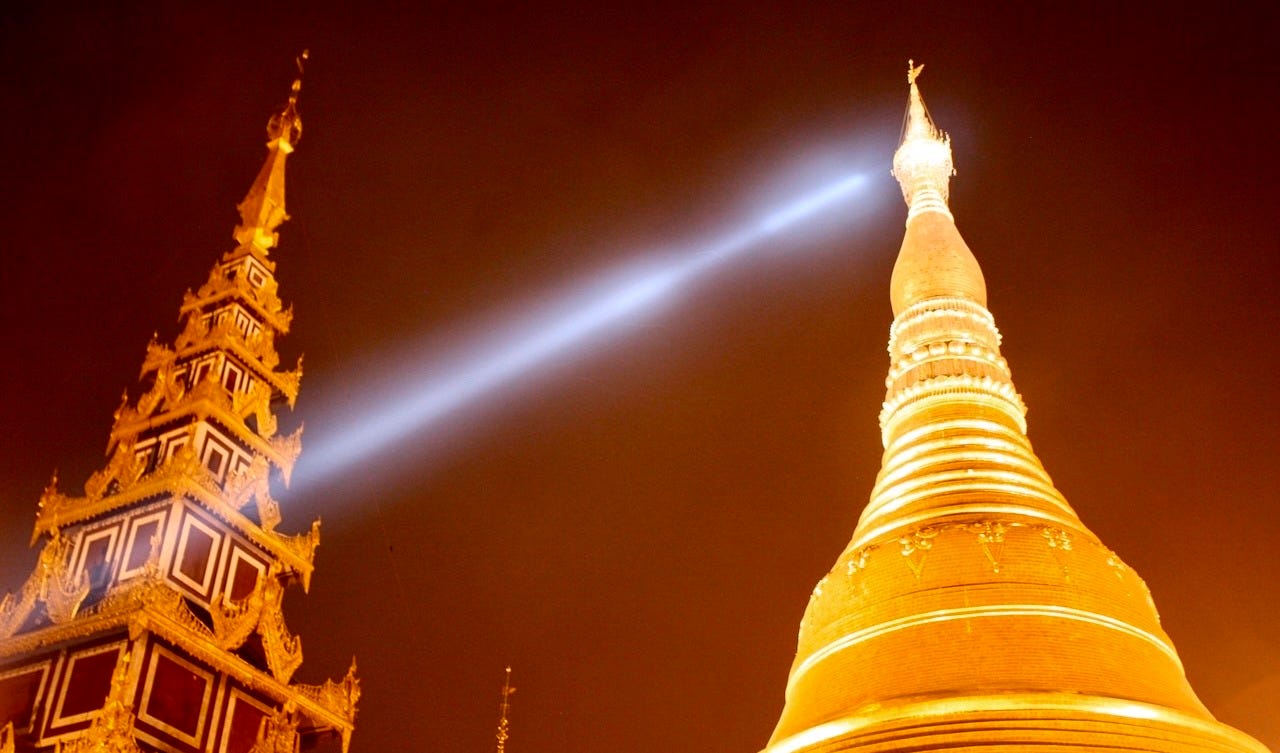
The buzz of the New Year hung in the air. Not loud, not festive, but as something building quietly toward release, as if this might be the year. Shwedagon Pagoda was where we decided to spend it. Not in a hotel bar like the few foreigners scattered across the city, but at the golden stupa that anchored Yangon. If you wanted to start a year with meaning, you went there.


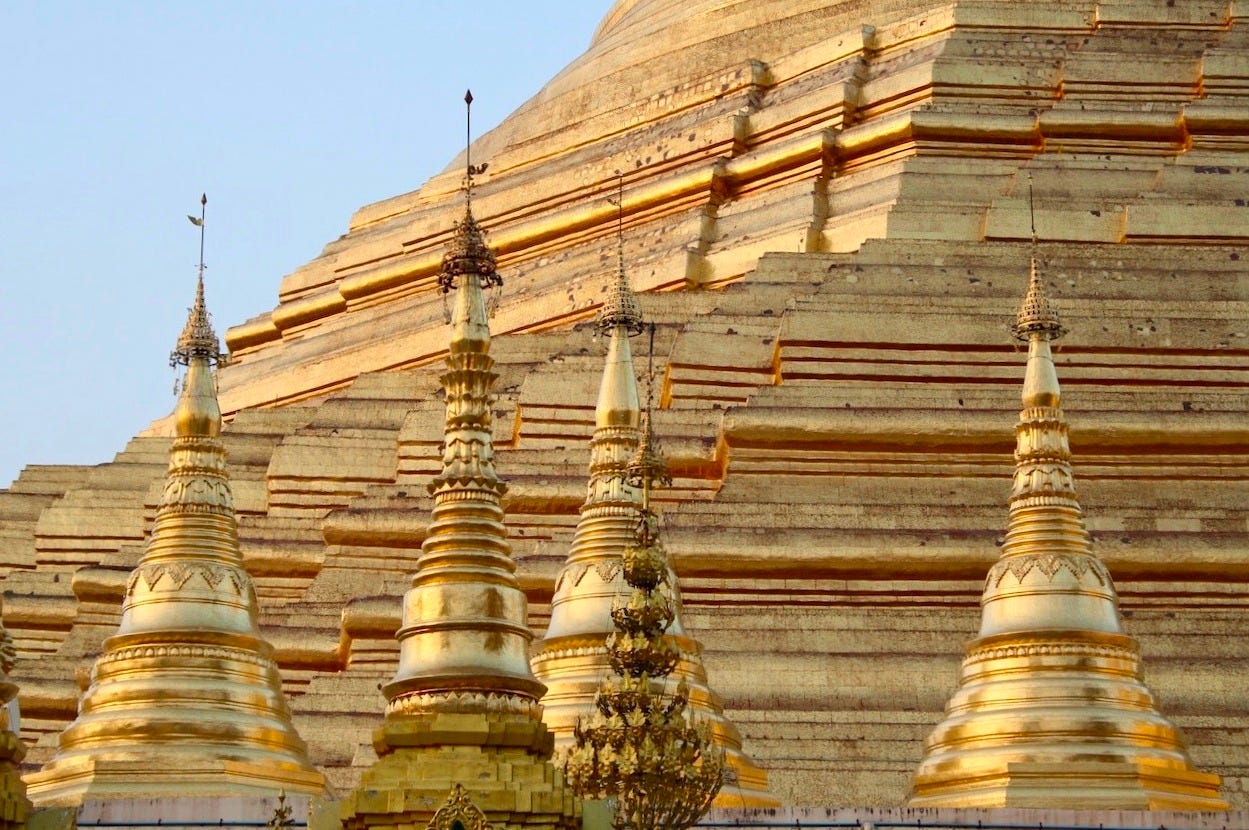
We joined the crowd before dusk, climbing barefoot past prayer halls and smaller shrines until the stupa itself filled the sky. Up close, it was less like a building and more like a sun: gold leaf stacked into a mountain, glowing against the night. People drifted slowly together, candles balanced in their hands. Some muttered prayers. Others simply stared upward, necks tilted at the impossible slope of it.
Throughout the night, the crowd ebbed and swelled, a ripple of sound moving through us—chants, murmurs, voices that sounded almost shy, prayers for a new year and a new beginning. I remember looking up and catching the glint from the diamond at the top. It caught the city lights and scattered them outward, as if throwing the future itself into pieces we might gather. For a moment, the world felt suspended. Just this immense structure burning in the dark while thousands of us breathed together below it.
It wasn’t the silence Larkin had written about, the fearful hush of a repressed country. This was a silence of awe, brief but whole. For me, it felt like the country was exhaling into possibility, letting itself imagine something better.
The photos I took were unnecessary. This was an experience already engraved in memory, as indelible as the diamond’s glint. I only remember thinking: this is what it feels like when history tilts.
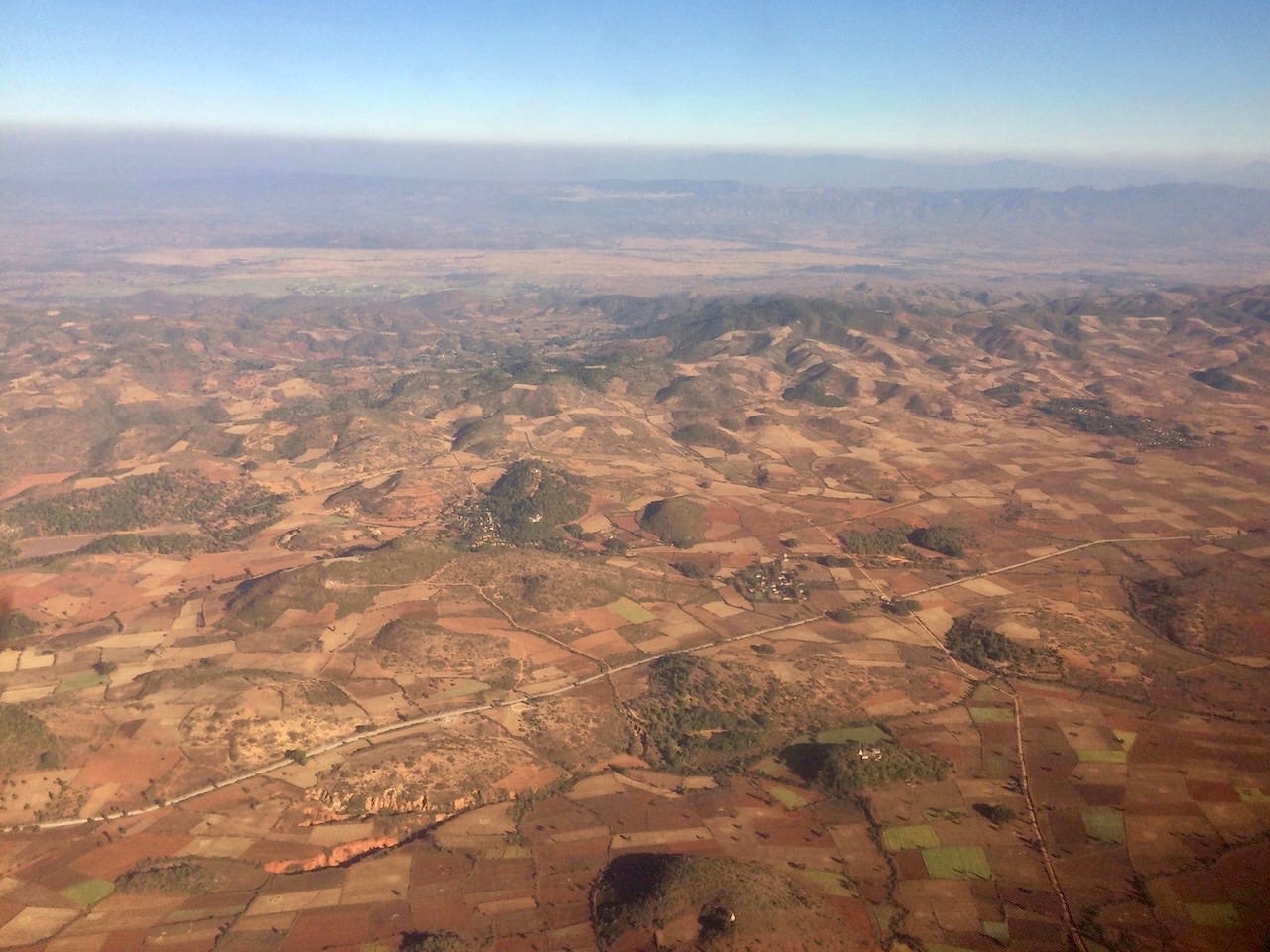
A few days later, we left the city behind, paying cash for a domestic flight to Inle Lake in Shan State. From the air, we were greeted by fields in every shade of brown, rolling over the hills like folds of cloth. Then, just before landing, the lake appeared, Myanmar’s second largest, spreading wide, a sheet of silver ringed with green.
We hired a boat, long and narrow, the driver crouched at the stern as the motor pushed us out into open water. Fishermen balanced on one leg at the prow of their skiffs; the other leg wrapped around an oar in a rhythm that looked impossible until you saw how naturally they did it. Nets dipped and rose. Ripples spread in perfect circles, vanishing back into the lake as if nothing had happened at all. Larkin had written of people carrying truths quietly, hidden in gestures. Watching the fishermen’s rhythm, I wondered if this balance was another form of survival.


Villages stood on stilts above the shallows. Children waved from narrow wooden skiffs as they passed. In one house, women rolled cigars with patience, stacking them into neat little towers. I hadn’t realized cigars were part of life here; I’d expected betel nut instead, the little green packets sold on every corner, chewed until sidewalks were marked with red stains.
We drifted into a monastery where cats stretched across the floorboards, each finding its own sliver of sun. Outside, I spoke with locals who were welcoming but cautious, hopeful about what this new openness might mean, yet careful not to say too much.
Larkin had gone looking for truth in whispers and half-conversations. I wasn’t conducting interviews or testing boundaries. My truths came in smaller ways—in the evenings, gathering on stools for street food, or walking through a carnival that had sprung up for the New Year. There were games, music, and colored lights. One booth offered a row of balloons to be shot at with rifles. The guns were very real, lying on the table unmoored. It felt like overkill for something as fragile as a veil of rubber around air.
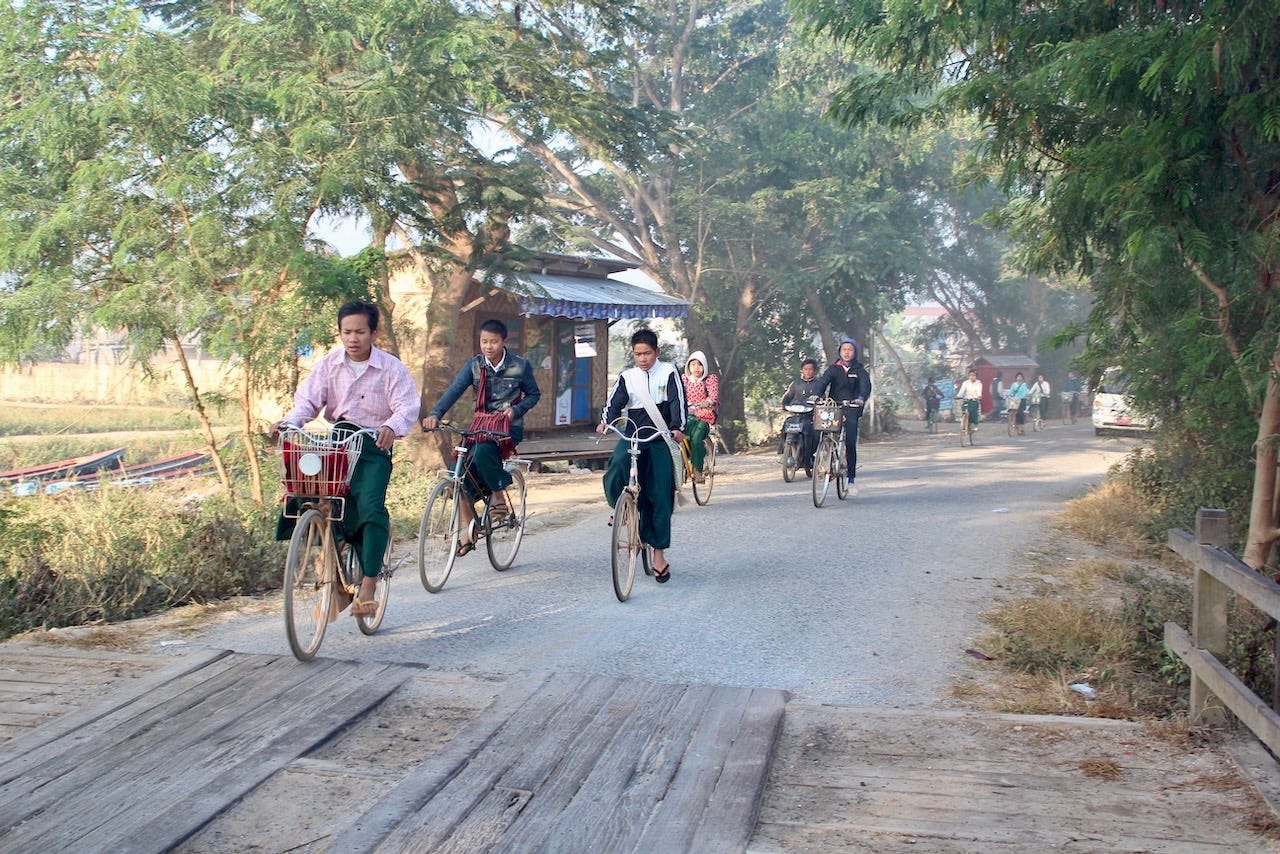
The next morning, we cycled out of town in the opposite direction of the daily commute. From there, my friend and I parted ways, and I paid cash for a domestic flight to Bagan. By the time I arrived, the sun was already sinking, painting the horizon in bands of orange and ash.
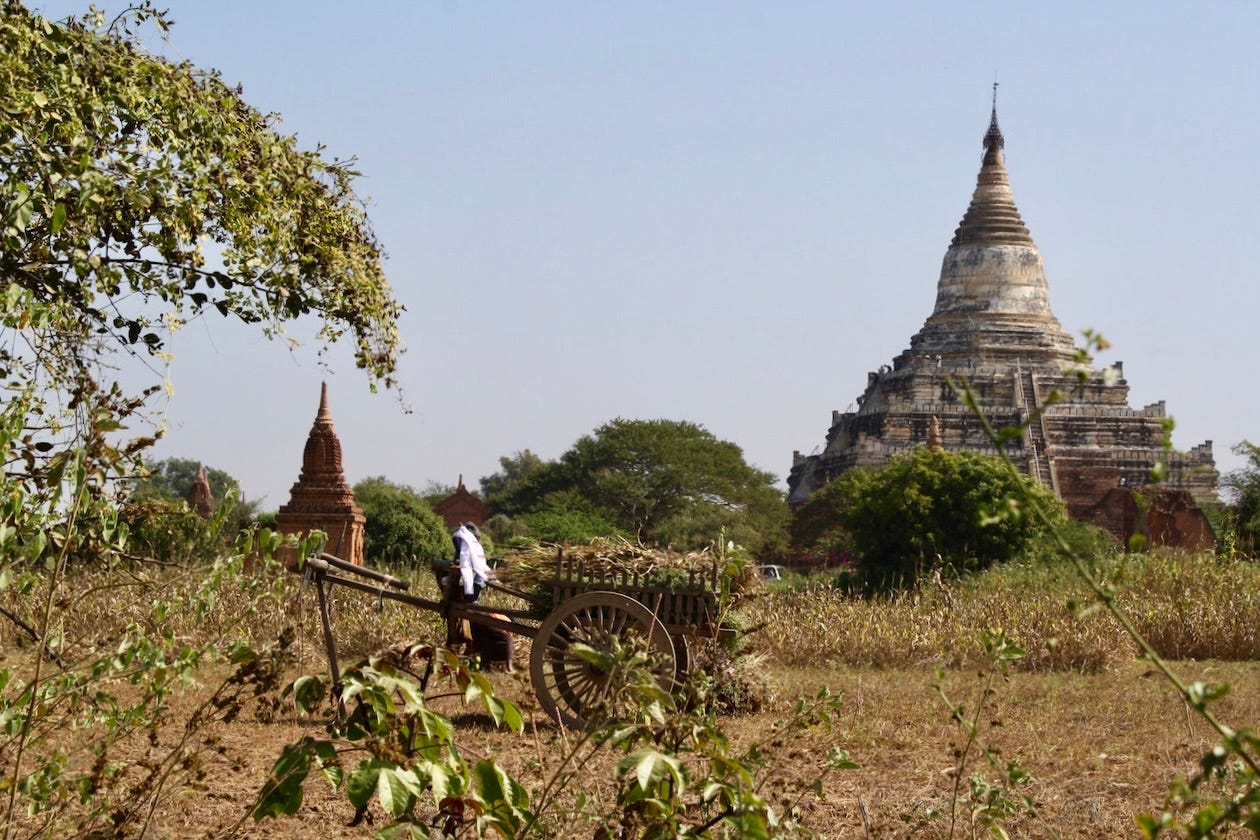
Bagan stretched out like an ancient puzzle. Thousands of temples, big and small, crowded the plain, their spires rising like a forest of brick. I rented a bicycle and rode through the haze, down dirt paths, and into villages. The chain squeaked; the whole country did, really, hoping a little oil was all it needed to get it going again. Dust clung to my legs. I climbed staircases worn smooth by centuries of feet and looked out over a horizon littered with shrines. Some felt timeless, others suspiciously new, as if reconstructed in the past year for the sake of continuity.
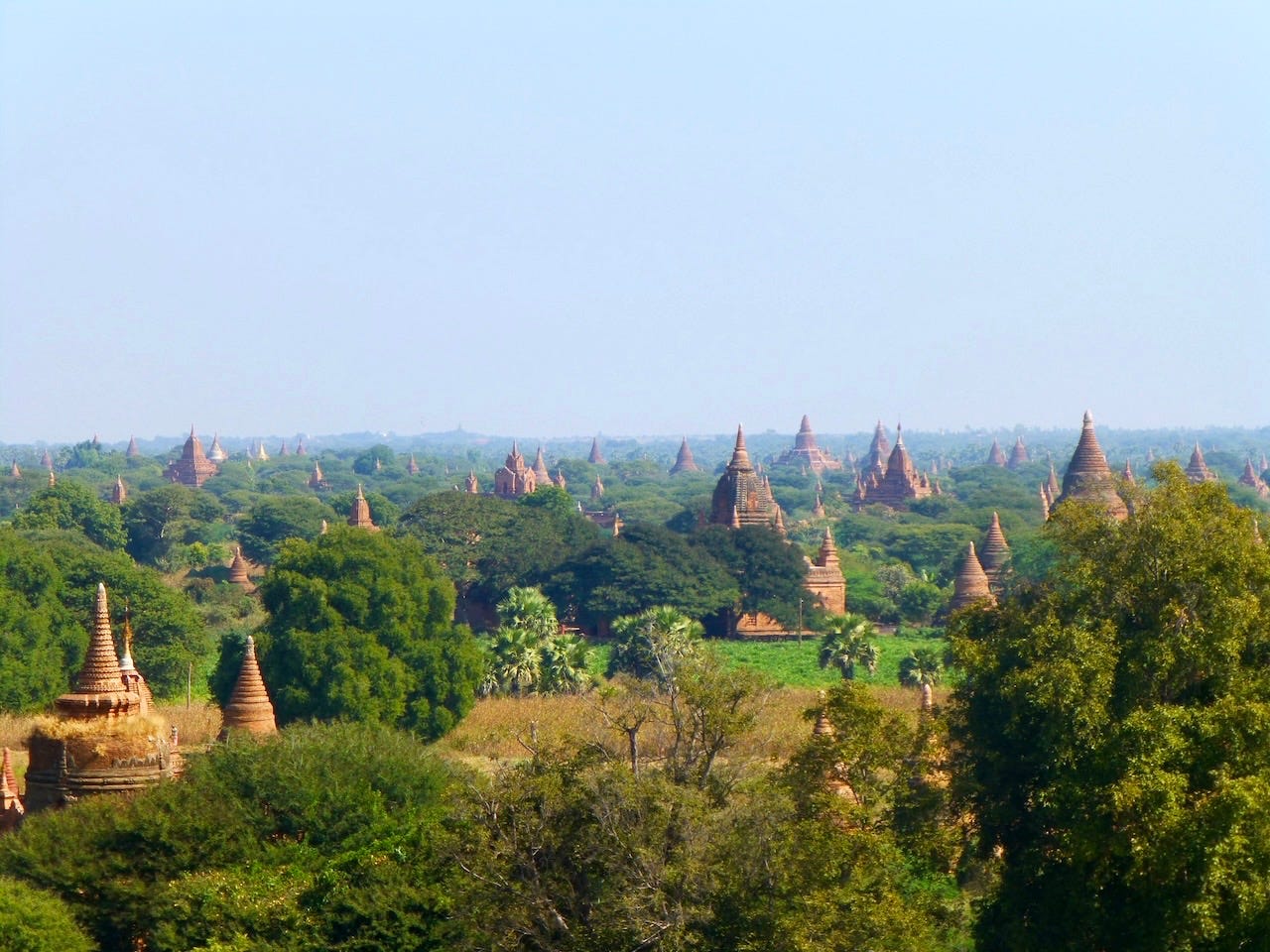
The beauty was overwhelming, but what stayed with me was the scale. The sense of endlessness. A civilization had risen here and collapsed, leaving behind a plain crowded with memory. Larkin had written about Burma’s cycles of hope and collapse, how Orwell’s three books could be read as a prophecy of the nation’s path. In Bagan, the temples told the same story without words. Empires rise. Empires fall. The ruins remain. Sometimes they are rebuilt, but only when it suits.
I pedaled back through the dust as the sun dropped. Children laughed somewhere nearby. A herd of goats crossed the road, their bleats carrying into the dusk. For a moment, I felt both very small and very privileged. To be here, at this hinge of history, watching a country trying to decide which way it would turn.
At the time, I believed I was traveling through a country beginning to open. The book had warned me otherwise, though I couldn’t have recognized it then. Emma Larkin wrote of shadows and silences, of repression that seeped into everything. She used Orwell as a mirror, and in his reflection, she saw Burma’s past and future already mapped.
I preferred the optimism. The chants at Shwedagon, the glimmer of Obama’s visit, the quiet conviction that travel itself meant things were changing. I wanted to believe the diamond light marked a new beginning.
But memory shifts under hindsight. What felt like dawn turned out to be only a flare. Myanmar has since folded back into the darkness Larkin described; its people once again caught in the tightening grip of history’s cycle. Her work feels prophetic now in a way I couldn’t have recognized then.
And yet I can’t regret going. Her books opened the door, and what they gave me was more than political context or literary allusion. They gave me scenes that still live inside me: fishermen balanced on water, the sharp kisses that summoned waiters in restaurants, the endless horizon of Bagan’s temples, and the swell of voices at Shwedagon on New Year’s Eve.
Memory keeps me there. And in that glint of diamond light above Shwedagon, I can still see both the brilliance of what was possible and the shadow of what was inevitable.
Author’s note: This piece was originally written for Intrepid Times.
The Briefing
Bagan has over 2,000 temples spread across a plain the size of Manhattan, and most of them you'll have entirely to yourself. Here are some hotels I'd recommend in the country. Emma Larkin's Finding George Orwell in Burma retraces Orwell's time in the country and uses it to understand modern Myanmar, and Thant Myint-U's The River of Lost Footsteps is the best single history of the country.
If you liked this, there's more where it came from. Nothing to Declare opens a window somewhere new every week —travel essays, photography, cultural observations, and books worth reading. Once a week, sometimes more. Free to subscribe.
If you’d prefer to support through photography, I also sell prints. And if you spot a photo in a story that you like and isn’t listed, just reach out. I’m happy to do special runs at no extra cost.
Fascinating country I hope to visit one day. Thanks for this glimpse into Myanmar's recent past.
Thank you for your descriptive account. Myanmar defies comparison with anywhere else; that is definitely part of its allure.