


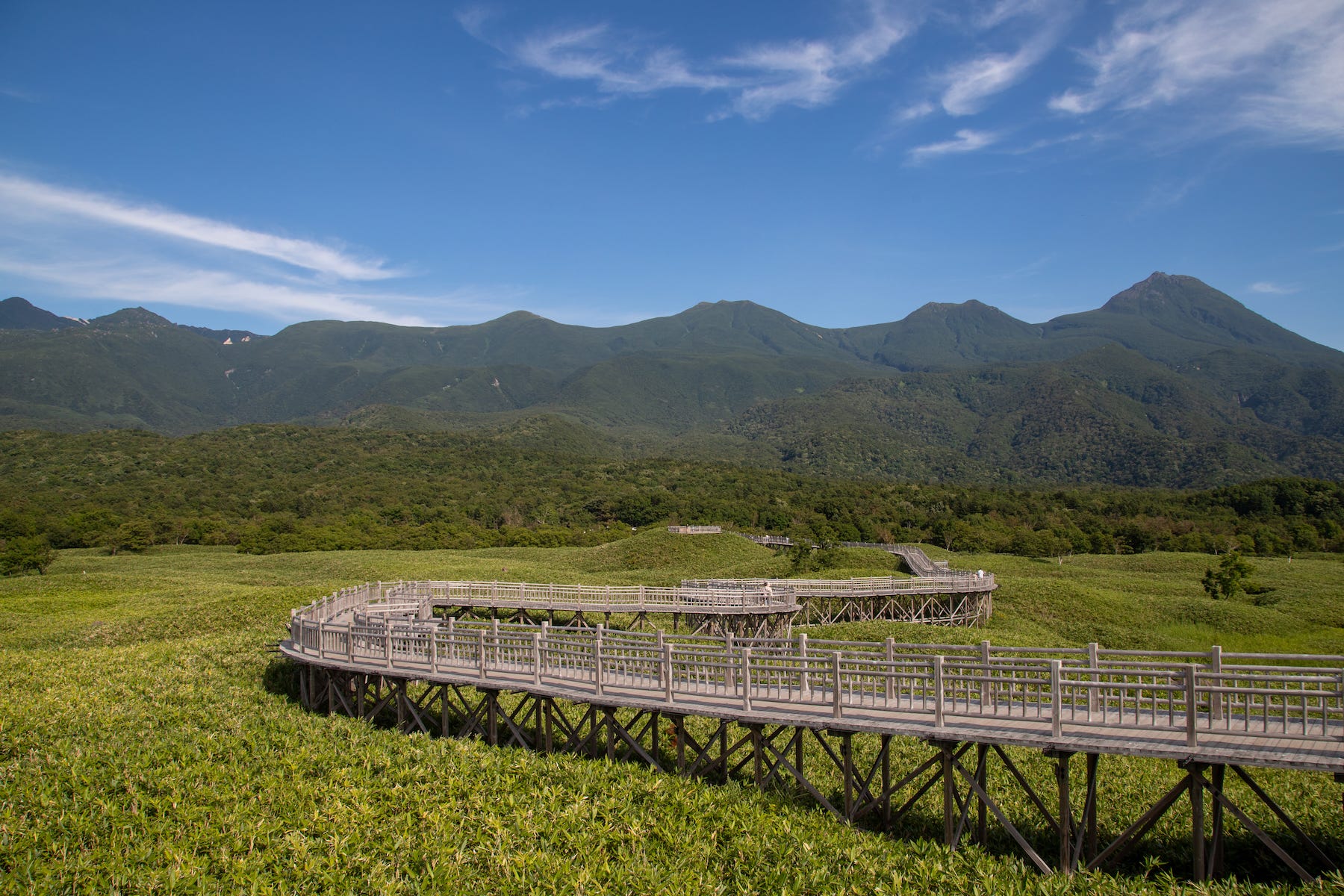
I spent part of July and August in Hokkaido, Japan’s northernmost and second-largest island. It was a place that I had been looking forward to visiting for a long time, and after experiencing some of the overtourism everyone reads about in Honshu on a few of my most recent trips there, I bypassed the mainland entirely. Between a handful of recommendations from contacts I had previously met from Hokkaido’s tourism board and reading Burcu Basar’s atmospheric pieces on the island, I had enough of a direction to just rent a car and go.
Upon reaching the northeasternmost part of the island, we checked into The SUNSET Shiretoko, a no-frills hotel above Utoro where you shower downstairs in the shared onsen and most rooms are shared occupancy. The lack of a shower in the room initially concerned my wife; however, once there, the peacefulness of the place and the views from the rooms and the onsen were incredible. You could see down to the harbor, and a herd of sika deer came by each night to graze in the last of the light, completely unbothered. It was one of the many great places we stayed on the trip, near accessible hiking in the national park, and I cannot think of a single reason not to tell you about it.
The New York Times ran a piece on gatekeeping while I was there, titled “In Travel Hot Spots, Gatekeepers Are Hiding Their Favorite Places.” The piece centered around Copenhagen, Mexico City, and Milan and garnered four hundred-plus comments, with most arguing that their neighborhoods have also recently been ruined by tourism. I can see their points. Although I don’t live directly in Copenhagen (I am about 20 minutes away), places like a seafood restaurant and bar called La Banchina that I took some photos of two summers ago are now in the Times’ new Copenhagen guide and appeared in my feed in two different Substack Notes yesterday. It’s a nice spot, sure, but with so many waterside bars and swimming spots, does everyone need to go there?


A Dane commenting on the piece defended his countrymen, saying that Danes don’t gatekeep but rather “want the tourists to fan out off the beaten path.” More people should share in this mentality. In the past, people used to just travel, experience a place, and come back with their memories and stories to share. Those usually came with recommendations, and if those family or friends made the trip themselves, it was likely that those business owners who provided the great experience the first time would benefit.
Now, with the rise of gatekeeping, there is a contingent of people who visit a place, post about it to collect the engagement, and then withhold the locations or booking information, citing that “they don't want this place to change.” How is that not pulling the ladder up behind you? I understand why people would want to keep something ecologically sensitive, like a beach for turtle hatching, quiet, or respect a community that has asked visitors not to come, and I support doing so for things that might damage the environment or a way of life, especially if there are not already mechanisms in place to restrict it. However, if you genuinely want to keep a place or an experience to yourself, then keep it to yourself. But once you have made the choice to share, you should follow through if someone asks. Choosing not to, just to curate your own brand, is nonsensical, especially when the business that hosted you would probably like the next guest too.
The travel industry does not grow exactly how you think it does. The normal way that growth happens (and overtourism happens) is really due to transport, specifically flights. Just a few weeks ago, United Airlines announced “its largest international expansion in history with ten new destinations in Europe.” Eight of the ten destinations on this new list currently have no non-stop service from the US at all. When those places go from requiring a connection to being a direct booking 4x or 5x a week, that is when the wave of overtourism hits. Look out, Ljubljana. Normally, the corridors precede most of the articles and the influencers. Any writers or influencers who cover these places before the flights arrive are the ones toiling away with hard pitches to publications and minimal views on their blogs to help the destinations become part of a corridor. Meanwhile, places that are easy to reach have crowds coming whether you tag them or not. So United’s new Denver to Paris non-stop is really just adding to it.
So, what does withholding the details of your trip accomplish besides costing the owners and operators there a booking? Eighty percent of international travelers visit ten percent of the world’s destinations, and this is largely due to these corridors, limited vacation time, and the urge to see and do the same things as everyone else.
The whole gatekeeping debate is almost entirely about that ten percent, and I get it. The other 90% of the world is out there, though, with many places already having the capacity to welcome more people than are currently showing up, especially in the shoulder and off seasons. People are going to travel regardless, and the more they hear about these places, the fewer end up in the places that are already under pressure. If you have been somewhere that traditional travel publications are not covering and it is worth going, you should post about it and write about it.
I don’t believe the risk is that, by doing so, too many people will follow and spoil the place. I think the risk is that by not doing so, people never learn about the alternatives — and there are so many.
Speaking of not gatekeeping! A restack or forwarding this story is the single best thing you can do to spread the word, even if you do so in disagreement.
If you liked this, there’s more where it came from. Scott Monaco opens a window somewhere new every week —travel essays, photography, cultural observations, and books worth reading. Once a week, sometimes more. Free to subscribe.
I think you make some excellent observations, Scott. I agree that direct air corridors have a large influence, look at what the A321XLR is opening up for American tourists; heck, living not far from JFK airport we always have a wealth of new options every summer—my husband and I have wanted to go to Malta but we're doing it this year because there is a direct flight and it became significantly easier.
The media/social media landscape has also changed vastly... and I agree with you: why post a place for engagement and then pull the ladder up and gate keep it? I thought about this recently while hiking in the Snowy Range in Wyoming. It's locally well known but not a "known" place broadly—a highway takes you up to 10,000 feet amongst pristine alpine tundra. The perfect place to hike and see stunning scenery, yet all with the option of putting in very few miles on the trail (if that's your desire). In the wrong social media hands, that place could easily 'blow up' and become a snarl of traffic and selfie sticks.
Perhaps I'm old fashioned and yearn for the days when people weren't inspired to travel from a 3 second visual clip or hook, instead a compelling story led them to book a ticket and pack their bags.
this made me think a lot, and while i'm still not sure whether i agree or disagree with you here, i really appreciate you writing this
the transport argument is true, and i also agree that the "i did it but you shouldnt" and "look at me in this beautiful place but i wont tell you where it is" mentality is unhelpful. at the same time, i saw someone on instagram post some photos of an island in indonesia and say that she won't publish the exact location because if you can't do bare minimum research and just want the same pics, you shouldnt be visiting. to people who did find the place and messaged her, she would then give local contacts. and honestly, i kind of respect that because on social media, people are sometimes so entitled to all sorts of information being spoonfed to them when google is right there.
I also recently saw someone recommend a restaurant in Bogota on TikTok, which is my in-laws' favorite spot run by an elderly couple. i don't think they want more business in the form of influencers sticking phones in their faces, so the post got me a bit worried. i do believe that these community and tradition-driven places are sometimes better gatekept, or at least given out with caution.
personally, despite being a nobody, i try to approach everything i post online with "what if a big influencer sees this and makes content about it" approach, and if i'm not comfortable with the outcome, i either don't share or at least paywall