


We left the car in La Línea de la Concepción and walked across the border into Gibraltar. The checkpoint was brief — a few people ahead of us, a quick look at the passports — and then we were through and standing at the edge of an active runway.
Gibraltar’s airport runway cuts directly across the only road into the territory, a strip of tarmac that functions as both landing zone and pedestrian crossing depending on when you arrive. An EasyJet flight was on approach, and the barriers had come down, so we stood with a handful of other people and a few idling cars and watched a commercial aircraft land from a few hundred feet away. When it cleared, the barriers lifted, and everyone walked across the runway and into town.
For decades, crossing into Gibraltar involved more than a runway and a passport check. La Verja, the fence, was the hard border between Spain and the British Overseas Territory, a 1.2-kilometer chain-link barrier that Franco sealed shut in 1969 and that wasn’t fully reopened until 1985. Even after that, it remained a bottleneck, with queues that could stretch for hours, since even when the UK was in the EU, Gibraltar was never part of the Schengen area. A new treaty between the UK and the EU, provisionally effective this July, dismantles it entirely. The land border check we had just walked through will soon cease to exist at all.
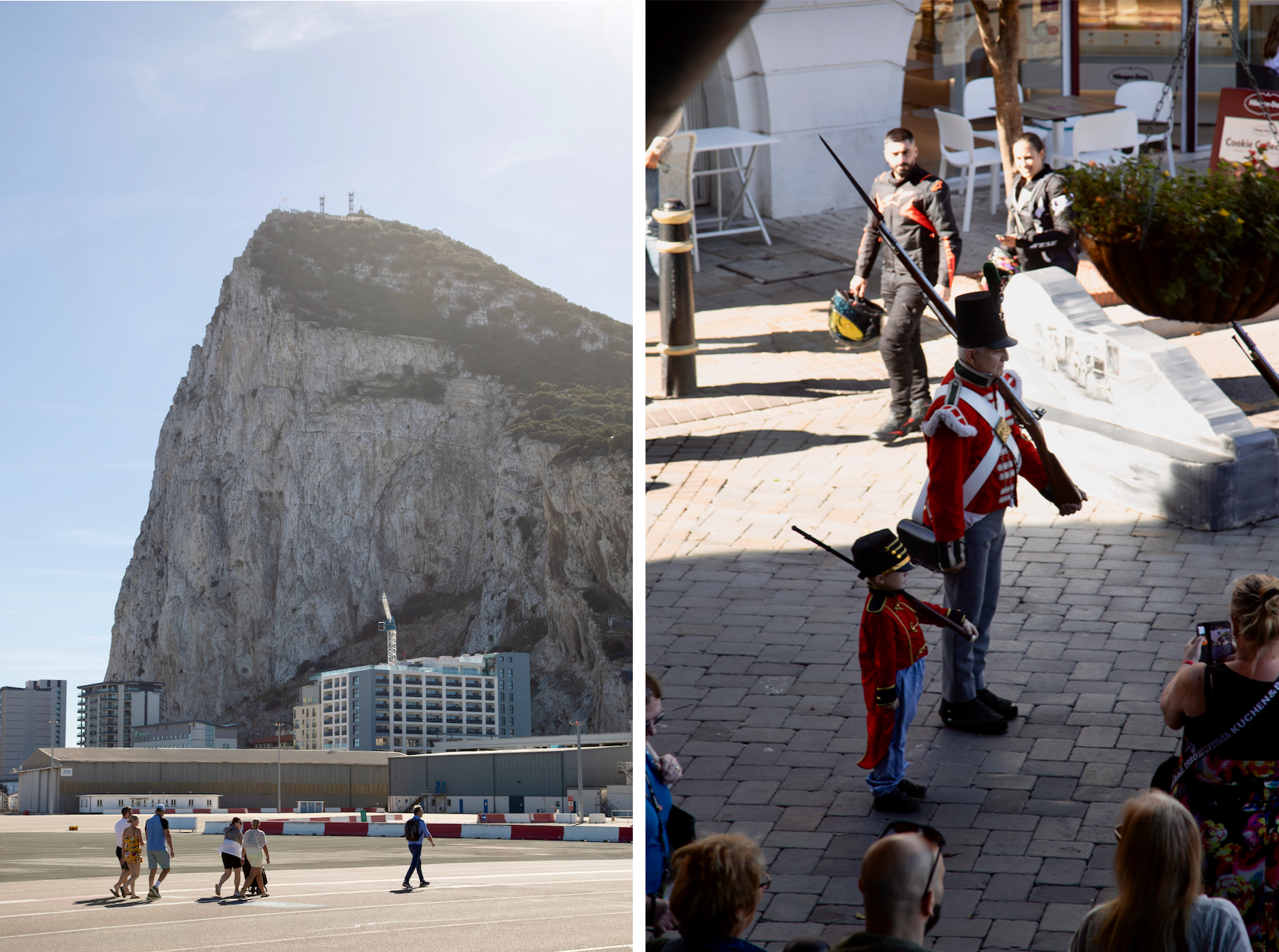
The Rock rises over 400 meters above the town, a mass of Jurassic limestone visible from nearly every street, and the tunnels bored into it during the Great Siege and both World Wars extend for over 50 kilometers inside the stone. I walked Main Street and the alleys that branch off it, through Casemates Square, where people sat eating in the sun, and continued on toward the cable car at the base. You can hike the upper ridge, take the cable car, or pay one of the taxi drivers who were working the queue with real enthusiasm. I joined the line for the cable car, which turned out to be a very British queue — orderly, patient, and after thirty minutes showed no signs of becoming anything else. It was a beautiful day, and everyone on the peninsula had the same idea. I figured I would come back and went to explore the lower levels on foot instead.
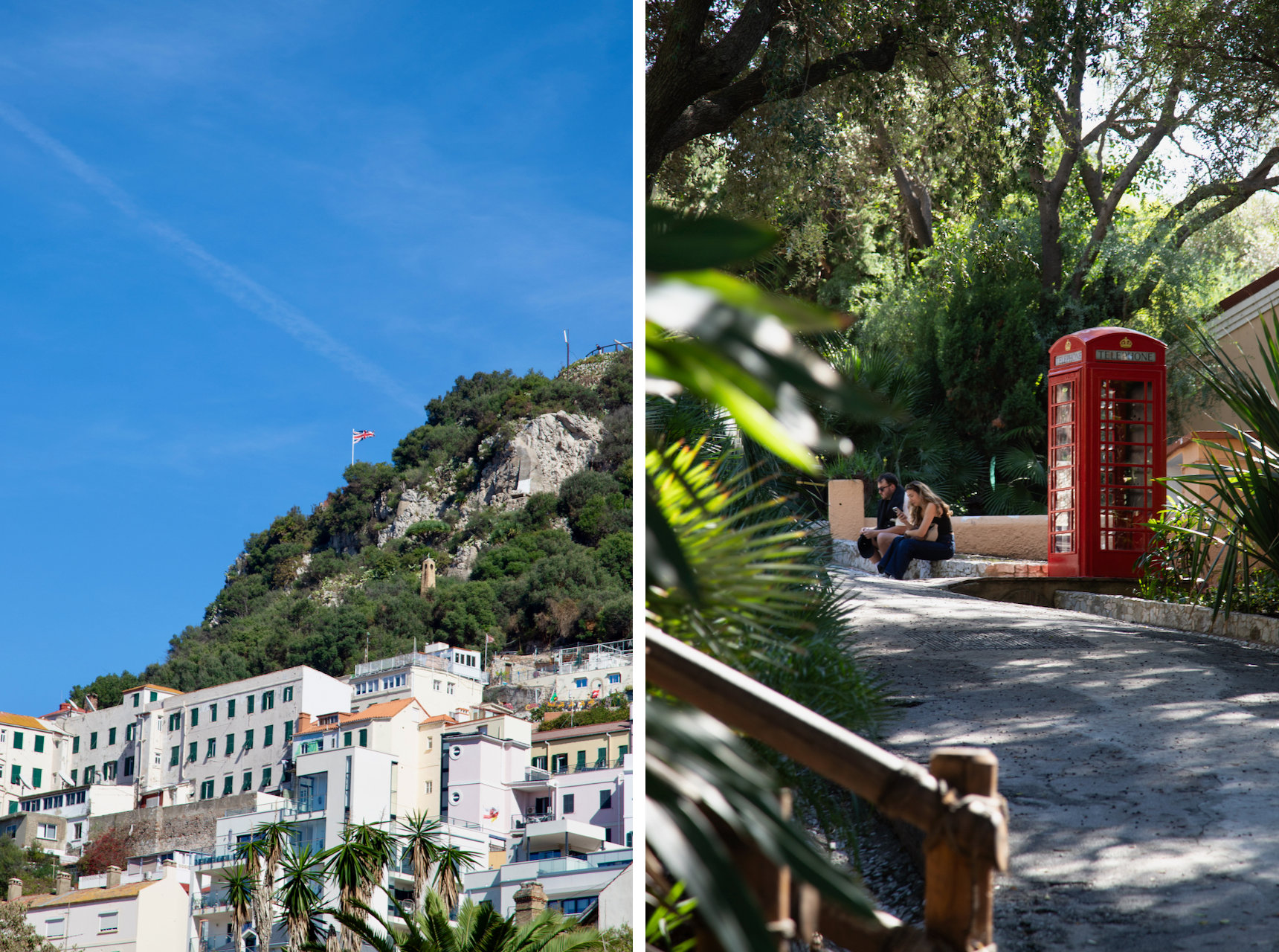
In the Alameda Gardens, I strolled under dragon trees older than the gardens themselves and past beds of cacti and South African aloes before coming upon a red telephone box. The phone box may or may not have been functional, but it was doing its job regardless, which was to remind you that this sliver of Mediterranean coastline belongs to the British Crown. Gibraltar has voted twice, overwhelmingly, to remain a British Overseas Territory, and the evidence is everywhere — pubs advertising fish and chips and full English breakfasts, street names that belong in Kent, and Union Jacks whipping in the wind.
Walking back toward the border later that day, I realized the Britishness of the place had been more striking than I had expected, and that I was more drawn to it for exactly that reason. We crossed back into Spain the way we had come, on foot and across the runway, and drove south. An hour along the coast, at the point where mainland Europe runs out of road, something entirely different was waiting.
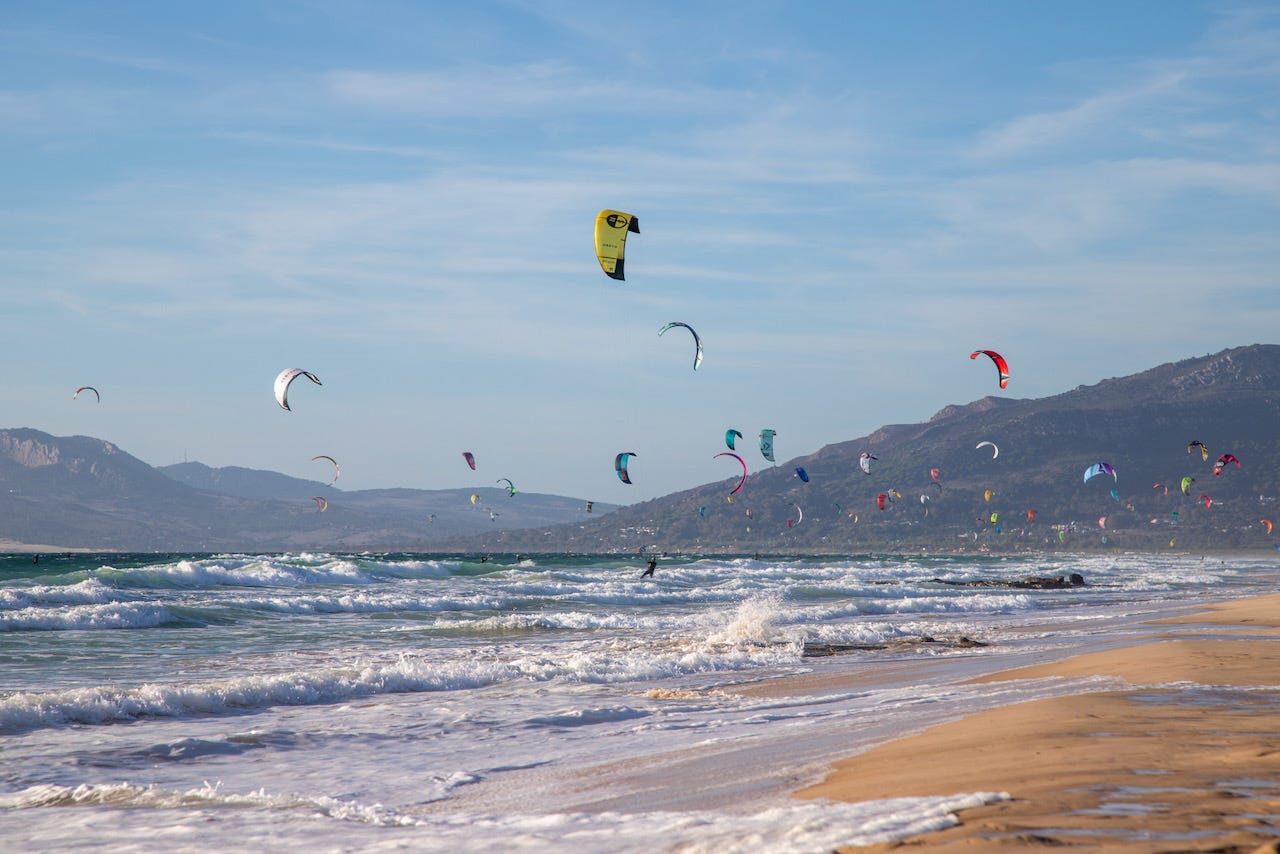
I saw the kites before I saw the town.
They appeared above the waterline as I came around a bend on the coastal road, bright shapes pulling tight against the wind, too many to count. By the time we reached Tarifa and parked, there were seemingly hundreds of them strung across the strait, riders cutting back and forth through the chop while their sails carved arcs overhead. I dropped my bag in the room and went straight to the beach.


Tarifa is the southernmost point in mainland Spain, and people have been crossing the strait from here for over a thousand years. In 710 AD, a Berber commander named Tarif ibn Malik sailed from North Africa with four hundred soldiers and made landfall on this coast. The town still carries his name, and the castle he would have recognized still stands by the port. Two winds, the Levante from the east and the Poniente from the west, funnel through the strait and have turned the beaches into one of the best kitesurfing destinations in the world. On the sand, a man was trying to come in from the water, which I learned requires someone onshore to help harness the sail. I was useless at first, standing there with my camera, until I watched a few others do it and got the idea.
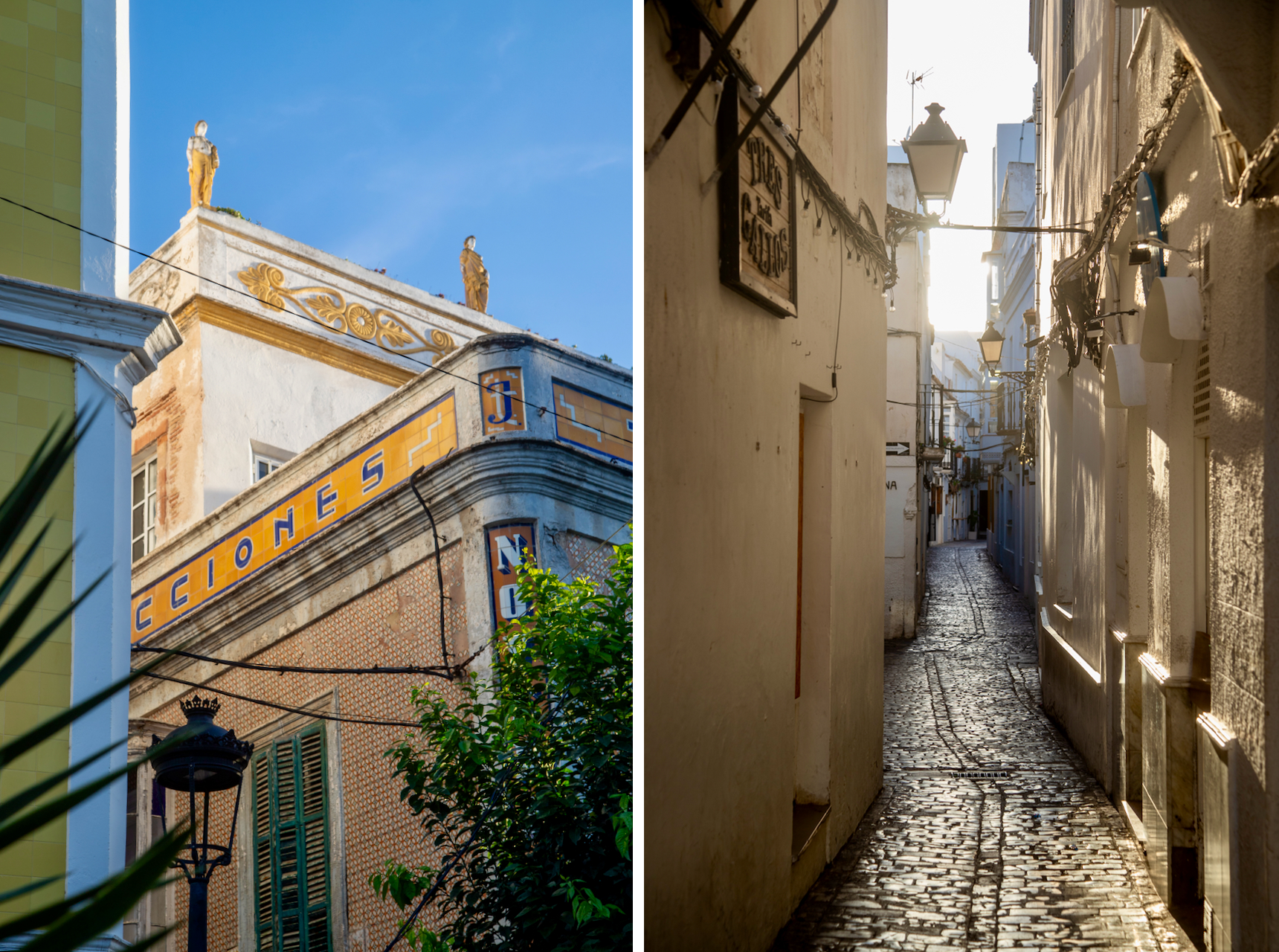
The town is small enough to cover on foot in an afternoon, with narrow streets and small plazas where people eat well and without hurry. We found a place for dinner and arrived at what we considered a reasonable hour for bed, which in Spain meant the restaurant was not yet open. I loitered outside with enough transparency that the waiter eventually took pity on us, patted me on the back, and ushered us to a table before the kitchen was officially running. The seafood tapas that followed were excellent, unfussy, and light enough to offset the full English if you visited both places in a day.
From most points along the coast, you can see the Rif Mountains of Morocco rising from the opposite shore. Africa is right there, sitting across a channel of water narrow enough to make you reconsider what you thought you knew about the distance between continents.
Fourteen kilometers, at the narrowest point.
The next morning, we boarded the ferry. Spanish immigration processed us at the terminal in Tarifa before departure. Moroccan immigration started as soon as we were onboard. The officer had set up in a small curtained cubby on the upper deck with a portable computer that looked like a suitcase from a Bond film — the kind of setup you’d expect to see someone use to decrypt something, not verify the validity of a document. He was efficient and friendly, considerably more so than any arrival I have experienced at other Moroccan entry points, and by the time the boat docked in Tangier we were already cleared to enter. We walked off the gangway and onto the African continent without stopping. The crossing took exactly one hour.
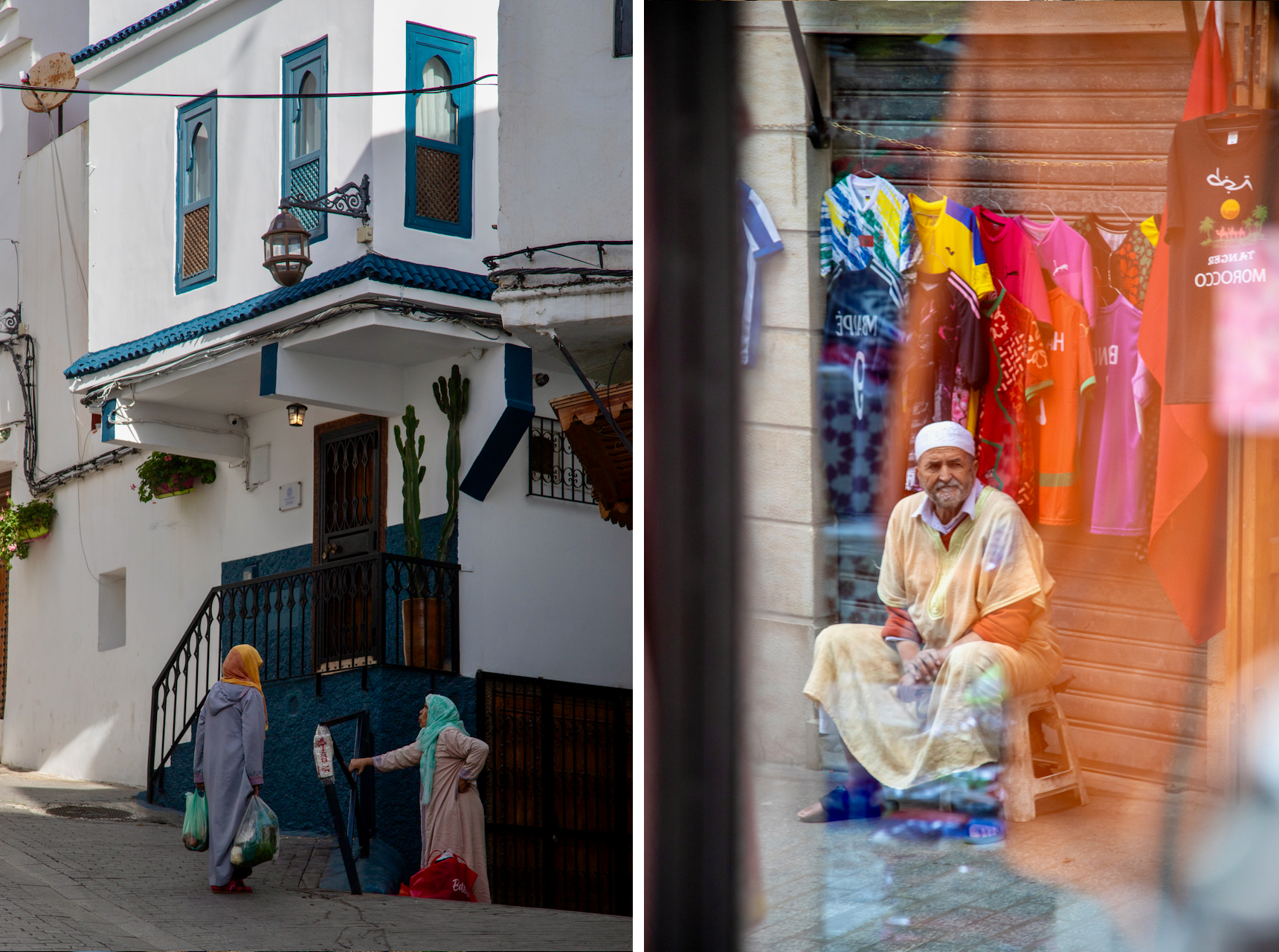
Tangier has been absorbing people who arrive unsettled by the speed of that transition for a very long time. Paul Bowles came in 1931 and returned so many times he eventually stopped leaving, spending the last 52 years of his life in the city. William Burroughs wrote Naked Lunch in a room in the medina. Allen Ginsberg passed through and kept passing through. They were drawn to a place that sat at the entrance to the Mediterranean and operated under its own logic —a city that had been an international zone governed by eight foreign powers simultaneously and then an independent one that still carries the residue of all that overlap. The writers came because Tangier didn’t require them to be one thing, and because the crossing from Europe was short enough to be easy and long enough to feel like an escape.
The medina was far more pleasant than Marrakech. We wandered for a long time without a plan, which is the only way to move through streets that are narrow and layer on top of each other, which rewards a slower stride. We found a rooftop, ordered lunch, and sat in the sun looking out over the medina.
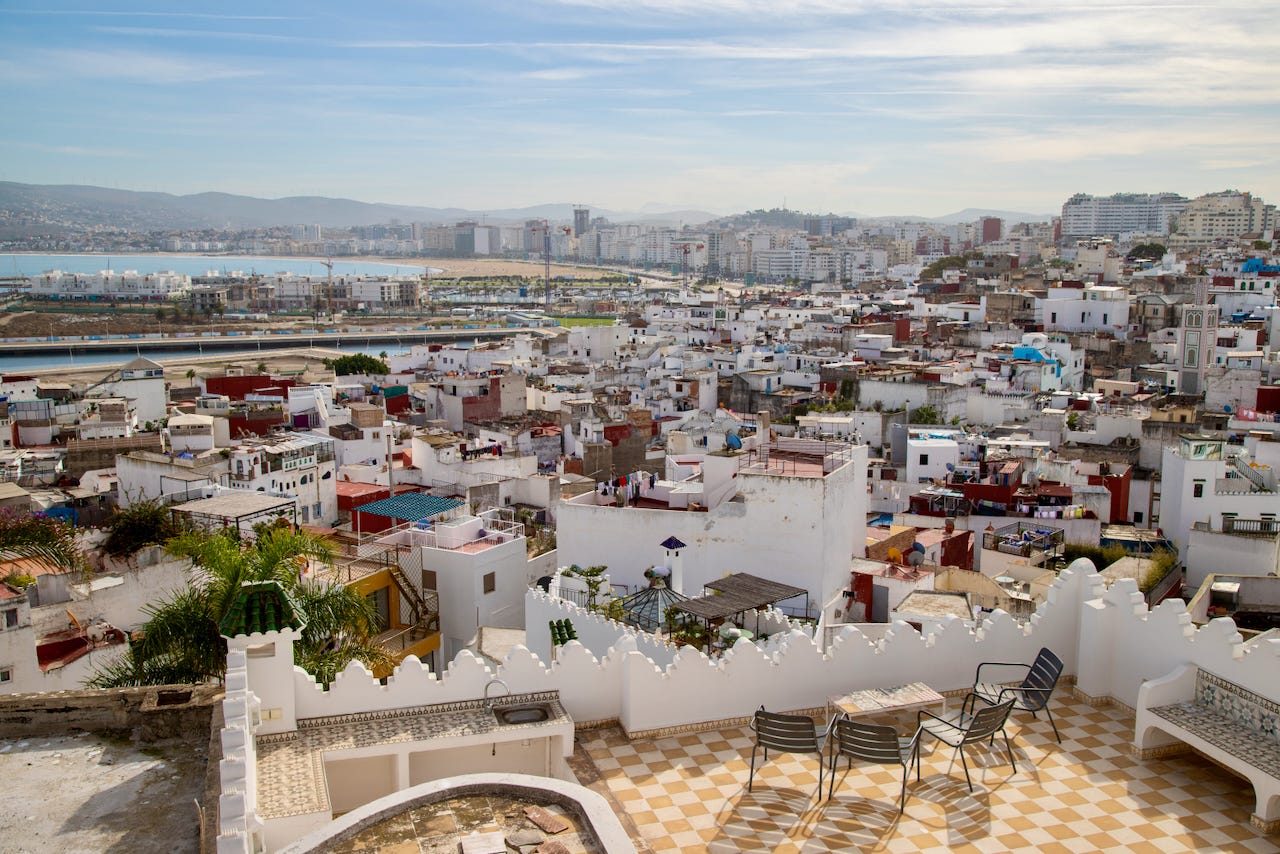
The ferry back was the same crossing in reverse, an hour over the same water, except this time a kid in the row behind us was playing one of those rhythm games on his phone, the kind where you tap along to the music, and he was stuck on “Dance Monkey” by Tones and I. He kept failing and restarting, which meant we heard the same thirty seconds of that song on a loop for roughly twenty minutes, which is not something I would wish on my worst enemy. By about the fortieth repetition, it occurred to me that this was the most difficult part of the entire trip.
We had left our car in Tarifa, so before the drive back, I ducked into the lobby of the place we had stayed the night before to use the bathroom. Two Swedish tourists were at the front desk, and they had questions. A lot of them. How easy is it to get to Tangier? Where do you park? Can you do it in a day? Is the ferry reliable? How does immigration work? What if they drove to Gibraltar instead, how easy was that? They were very talkative Swedes. They were still going when I came out.
I thought about saying something. That we had just done exactly what they were asking about, and that it could not have been easier. That you can stand in three countries on two continents in as little as two days and enjoy them all, and the crossings are the simplest part. That the fences are coming down, the ferries run on time, and this rewarding cultural triangle is only 14 kilometers on its shortest side.
I picked up my bag and walked out to the car. They would figure it out. The continents drift, slowly and always, but right now they are close. 🧭
The Briefing
This trip works comfortably as a long weekend, though there is enough to make it a much longer one. Fly into Malaga, the nearest major international airport, and rent a car —Gibraltar is about 90 minutes south along the coast, and Tarifa another hour beyond that. You can also fly directly into Gibraltar from the UK on EasyJet or British Airways, or into Tangier from several European cities. From July 2026, Gibraltar’s land border with Spain will be fully integrated into the Schengen area, eliminating passport checks on foot and by car; air and sea controls will remain. Park in La Línea de la Concepción and walk across. FRS and Inter Shipping operate fast ferries from Tarifa to Tangier with crossings of approximately one hour and multiple daily sailings, though schedules vary by season. Moroccan immigration is processed onboard on the outbound crossing, so you disembark in Tangier cleared to enter. U.S., UK, and EU passport holders do not need a visa for Morocco for stays under 90 days.
If you liked this, there’s more where it came from. Nothing to Declare opens a window somewhere new every week —travel essays, photography, cultural observations, and books worth reading. Once a week, sometimes more. Free to subscribe.
Not sure if you've read "Outposts" by Simon Winchester but it's interesting to see how the border relations have changed over the years between Spain and the UK. When he wrote it he couldn't cross by land and instead had to take the ferry to Morocco and back.
My mother spent 6 years as a teen in Gibraltar, loved it, and when we lived in Madrid we made a couple visits. Back then the border crossing was an arduous procedure (this was from 1986-1989). We never made it to Morocco, unfortunately.