


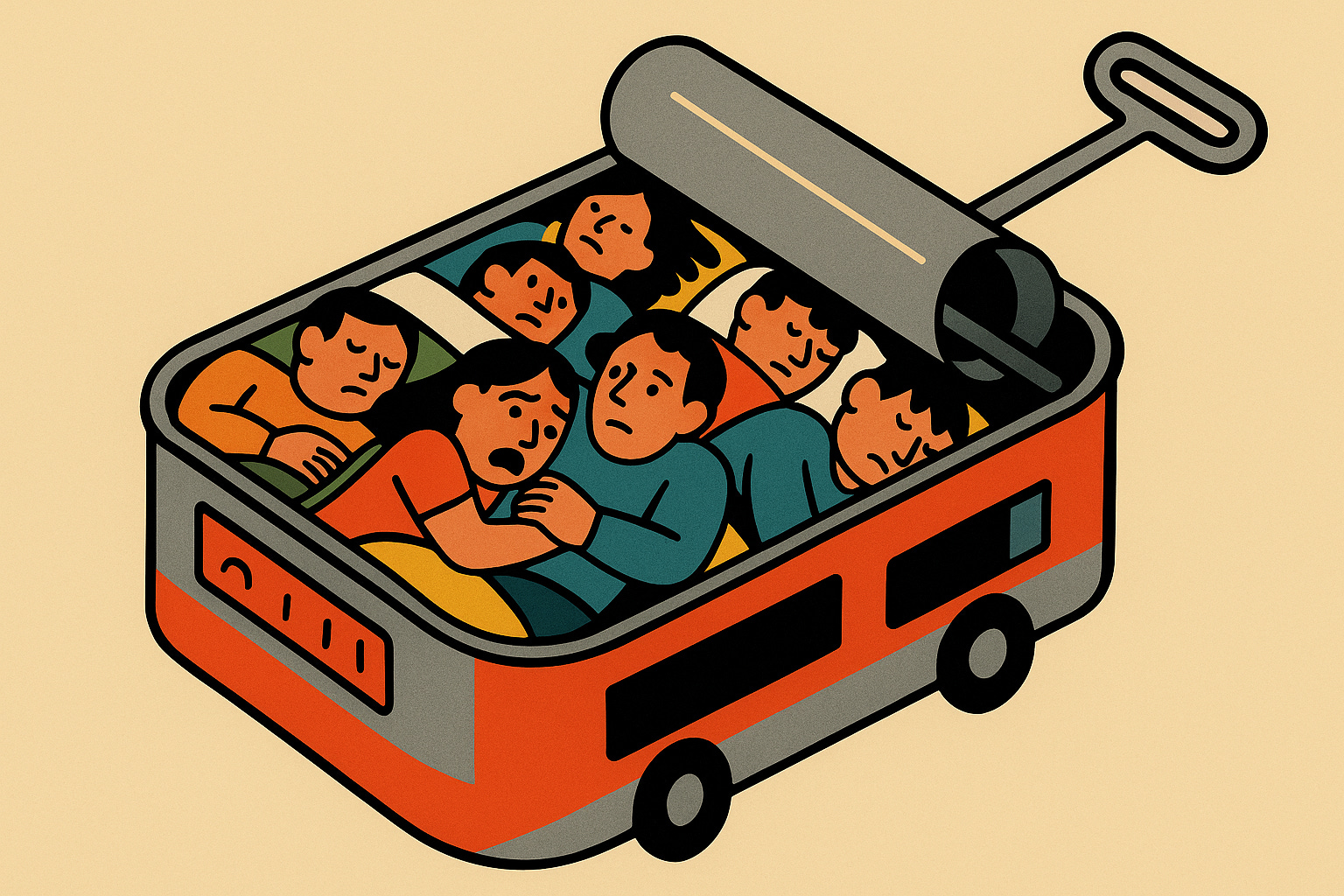
We didn’t exactly plan to suffer.
If anything, we were feeling kind of smug when we booked the sleeper bus from Dali to Jinghong. It felt adventurous. Authentic. Like the kind of gritty, off-the-grid experience that separates “travelers” from plain old tourists. We weren’t just going somewhere—we were earning it.
Somewhere deep in our brains, we must have believed that discomfort equals depth. That enduring a 13-hour overnight bus through rural China would give us stories, perspective, and maybe a deeper connection to the country we were about to leave after living there for the past five years.
And to be fair, it did give us all of that, just not in the way we expected.
We arrived at the Dali bus station early, optimistic in that quietly determined way only travelers can be. The ticket promised a “sleeper bus,” which we took to mean a reasonably comfortable ride: beds instead of seats, maybe a pillow, possibly even something resembling a blanket. What we got was a narrow, smoke-filled metal tube with three rows of thin bunks running front to back.
The air was heavy with stale cigarettes. My wife took a bed by the window; I got the top bunk in the middle—because nothing says comfort like climbing a metal ladder in a moving vehicle. We were separated by an aisle but close enough to talk, which helped. Misery is always easier to bear when it’s shared.
I glanced over the edge. “This thing have seatbelts?”
My wife didn’t look up. “If you’re looking for seatbelts, you’ve come to the wrong place.”
The bus pulled out at 9:20 a.m., on schedule. It was supposed to be a thirteen-hour ride. But only a few minutes in, it became clear that the schedule was more of a suggestion than a plan.
We began stopping frequently, unpredictably. What was meant to be a direct route felt more like a wandering delivery service. The driver picked up not just passengers but boxes, crates, and bundles of unknown contents. People flagged him down from the roadside, handed over cash, and climbed aboard. Whatever else this journey was, it had clearly become part of something else. A side hustle. A network. A route within a route.
I turned to my wife. “What do you think’s in the boxes?”
She looked out the window. “Does it matter?”
She was right. It didn’t.
Three hours in, we hit a roadblock. Not a metaphorical one—an actual line of cars stretched ahead of us on a narrow mountain pass. Our driver, undeterred, maneuvered us to the front. The reason for the delay was posted in Chinese on a shiny blue sign: High-risk slope operation area. Pass with care. Above us, workers chipped and blasted at the rock face. It wasn’t safe, and it wasn’t moving.
So, we waited. Seven hours.
A small makeshift shack had been set up by an enterprising local, offering shade and a few snacks. Clearly, he knew more than the bus company. My wife stayed with our bags while I wandered, not sure what I was looking for. Around us, people unfolded stools and card tables, as if this kind of delay was entirely expected.
When the road finally cleared at 11:30 p.m., we were exhausted in a way that felt deeper than physical. But there was no time to reflect. The bus started moving again, and we held onto the hope that the worst was behind us.
It wasn’t.
At 12:40 a.m., the bus pulled into a parking lot in a small village. The driver got out without a word, and we assumed it was a bathroom break. But after twenty minutes of stillness, the silence started to stretch. I finally stepped off the bus to find someone—anyone.
I found the driver squatting beside the bus, scrolling through his phone. When I asked what was going on, he barely looked up.
“No more driving tonight,” he said. “We go in the morning.”
I went back to break the news to my wife.
She stared at the dim lights flickering across the lot. “We have to sleep here? In this parking lot?”
“Apparently.”
The idea of spending the night on that same now smoke-saturated bus was more than we could take. Across the road, we spotted a hotel—the only one within walking distance. It wasn’t exactly inviting, but we presumed it had a shower, a lockable door, and a bed. That was all we needed.
The moment we checked into our room, business cards with heavily photoshopped photos and women’s phone numbers were slipped under the door.
“Lovely establishment,” my wife said, picking one up.
“At least we can shower?” I offered.
We washed off the day’s filth, double-checked to make sure the door was locked, and went to sleep, dreading the morning.
At five sharp, we were back on the bus, scared of it leaving without us while trying not to think about the horrors that awaited us. At this point, we had no trust in the schedule, no belief in the efficiency of the journey. We just wanted it to be over.
The driver, clearly sensing our growing misery, suddenly decided to take the actual highway to Jinghong—a route they had ignored the day before, presumably because it didn’t accommodate their side business.
Just when we thought we were finally free, about an hour from our destination, the bus stopped once again on the side of the road. This time, we were told we had to transfer to another bus because we were running behind schedule.
A new one appeared and was fine—just normal seats, nothing fancy, but at least it was moving in the right direction. By the time we reached Jinghong, we were beyond exhausted. We weren’t even angry anymore, just numb. We had survived, but at what cost?
After fifteen hours of recovery, hot showers, and warm bowls of mapo tofu and vegetables, we had no choice but to give the sleeper bus one more try. We still weren’t out of China, and at this point in the journey, buses weren’t just an option—they were the only option.
In our defense, we genuinely believed the last experience had been a fluke. A one-time disaster. An unlucky roll of the dice. Surely, the law of averages was on our side now. Lightning couldn’t strike twice, right?
At the station, we were offered an upgrade: a VIP sleeper bus to Luang Prabang for an extra 100 RMB each. The words “luxury,” “direct route,” and “air-conditioned” were thrown around. Desperation makes you gullible.
The bus did look promising. It had soft, double beds lining the perimeter, which could sleep at most 20 people, and it was only half full. My wife and I could lie next to each other, which felt practically decadent after the previous ride. For the first few hours, everything was fine. We stretched out, read our books and gazed out the window, and enjoyed the kind of fleeting contentment that only exists when you don’t yet realize disaster is approaching.
That changed at the China-Laos border.
The process started normally enough. We gathered our bags from below the bus, went through customs, and watched as our bus was driven through the Boten International Checkpoint.
And then, seemingly out of nowhere, all hell broke loose.
A wave of Chinese migrant workers descended on the vehicle like it was the last chopper out of Saigon. Anything on their person including tool bags, muddy boots, plastic-wrapped bundles—everything flew up the steps in a chaotic blur.
I stared, blinking. “That’s not our bus, right?”
But it was. Our supposed VIP sanctuary was now under siege.
We pushed our way up the steps of the bus and found the driver, utterly unmoved.
“Can we put our bags underneath?” I asked.
He shrugged. “All full now.”
I looked over. Our luggage compartment—once containing our carefully packed backpacks—was now stuffed to the brim with sacks, reels of industrial tension cable, and Tyvek bags that almost certainly hadn’t come from customs.
Apparently, VIP status could be revoked at any time. The migrant workers hadn’t bought tickets—at least none we could see. One by one, they handed the driver cash in what was clearly an under-the-table arrangement. No receipts. No questions. Just business as usual.
Inside, chaos erupted. The ten of us who had paid for our tickets from Jinghong were shouting at the driver and arguing with the workers, pointing at our assigned seat numbers. No one was listening. My wife, clutching her backpack, looked pale. I was trying to hold our space, fending off strangers. The workers were pushing each other, shouting over the noise. No one seemed to know what was happening—or who was supposed to be in charge.
And then the driver finally turned to face us.
“You go to sleep,” he said calmly. “Then you won’t know they are here. You never saw them.”
I stared at him. “That’s your solution?”
He grunted, turned back around, and started driving.
That was it.
With more than fifty people now jammed into a space designed for less than half that number, comfort ceased to exist. So did airflow. So did personal space. We were just bodies in motion, suspended in fumes and noise, trying to disappear.
The heat was unbearable. The smell—a rich blend of sweat, cigarette smoke, and diesel—hung in the air like a punishment. The noise was relentless. Conversations erupted and overlapped; people argued, spat, laughed, and shouted. No one was sleeping, no one was relaxing. The only “luxury” left was shared survival.
Then came the staring.
My wife, one of only three women on the bus, instantly became the unintentional centerpiece of the journey. A hundred eyes tracked her every movement. It wasn’t malicious, just relentless. I positioned myself between her and the crowd, doing my best to be a human curtain.
Hours passed. The bus didn’t stop.
When we finally pulled to the roadside, the men filed out and handled their business right there, in plain sight—some peeing on the wheels of the bus. Maybe it was best that our luggage wasn’t in the hold below, after all. My wife, for obvious reasons, declined the invitation for a bathroom break.
“You sure?” I asked. “I’m not sure if he’ll stop again. I’m not sure how much longer we have to go. I can block you from view.”
“About fifty men are staring at me. I’ll wait,” she said without hesitation.
Fair enough.
The bus rumbled on through the night. After the bathroom break, we connected with the only other two women on board —two young Chinese girls just beginning their backpacking trip through Southeast Asia. They were quiet, kind, and doing their best to stay invisible in the back. Like us, they were just trying to make it through —and, in our eyes, they were even braver than we were.
From that point on, we looked out for each other. Shared snacks. Whispered updates on location through our intermittent phone signals.
By the time the bus rolled into a parking lot about thirty minutes outside Luang Prabang, we didn’t even realize we’d arrived. No announcement. No hint of finality. The bus simply stopped, and the driver got off without a word.
We sat there for a while, unsure of what was happening. Then we decided it was best to get off the bus as quickly as possible. The two girls from the back joined us. The rest of the passengers—the shouting men, the muddy boots, the sacks of unknown cargo—remained onboard, showing no signs of leaving. The bus was continuing on. To where? We had no idea. Cambodia? A border town that doesn’t appear on maps? Wherever overloaded buses go to disappear?
Whatever the destination, it wasn’t ours.
The four of us flagged down a rickshaw and split the ride into town. The silence broke quickly. We were still a little shellshocked, but the adrenaline had shifted—there was relief now, even laughter. We talked. We shared the parts we couldn’t say during the ride. The night air rushed past us, cool and fresh, and for the first time in what felt like forever, we could breathe. We had made it. Off the bus. Into the city. And somehow, together.
We never saw the two girls again. No goodbyes, no exchange of contact info. Just the quiet understanding that, for one difficult stretch of road, we’d found each other—and that was enough. Just that strange, brief alliance carved out of exhaustion and quiet solidarity. And yet, we still think about them. Not out of sentimentality, but because sometimes, the most meaningful parts of a journey are the people you meet in passing—the ones who walk with you, just for a while, when the road gets hard.
Looking back, I still don’t know what we were trying to prove. That we were real travelers? That we could handle discomfort? That overland travel somehow make the journey more meaningful?
We romanticized the idea of “taking the long way”—of tracing the map by road, of seeing the world at ground level. But the thing about the ground is that it’s not always stable. Sometimes it gives way to landslides or road work. Sometimes it’s littered with cigarette butts and questionable cargo. Sometimes the only thing you gain from taking the hard road is realizing it was, in fact, very hard.
And yet, in the middle of all the chaos—between the smoke and the shouting and the improvised bathroom stops—we did find something. Not clarity or enlightenment. Not even a particularly good view. But we found out what we could endure. How we handled each other when things got strange. How far optimism could stretch before it broke, and what waited on the other side when it did.
The road humbled us—not with awe-inspiring landscapes or life-altering revelations, but with crowded aisles and broken schedules and the quiet understanding that we were not in control. We never had been.
Adventure doesn’t always look the way you expect. Sometimes it’s beautiful. Sometimes it’s absurd. And sometimes, the most humbling thing of all is realizing you’d still do it again, just maybe not this week.
This essay won a Solas Award in 2025 and was published in Travelers' Tales.
Subscribe for more essays and unexpected dispatches from life abroad. Thank you for being here.
If you’d prefer to support through photography, I also sell prints. And if you spot a photo in a story that you like and isn’t listed, just reach out. I’m happy to do special runs at no extra cost.
That’s a showstopper. Whew. The gates of hell.
All the best travel stories come with a dollop of disaster attached!