


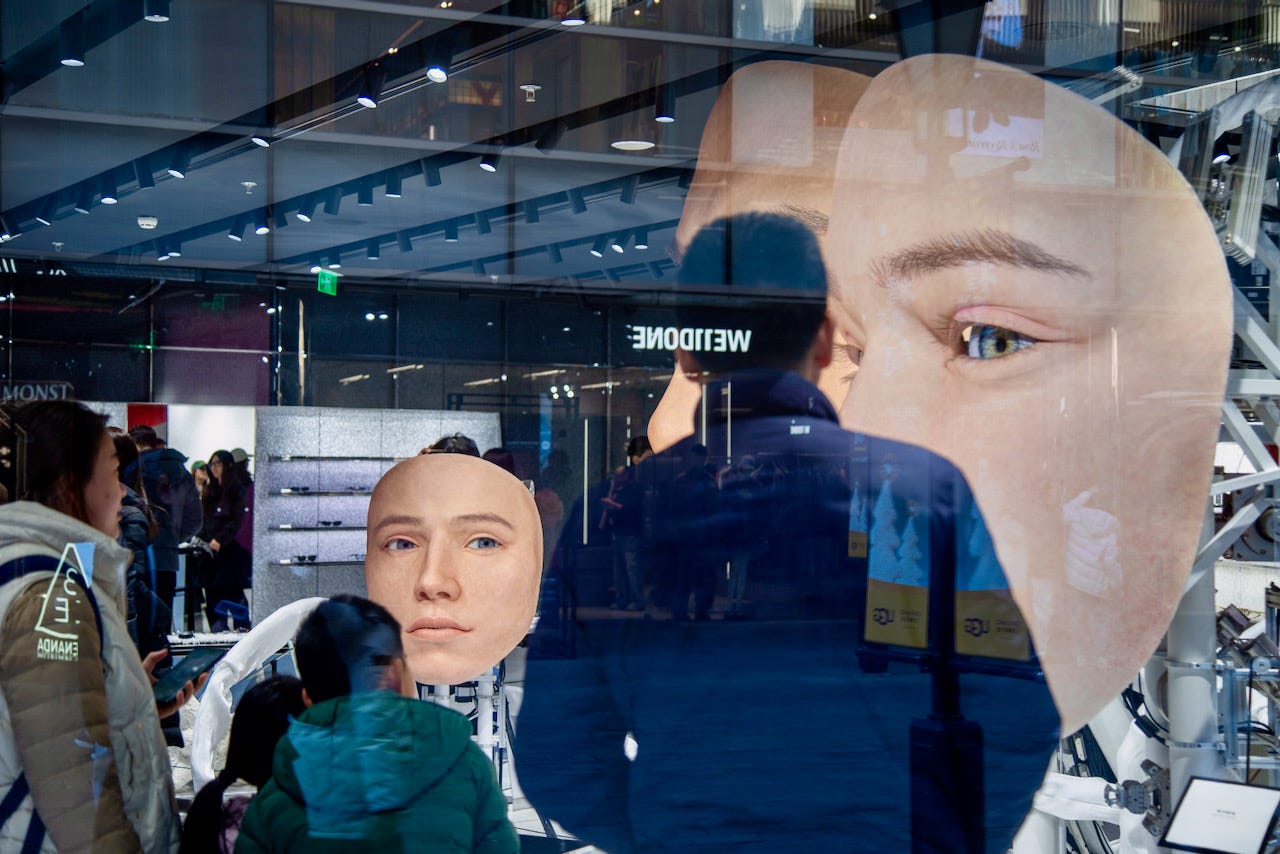
The Stage is a viewing platform at the top of a tower on the Bund, and on a clear night in January the wind off the Huangpu will cut through whatever you are wearing. I stood there on my first night back, after six years away, on a building that didn’t exist back then, and looked east across the river at the Pudong skyline I had helped build a part of, back when I was working in the industry that built it, for clients that no longer exist. The light show that now runs across the Pudong facades at scheduled intervals was smaller when I lived here and not the synchronized production it had become. The Bund below me was bathed in its yellow light, the colonial buildings glowing the way they have for as long as I have known them, and behind them, to the west, the city stretched out dark and dense and illegible. I could not see the old neighborhoods from up there. What had happened to them would take a long walk to understand.
I moved to Shanghai in 2011. I came for a job I had not expected to be offered and stayed for five years, working with local governments and developers to turn neighborhoods into construction sites across the country. I kept coming back after I moved away, and then in early 2020, the borders closed and stayed closed for four years. In March of 2022, the Shanghai municipal government imposed a lockdown on the city’s twenty-five million residents that would last more than two months, confining entire districts to their apartments, and leaving a mark on the people who endured it that none of my friends, six years on, seemed eager to discuss. I booked a trip for 2025 and canceled it from a hospital bed. When I boarded a flight to Pudong in January of 2026, I knew that every map I carried in my head was out of date.
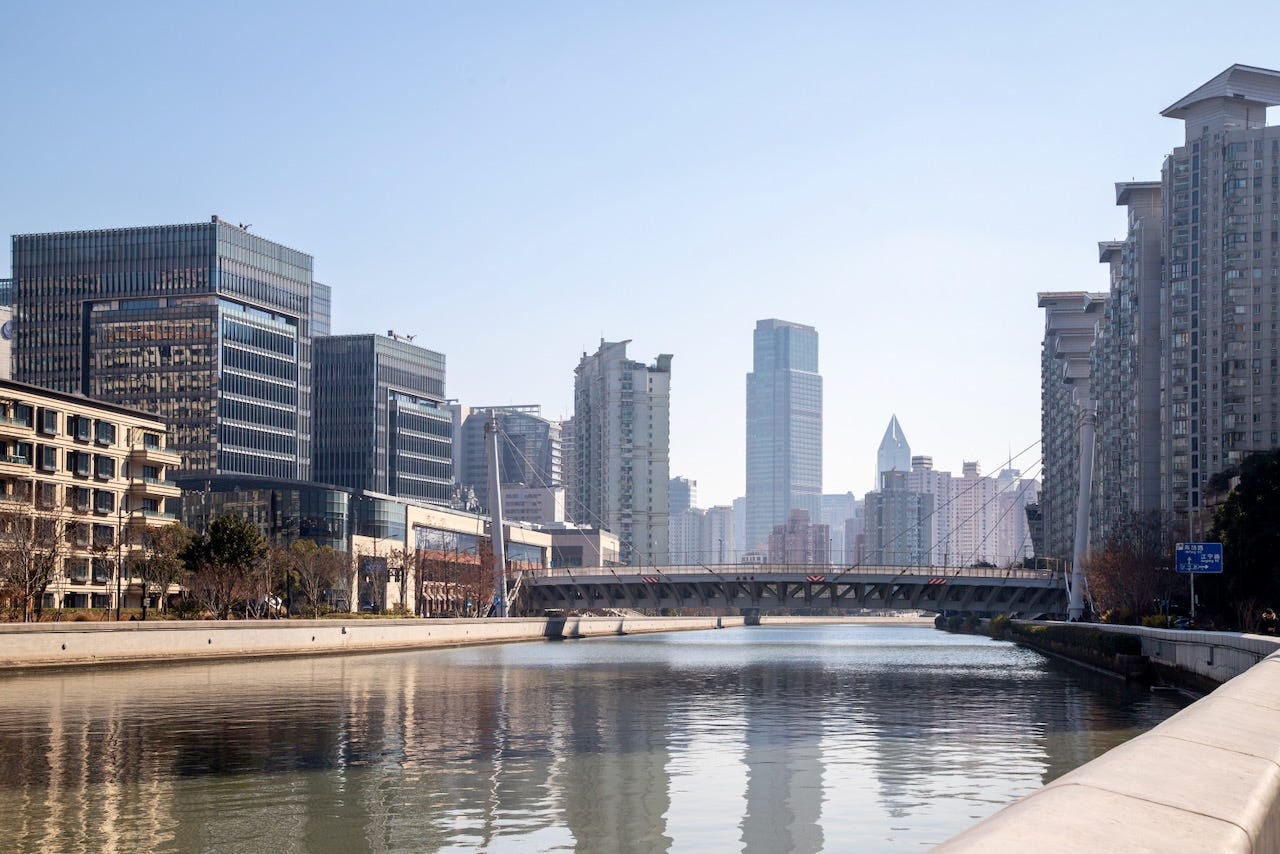
The next morning, I headed toward M50, the gallery complex on the north bank of Suzhou Creek, to visit one of my favorite artists. The streets were different before I got there. Electric cars had overtaken gasoline cars by a ratio I stopped trying to estimate, and the new EV plates — a gradient of green into white — had replaced the blue and white gasoline plates that used to be auctioned for amounts greater than a hundred thousand yuan by the time I left. At intersections where I would have heard idling engines and horn blasts, I could now hear birdsong. The mopeds that used to swarm through red lights lined up in designated lanes. The city was quieter than the one I had left, and more orderly, in every direction I looked, than I had thought Shanghai could become.
After M50, I walked along Suzhou Creek. The creek had been an open drain for most of the time I had known it, and the banks had been a maze of material wholesalers and workshops where I used to bike at night past men pushing handcarts and women sorting metal in the cones of streetlamps. I had loved it for the same reasons it was unpleasant. The city had spent the better part of a decade on a master plan1 to convert the banks into continuous public space, and what the creek is now is a promenade connecting small parks and new developments along clean water where more than forty species of fish have returned. I walked past joggers on rubber pathways, past benches facing the water, and did not see anyone collecting cardboard. What I did see, on poles at head height every hundred meters or so, were cameras.2
As I walked through Jing’an, I passed a series of signs mounted on the fences of residential compounds. They were official, and they addressed the pedestrian directly. One urged “considerate tourism.” Another promoted “courteous traffic behavior.” A third instructed residents on “proper waste sorting.” Each came with a cute cartoon illustration, and people were following the suggestions. At crosswalks, people would stand and wait for a light to change while no cars were coming. Nobody was spitting on the pavement. The whole city had become orderly in a way that I registered somewhere between admiration and unease — admiration because the results were real, unease because I could see the cameras on the poles above the signs, and I understood that the suggestions might not be entirely voluntary.
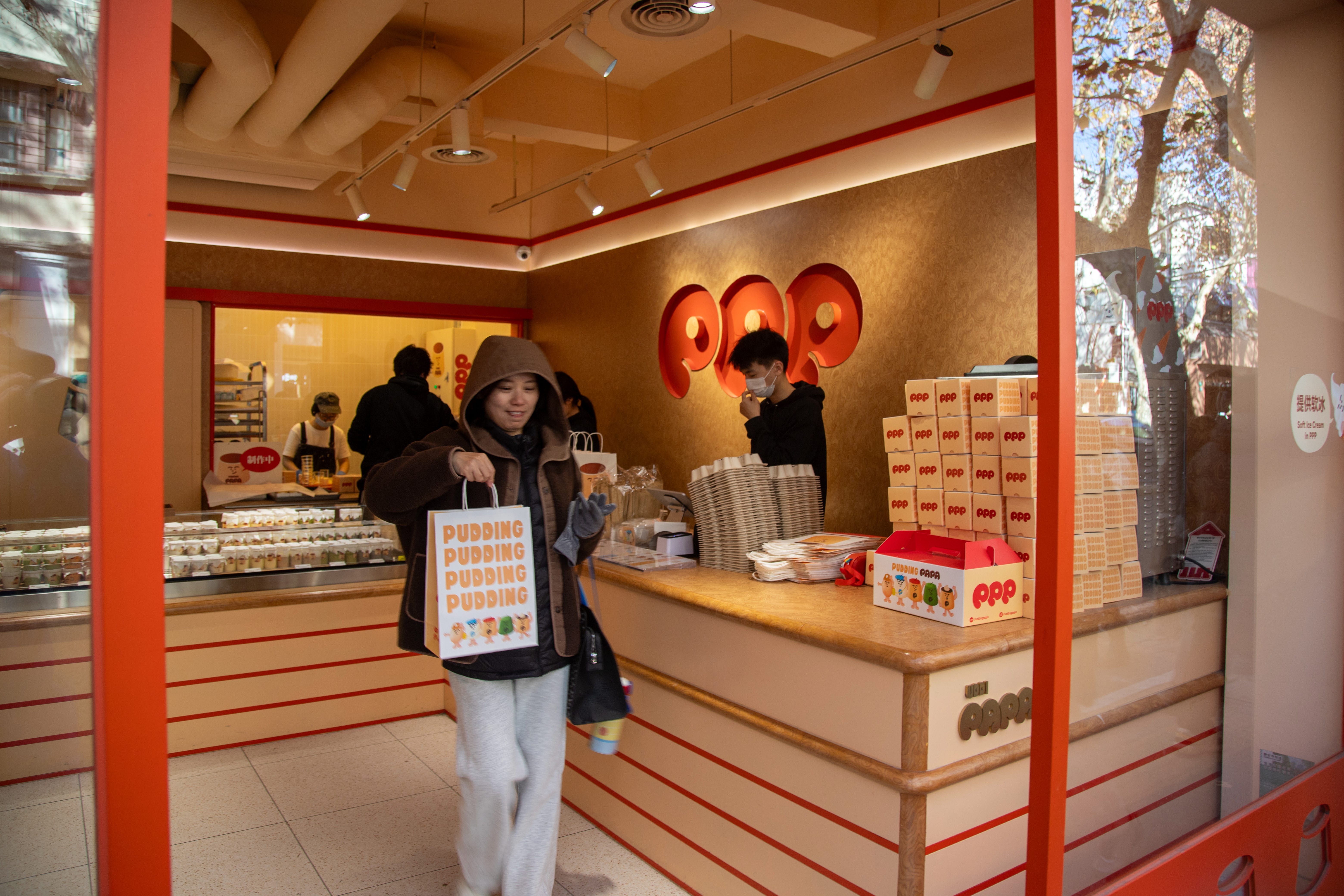
Most of my old haunts were gone, but that was expected. In the five years I had lived here, I had learned not to grow attached to any particular restaurant or bar, because a place could close without warning and reopen as something else within a week. What I had not expected was what had replaced them. When I lived in Shanghai, the foreign concession streets had catered heavily to foreigners and to a local clientele that looked to the West for its references — Yongkang Road, the bar street that exploded the year I arrived and was shut down the year I left, had been ninety percent foreigner-owned, and on summer nights the residents in the apartments above would dump buckets of water onto the crowd to get us to leave.
The places I was walking past now were different. They were Chinese-owned, Chinese-designed, and had a confidence to them that I had not seen before in this city. For as long as I had known Shanghai, the design standard for anything hip had come from somewhere. These places, however, were not running behind anyone. The signage, the interiors, the way they presented themselves felt like they had come from Shanghai and nowhere else, and they were as good as anything I had seen anywhere. Many of them were coffee shops. Shanghai now has more than nine thousand3, more than London or New York or Tokyo, and in 2025 a Shanghai barista won the World Brewers Cup. The city had built an entire coffee culture in the six years I was gone.
I walked south from Jing’an into the former French Concession. Fumin Road was also different — more small shops and eateries than I remembered, a street that had found its next life while I was gone. I stopped in a tea store and spoke to the owner, who had been on this block for twenty-five years. Over a cup of tea, he told me how the street had recently become one of the new destination streets in the city, the way Yongkang Road or Maoming Road had been in their time. He was still selling his teas, but he had expanded his range to include essential oils and other products that catered to the young hip local crowd now coming through. Outside, the London plane trees along the concession streets had been trimmed back for winter, and without their canopy I could see the architecture behind them — the upper stories of the old apartment blocks, the cornices and ironwork. The harsh pruning had bothered me when I first moved here, all those beautiful trees cut to stubs every winter, but over the years I had learned to love the way it worked — how six months of bare branches let you see the buildings, and six months of full canopy hid them again, and the city kept moving between what was visible and what was covered.
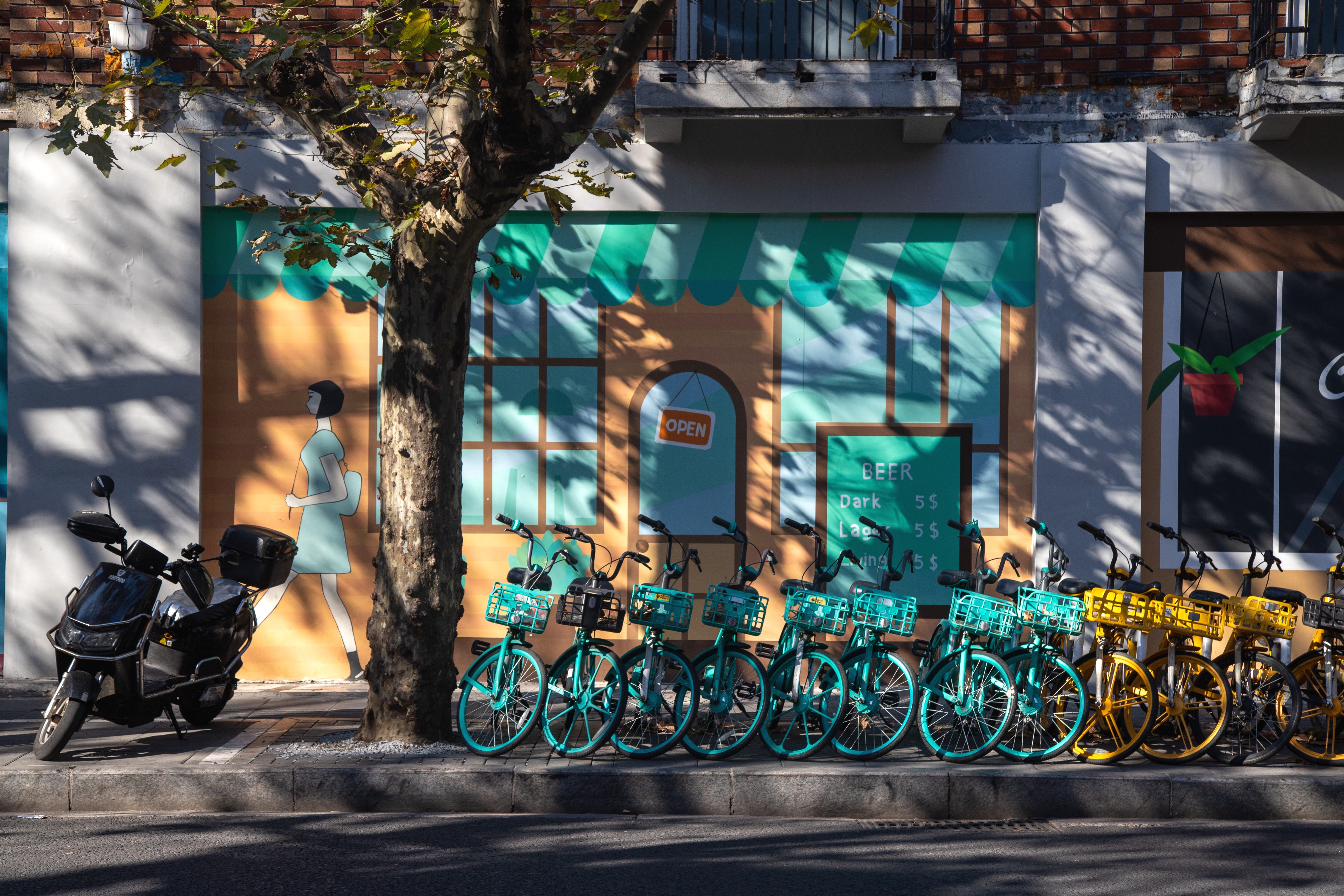
Near the corner of Julu Road and Fumin Road, I passed a mural painted across the sealed ground floor of an old building. It depicted a café with a striped awning, an open sign in the window, and a beer menu with prices in American dollars. It was charming. I took a photograph and kept walking.
A few blocks on, I noticed another one. A woman running on a beach with her dog, a cartoon shark in the surf. Then another. I started photographing all of them, because this was the kind of thing I used to send to friends when I lived here — look what they’re doing now — and because I wanted to know who was painting them. There were dozens. They were all different. Some were playful, some were nostalgic, but whoever had done them was seemingly very busy.
I spent most of the morning like this, walking and photographing, not following any route but instead cutting south through on the back streets I used to wander through aimlessly, past my first apartment, through Tianzifang, which was still there but hollowed out in the way that tourist precincts hollow out when the artists leave and the postcards stay. I was not yet paying attention to what was behind the murals. I was walking through a city that had been mine for five years and was not mine anymore, and what I felt was not grief exactly but something closer to the disorientation of seeing someone you once knew well who has become, in the years since, more than you remembered and more than you had become yourself. I did not know what any of it had cost, and I was not sure I was entitled to ask.
Past Xintiandi, still bustling. I walked down toward Dongtai Road, where the old antiques market had been — the lane of stalls where I used to take every guest who visited, the place where you could buy a little red book for ten and a ceramic Mao for fifty. I had known the market was gone before I came back — it had been under construction well before I left — but I wanted to see what had replaced it. The entire block had been rebuilt as the third phase of the Xintiandi development, a commercial project that bore no physical relationship to the neighborhood it had replaced. I stood at the corner and took the same photograph I had taken years ago of the market entrance, aiming the camera at a building I did not recognize.
It was after this that the walk changed.
East of Dongtai Road, I crossed into the area where old shikumen neighborhoods had begun. The Bird and Flower Market used to be here, on South Xizang Road — the place where old men bought songbirds and carried them home under a cloth. The market was gone. The ground-floor entrance on every neighboring building had been bricked shut. Above the sealed doors, brown fabric had been draped over the upper stories, covering the windows and the balconies and whatever remained of the rooms behind them. The murals appeared here, too, in ever-increasing numbers. On Shouning Road, I stopped to photograph a long mural and saw what I had been missing. Every mural I had been photographing since Julu Road, starting with the charming fake cafe hours and miles to the north, was not an announcement of anything about to open. It was a decoration applied to the surface of something that had already closed.
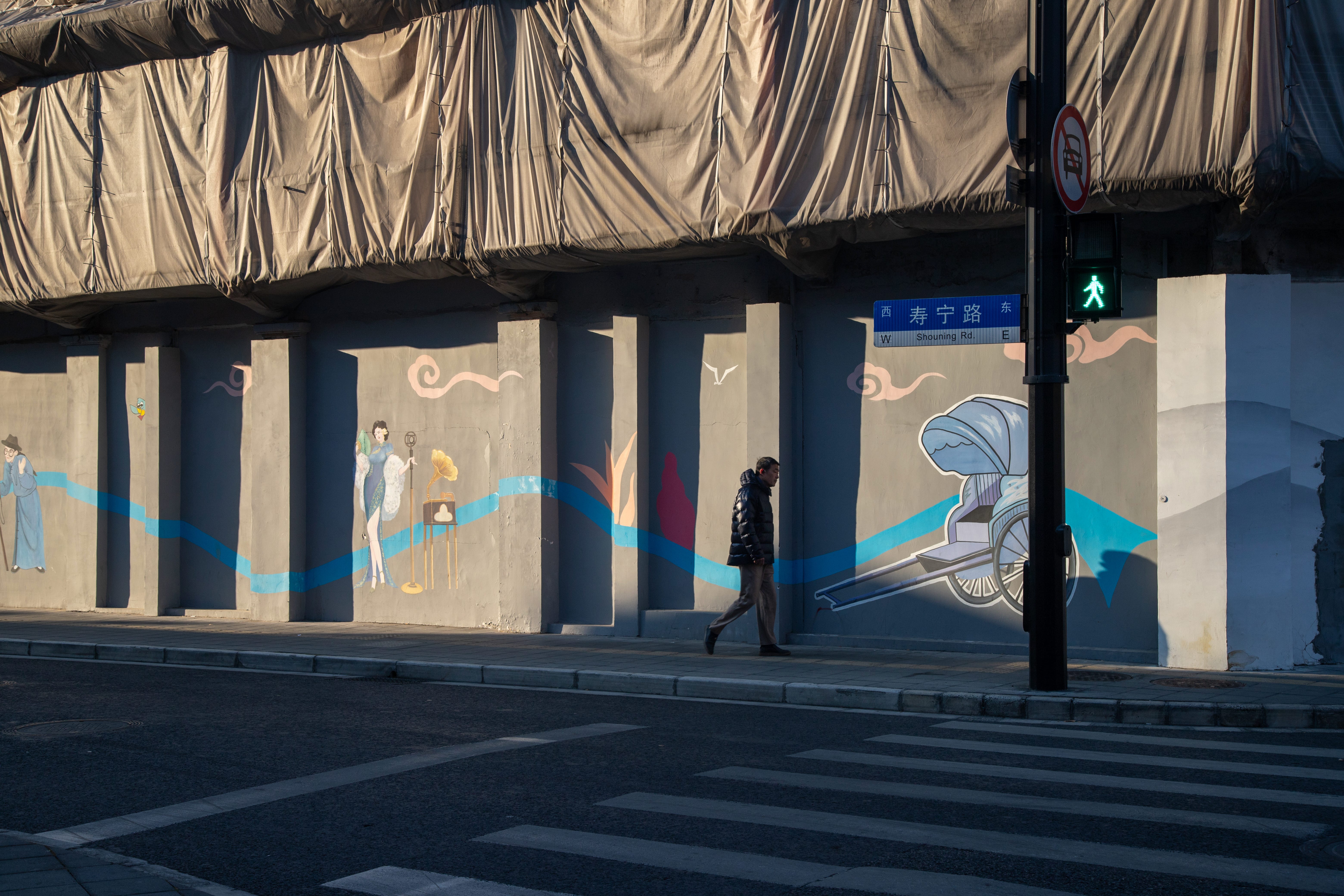
I kept walking. The zone did not end. Block after block, the pattern repeated, and as I moved east, it intensified. Past the sealed shikumen, I came into areas where the next phase was underway. Gray-brick buildings designed to mimic the architecture they had replaced, except without trees, or any of the things that had made the originals worth noticing.
Beyond that, closer to Yuyuan, the buildings stopped altogether. Construction walls lined the roads. The old neighborhood had been demolished entirely, and nothing had gone up in its place. The land was bare. Then, at the edge of this cleared zone, a development backed by the Fosun group — a self-described “modern folklore experience hub” — announced in signage that it would be emblematic of seven hundred years of Shanghai culture. Seven hundred years of culture on land that had been razed within the last five.


Then I came onto Fang Bang Road.
The entire street was white. Both sides, every building, every ground-floor shopfront sealed with roller shutters or cinderblock, every surface painted in the same flat cream, except that here there were no murals. The decoration had run out. What was left was the street itself and a few of us who looked like we had wandered onto a film set after the crew had gone home. On a pole at the corner, surveillance cameras pointed down the empty street.


I had spent a day falling back in love with a city, and I had arrived at this. I walked out of the sealed blocks not entirely sure where I was and came onto the Bund, twenty kilometers from where I had started, and the Pudong skyline was standing there in its late afternoon gold, the way it always has. I had crossed through the center of the city, and the center of the city had seemingly been completely emptied, sealed, and held, and I had no idea what to do with that. I had to meet friends for dinner in an hour.
I took the metro out to meet my oldest friends in the city, a couple I have known since I first moved here. They had moved further out, to a new development, a ground-floor apartment with outdoor space. I was ushered back to a private room, and we sat and ate and caught up on six years. When I asked about the 2022 lockdown, they said they had been thankful to have moved when they did — the ground floor and the room to breathe. They understood how bad it had been for others, they said, but I know they take the long view, and the long view meant not getting stuck on those weeks. What stuck was everything that came after. The lockdown had accelerated the city into full digital life. If you needed a pair of chopsticks, my friend said, they said you could probably have them within the hour. I asked whether the lockdown had changed other things too — the crosswalks, the order I had noticed everywhere. They thought it had, though they could not say exactly how. When I showed them the photographs of the cream-painted buildings in the old city, they did not know what they were looking at. We said goodbye with my promise that I would not let it be anything close to six years again, and I rode the metro back, searching for whatever I could find about what I had walked through earlier that day.
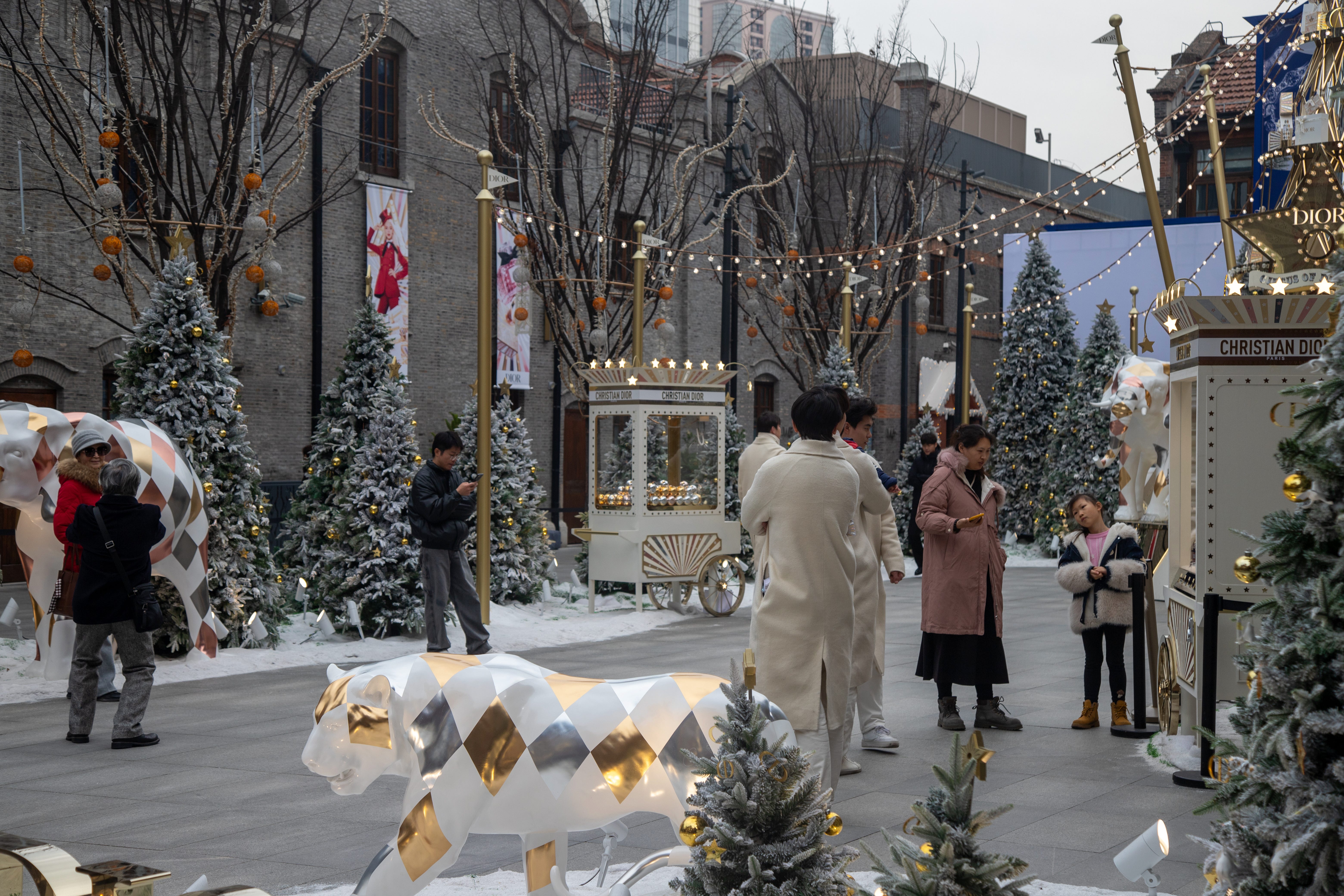
The next morning, I walked through a different part of the city and found the other version of how the old housing ends. Near the Nanjing West Road metro station, a development had taken a set of shikumen buildings and rebuilt them entirely as a high-end commercial district. This was not the cream-paint limbo but the finished product. The buildings had been lived in until the end, then cleared, then replaced with architecture that looked almost identical to what it had replaced. It was handsome and complete and empty in a way that was different from the emptiness of the sealed lanes to the southeast.
I walked through it. And then, at the southern edge of the development, I turned a corner and found Jing’an Villa.


I had been there before, years ago, and I had taken photographs. The neighborhood was still there. It abutted the new development on one side but had not been consumed by it. People were living in it, and laundry was still hanging on metal poles projecting from the buildings. I stood there for longer than I had stood anywhere else that morning. I thought about the two gregarious Shanghainese grannies I had met here, and I found myself wondering whether ten years on, they were still with us.
This block had survived by what looked to me like an accident of the boundary line or perhaps the strong coordination of the community, and the condition of it suggested the latter. The stonework was clean, and the spaces were swept. Whoever lived here had decided, individually or together, that the place was worth maintaining at a standard that made demolition harder to justify, and they had kept that standard for what appeared to be a long time. And so it continued, in January of 2026, to be a neighborhood, which is a thing that requires no permission to be, and which cannot be reinstated by any amount of money or heritage branding.
The next day, I finally got on a bike. Riding had been one of my favorite things to do in Shanghai. From my first apartment, I used to ride ten miles or more along the Huangpu River in the evenings, breathing air that the pollution index said I should not be breathing, and I did it anyway because the ride was worth it. The northern stretch of the east bank had been my favorite — a waterfront promenade where old shipping cranes stood illuminated against the sky and gravel barges slid past close enough that you could see the captain in the wheelhouse.
I rode south along the river, past the promenade, and full of melancholy. I knew this stretch would have changed, but much of the park was as I remembered it, with new office buildings and apartments now lining the opposite side of the road. Further south, past the park, the roads used to be desolate, and the land flat with gravel and weeds. I used to turn around by a cluster of informal businesses near the Longhua wharf. I did not need to arrive to know it was no longer there.


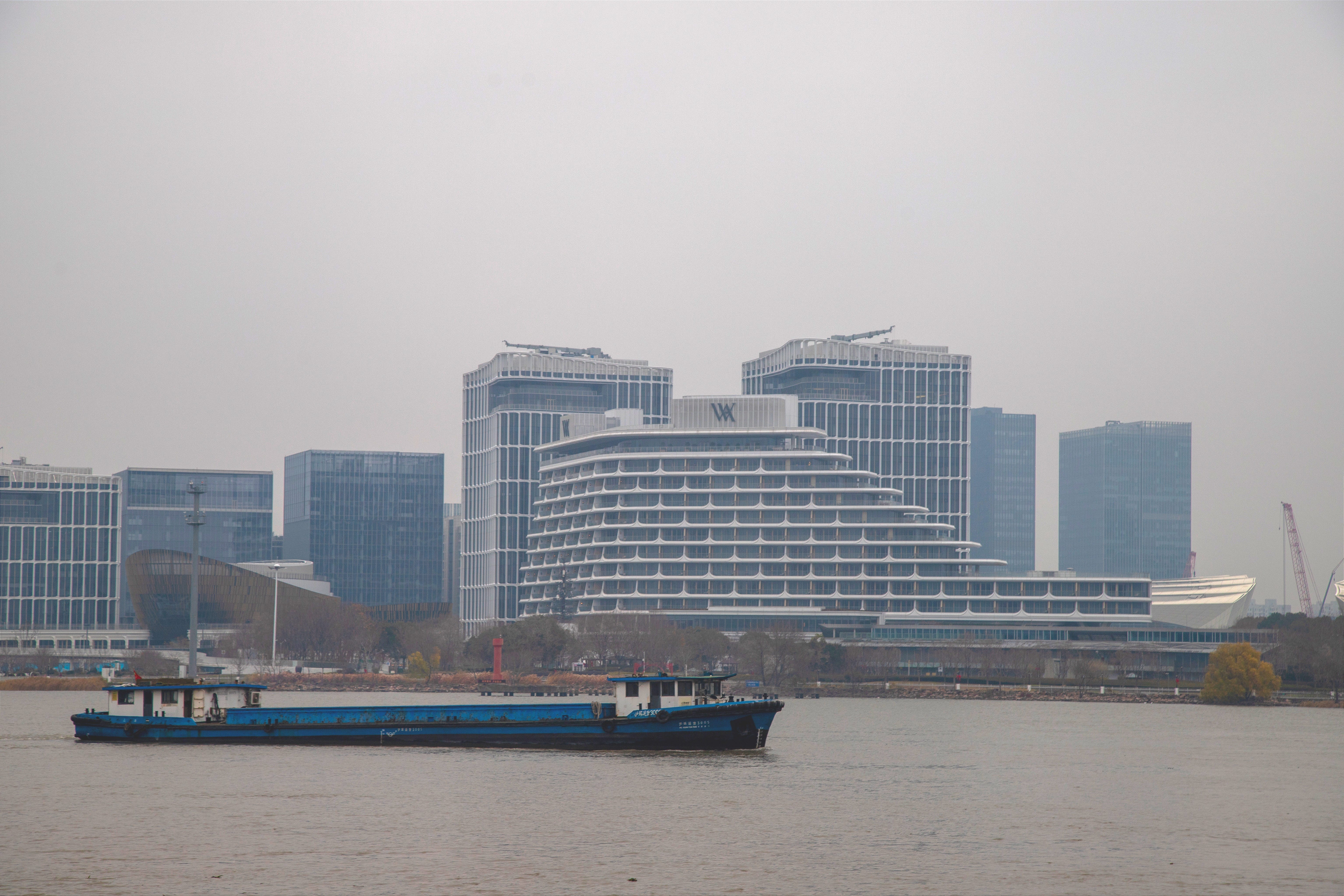
The West Bund AI district, built on the site of the former Longhua Airport4 — a stretch of riverfront that, when I left, had been coal wharves, a cement factory, fuel tanks, and an old aircraft hangar — was standing and occupied. I rode past a pair of towers that top out at two hundred and two hundred and thirty-five meters, completed at the end of 2021. I rode past the Shanghai Foundation Model Innovation Center, past offices for Microsoft, Huawei, and Alibaba, past other buildings whose tenants I could not identify and whose scale I could not process from the seat of a bike.
At the far end of the district, I passed a new cultural complex, Gate M West Bund Dream Center5, across the street from McDonald’s Hamburger University campus — the company’s management training facility for the Asia-Pacific region — and I stopped, parked my bike, and stood there laughing for about a minute. I had spent five years working inside the system that builds places like this and had sat in the meetings where parcels got assigned their futures. I knew the speed, in fact, the speed was the thing I had understood best about this city. And what was standing on either side of me was not something I had a response for.
This was not the cream-paint city six miles to the north. This was the other one. They were the same government, the same apparatus, the same five-year period. The difference was the money.
I stopped for a coffee at a shop in Gate M and paid with WeChat. From the terrace, I could see gravel barges moving south on the Huangpu, the same kind of barges I used to watch from the promenade, except that across the river from them now stood a Waldorf Astoria, miles from the Bund. The West Bund now has more than seven hundred AI companies in the Xuhui district alone, and is generating close to a hundred billion yuan in annual output6. Xi Jinping had visited the Shanghai Foundation Model Innovation Center here in April of 20257, which, in the context of Chinese politics, meant the district was no longer a local project but a national strategy.
For the years I worked in Shanghai, the line I heard from Western analysts and colleagues was that China’s growth was a real estate story. Property and its downstream industries accounted for more than a quarter of GDP8, and the assumption — stated or not — was that the whole thing was a construction bubble running on land sales and debt. It was partly true. The developers I sat across from were leveraged to the roof, and the land auction system that funded local governments was a machine that needed to keep selling parcels to keep running. But what I was standing in was not real estate. The towers around me housed AI labs and foundation model startups backed by a sixty-billion-yuan national fund and a twenty-two-and-a-half-billion-yuan municipal fund-of-funds.9 The government had not stopped building. It had stopped building one thing and started building another.
The shift was real, but it was not yet large enough to replace what it was meant to succeed. A Rhodium Group analysis published the week after I arrived in Shanghai found that from 2023 to 2025, new industries — AI, robotics, electric vehicles — had added less than one percentage point to China’s economic output, while real estate and other traditional sectors had declined by six10. The old engine had stalled, and the new one was running but was not yet producing comparable power. The sealed lanes to the north were the result of that gap — land cleared under the old model, by developers operating under the old logic, now held by government entities that could not auction the parcels at prices that justified what had been spent to clear them.
In August of 2020, Beijing introduced a set of borrowing constraints on property developers known as the three red lines11 — caps on debt-to-cash, debt-to-equity, and debt-to-asset ratios designed to bleed air out of a bubble the Party had decided was no longer sustainable. By the end of 2021, Evergrande had defaulted on its offshore bonds. It owed more than three hundred billion dollars. It was delisted from the Hong Kong Stock Exchange in August of 202512. Country Garden followed into default two years later. Over the four years since the three red lines, more than sixty Chinese developers have defaulted on offshore debt or entered restructuring. A recent Caixin Global report found that only fifty-three of the top one hundred developers from 2021 were still in the top one hundred by the end of 2025. The number generating annual sales above a hundred billion yuan had dropped from forty-one to ten13. In August of 2025, the Shanghai municipal government loosened home-buying restrictions for the outer districts14, a move that would have been unthinkable during the years I worked here, when the problem had been keeping people from buying more apartments than they were allowed.


What I had walked through on Fang Bang Road was what was visible of a stall that had multiple causes and no single owner. A February 2026 Atlantic Council analysis found that surviving state-backed developers were being kept afloat with favorable funding and privileged access to undeveloped land in the biggest cities15. But in the old city, the situation was more tangled than that framing suggests. Some parcels had already been sold to developers who could not build profitably — the Fuyu plot near Yuyuan, for instance, had been transferred to a Fosun-backed development company and rebranded as “豫外滩,” but on-site visits as recently as mid-2025 showed no signs of construction. Other parcels were held by government land reserve entities that had not yet auctioned them. The Huangpu district government had designated the Laoximen area as one of Shanghai’s earliest urban renewal units and had approved planning adjustments on paper — including residential towers up to a hundred and fifty meters — but none of it had been built.
The clearances themselves, however, had accelerated during the Zero-COVID period, when compensation settlements with shikumen residents were reportedly easier to reach — the appeal of more space meaning something else entirely to a family that had spent two months locked inside a twelve-square-meter room with a shared kitchen. Between 2020 and mid-2022, Shanghai completed the requisition of 185.7 square kilometers of old housing and relocated 92,000 households in the central districts alone, finishing the thirty-year campaign ahead of schedule16. The residents were moved. And then the property market collapsed, and the developers who were supposed to build the next phase could not make the numbers work, and the government entities holding the unsold parcels could not auction them at prices that justified what had been spent to clear them. So the land sat. The buildings were sealed, and the paint was applied.
A Shanghainese friend in the real estate industry met me for coffee in Jing’an. I asked her what she thought was happening in the old city. She thought about it for a moment. She said she was not sure anyone fully knew — that it was some combination of developers who were stuck and a government that was waiting, and that the waiting could last as long as the market needed it to last, which could be years. All she knew was that a significant part of the city’s fabric was already lost.
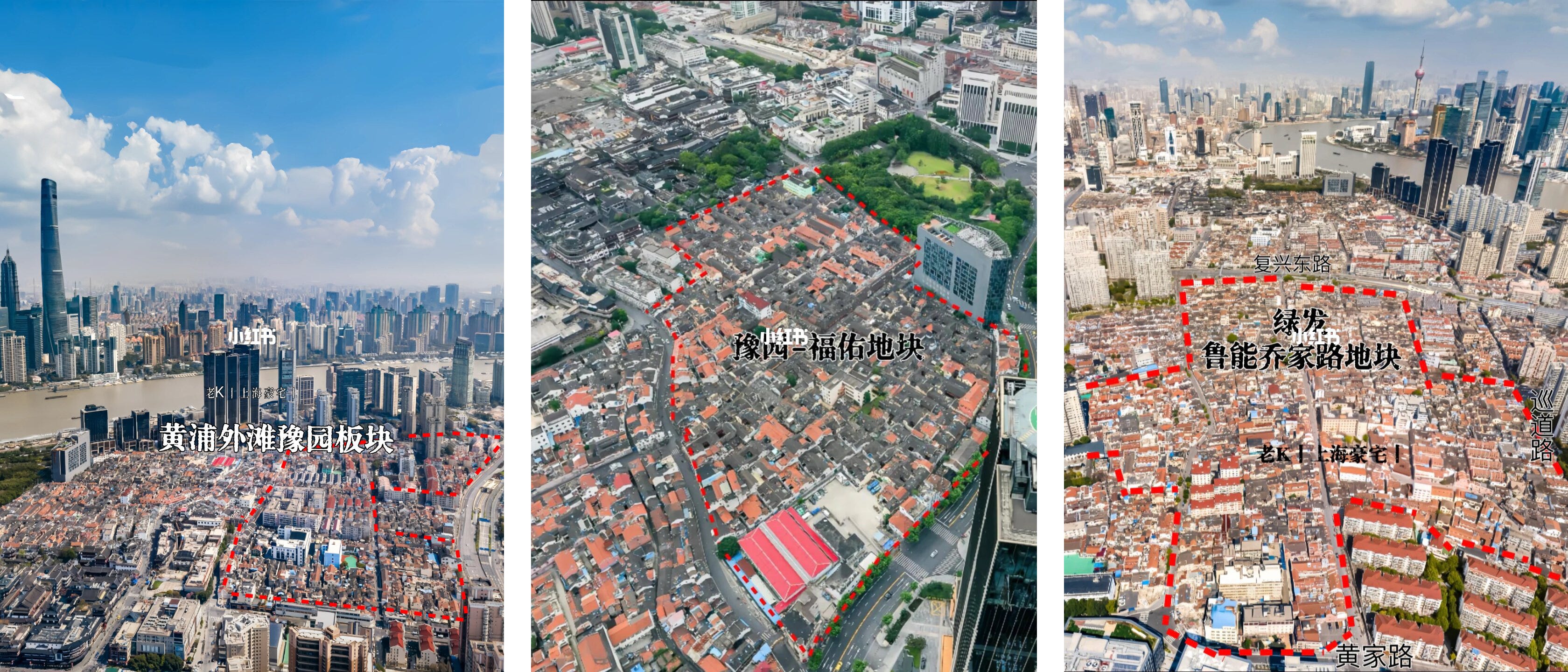
Most of the neighborhoods that were sealed and painted are old housing stock — much of it shikumen, though not all. The old city south of Renmin Road is older and denser, a mix of lane housing that predates the shikumen form. Shikumen — the name means "stone gate" — are a building type unique to Shanghai, developed in the 1860s as a hybrid of Western terrace-house construction and Chinese courtyard layout. They became the dominant residential form in the city for the better part of a century. At their peak in the 1930s, shikumen compounds housed roughly sixty percent of Shanghai’s population. More than seventy percent of them have been demolished since the 1990s.17
In the summer of 2019, on my last visit before the gap, I walked through Dongjiadu — a neighborhood just south of Laoximen, down by the river — and watched blocks coming apart. Oceanwide, the developer that held the site, had spent thirteen years completing resident relocations for the first phase alone, and the other phases were still unfinished. But the demolition that was underway was the old kind: loud, chaotic, and porous. Life was still happening around it. Holdouts were holding out, and people were still moving through and still calling it home.


What I walked through in January was not that. The residents were gone. The compensation had been settled during the lockdown years, when the conditions for settling were different from those they had ever been or are likely to be again. What remained was silence, and buildings standing empty above their sealed doors, and no pressure on anyone to say when the next phase would come.
For five years, I helped make these projects possible in cities like Wuhan, Chengdu, and Zhengzhou. The people in those districts were not my neighbors. The lanes we proposed to clear were not lanes I had ever walked down to buy breakfast. I did not think about what happened after the plans were approved, because what happened after was not my department, and because the places were not mine. Walking through the sealed blocks east of Dongtai Road, I understood that it had mattered all along. I had only noticed because this time it was somewhere I loved. And so I started paying attention to the part I had never looked at and what happened to the people who left.
In the early decades of clearance, the government called the process 拆迁 — demolish and relocate — and the term carried the blunt honesty of its two characters. By the 2010s, the official vocabulary had moved to 征收, requisition, a word that reframes the relationship between state and resident: the state is not displacing you, it is collecting what it needs. The compensation formulas changed alongside the language. The old method had calculated payouts partly by counting the number of people in a household — 数人头, “counting heads.” The newer method counted square meters — 数砖头, “counting bricks.” The shift sounds technical, but what it meant in practice was that a family of six in a twelve-square-meter room, who under the old formula might have received compensation reflecting six people’s worth of need, now received compensation reflecting twelve square meters’ worth of value. In a city where shikumen rooms averaged around that size and the families inside them did not, this was a losing proposition.
The families who left those twelve-square-meter rooms were not, in most cases, fighting to stay in twelve-square-meter rooms. The new apartments were larger, and the kitchens were private. The offer of more space was real, and for many of the people who took it, the deal was better than what they had. I knew this. The question I kept returning to was not whether the people were better off. Many of them were. The question was what a city becomes when it clears the only kind of housing it cannot build again, to make way for something it has not yet started, while six miles to the south, the government is building a hundred-billion-yuan AI district. The future has not abandoned Shanghai; it has moved to a different part of the riverbank.
On my last morning, I went out for baozi from the vendor three blocks from my old apartment, the same stall that had been there for all the years I lived in Shanghai and apparently all the years after. I paid with WeChat instead of the coins I used to fish out of my pocket. I took the metro to Hongqiao and boarded a flight.
The city was still itself and was also, in ways that were still being decided, not what it had been. The West Bund was generating its hundred billion yuan. The coffee shops were open and were very good. The creek was clean, and the cameras were on, and the signs in Jing’an were asking, politely, that you engage in courteous traffic behavior.
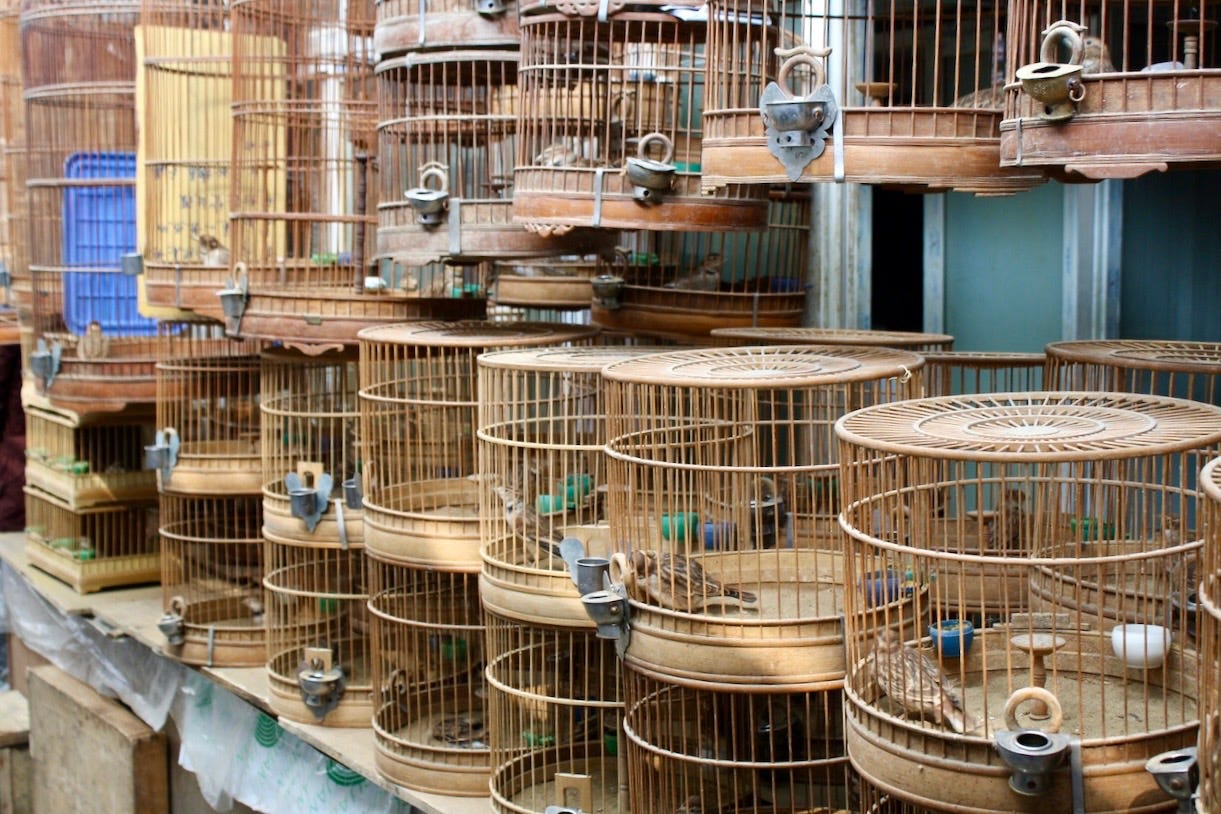
When I first moved to Shanghai, my apartment was near Fuxing Park, and on mornings when I jogged through it, I would see the bird men arriving. They came with bamboo cages covered in cloth — brown cloth, blue cloth, whatever they had — and they swung the cages like pendulums as they walked, which I later learned forced the birds to grip their perches and kept the feathers tight. The cages stayed covered for the walk and were only uncovered in the park, where the men hung them from the low branches, close enough that the birds could hear one another. The birds started singing. The men sat on stools below and talked or played cards while the birds competed overhead. A bird kept under cloth does not sing.
The Bird and Flower Market on South Xizang Road was where many of those birds were bought. Now, in that area, above the sealed doors, brown fabric has been draped over the upper stories, covering the windows and the balconies and whatever remains of the rooms behind them.
In the weeks after I left, I kept coming back to what I had walked through in Laoximen and Yuyuan. In Fuxing Park, the cloth came off. On South Xizang Road, the cloth is not coming off. The buildings are standing behind it in the same condition they were in when the last families left during the lockdown years, and no one I spoke to could tell me when or whether they would be uncovered. The center of Shanghai is under cloth, and it is not singing. 🌆
If you’ve made it this far, I would love to recommend others whose work on China I greatly enjoy:
Lucy Hornby’s She said Xi Said
Tina Kanagaratnam’s Historic Shanghai
Olivia Plotnick’s who what wai
https://www.sixthtone.com/news/1010242
If you liked this, there’s more where it came from. Nothing to Declare opens a window somewhere new every week —travel essays, photography, cultural observations, and books worth reading. Once a week, sometimes more. Free to subscribe.
Is that Hamburger University open to the public? I still haven't been able to visit one yet.
This on-the-ground reporting in China is so precious. Thank you.