


You think green is green.
It’s one of the first truths you were handed. The kind of word you could point to as a toddler and win applause for. Grass is green. Honey is yellow. Those labels stick, and we carry them into adulthood, mistaking words for reality. Then one day you find out honey can be green.
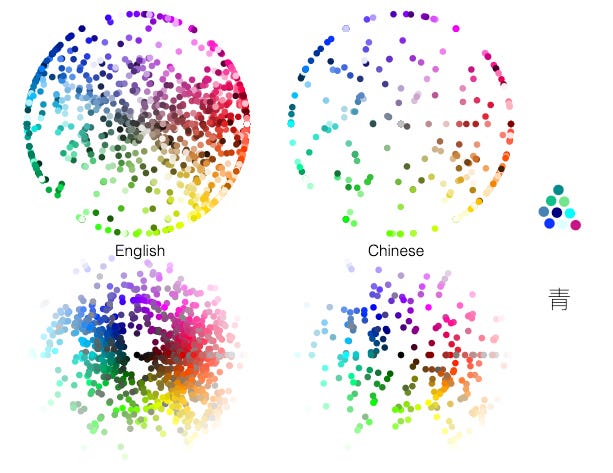
Back in 2013, Taiwanese researcher Muyueh Lee created a beautiful project comparing how English and Chinese divide the color spectrum. It was designed as an exploration in data visualization. However, the project showed me how narrow my own categories were. I opened it without much expectation.
In English, the chart looks predictable. But on the Chinese side, as you scroll down, a single word leaps out — qīng (青). Depending on context, qīng might mean green, or blue, or in older usage even black. In the visualization you see it move between categories that English treats as separate, and as you do ‘green honey’ stops sounding absurd.
That’s the moment you realize that language doesn’t describe reality but edits it.
Even after you close the browser, grass is still green and honey still yellow, but the confidence you once had in those labels is gone. I should have known earlier. Years before I ever saw that visualization, China had already shown me.
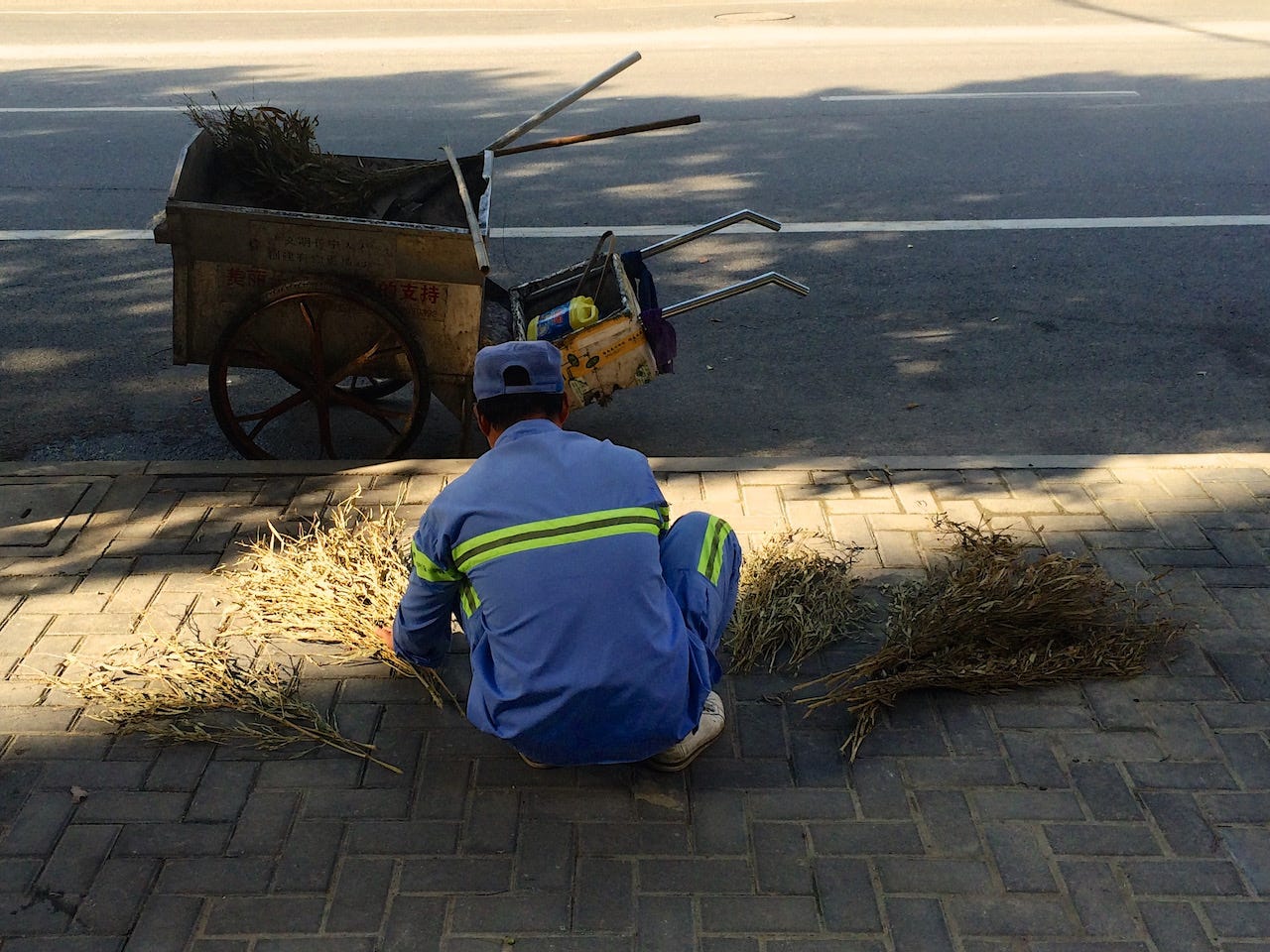
I was standing on a side street, watching a man build a broom during my lunch: tying together stalks of bamboo, knotting twine, and shaking out the bristles.
I’d been studying Chinese. It was a tough go, but I thought I was making progress. And then, staring at him, it hit me: he wasn’t thinking this in English. His thoughts weren’t passing through my structure at all.
It sounds obvious, and it should have been. But in that moment, it stopped me cold; it was like stepping off that curb and getting hit by a taxi.
That was the first time I think I understood that thought itself doesn’t translate.
A few years later, when I saw Green Honey, that street came rushing back.
Take food.
In English, “spicy” is just spicy, and that includes everything from jalapeños to wasabi to chili flakes. You can add qualifiers (“mildly,” “very”), but it’s still one blunt category.
In Sichuan, “spicy” divides into two feelings you can’t ignore once you taste them. Málà (麻辣): má for the numbing of the Sichuan peppercorn; là for the heat of chili. Together, they create a tingle you can’t register properly in English. Without the word, you don’t quite taste it. With it, your tongue learns to separate what used to be defined as one. A vocabulary gap like this isn’t just a missing label but a missing experience.
Or take color.
In English, “blue” is blue. However, in Russian, you’re forced to choose between goluboy (light blue) and siniy (dark blue). They’re treated as two separate basic colors similar to how English treats red and orange. In Namibia, the Himba people have dozens of terms for green but no single word for blue; as a result, they’ll instantly notice distinctions in foliage you and I can’t.
And then there are words you can’t drag into English at all.
Yuánfèn (缘分) is a Chinese concept that means two people are bound together by fate so strong that “an invisible thread has aligned their meeting.” In English, we flatten it into “luck” or “coincidence,” but that is doing it a disservice. Luck in this context is more akin to a shrug, while yuánfèn is more like a destiny.
The more I learned, the more obvious it became: English hadn’t prepared me for any of this and being mostly monolingual meant that I was missing out.
When we travel, we like to tell ourselves we’re neutral. We carry cameras and notebooks with our eyes wide open, convinced we’re capturing places as they are.
But that’s a myth.
We don’t arrive blank and are far from neutral. Our language has been shaping our attention since before we could speak in full sentences.
And here’s the uncomfortable truth: most travelers never notice. They believe they’re seeing the “real” city, the “authentic” culture, the “unfiltered” truth without realizing that every thought they have about it is already shaped by their own vocabulary and perspective.
The divide isn’t between people who speak a language and people who don’t. The divide is between those who realize they’re carrying a filter and those who don’t.
And that’s where travel actually matters, in brushing up against other ways of thinking and trying to get beyond your filter.
I never became fluent in Chinese. I still stumble through conversations and retreat into English far too often. What I got instead was knowing that my own language is not the full story, and that it never was the neutral thing I took it for.
You thought green was green. Honey can be green. ❎
Acknowledgment: My thanks to Muyueh Lee, whose original visualization first crossed my Google Reader feed over a decade ago and changed how I thought about language and my life abroad in China. I’m also grateful for his generosity in sharing the Internet Archive link that allowed me to revisit it while writing and share it here.
If you liked this, there’s more where it came from. Scott Monaco opens a window somewhere new every week —travel essays, photography, cultural observations, and books worth reading. Once a week, sometimes more. Free to subscribe.
When I first came to Germany, I couldn't speak any German at all. I learnt it by immersing myself in it, like music. After a while you hear notes you recognise, then melodies. Eventually you begin to understand a new perspective that is another language and to fall in love with it. Then you start dreaming in that language. Now, forty years later I think bilingually.
I have been learning Greek for some time now. It is hard because I am not with Greeks enough of the time to immerse myself. That will change in the coming years, now I am retired and can spend more time there. Greek gives us clues to how English was formed, as well as offering a more relaxed view of life, much older and wiser.
Thank you for writing this piece, it is so important for a fuller comprehension of humans and language.
This is wonderful!
As Lisa notes, there are so many thoughts in French that don't exist in English. My Nana used to rue that I didn't learn Italian dialect - apparently I missed out on a lot!
Living in New York I learned that the Yiddish schlepp isn't just walking - but it's the energy required to make it happen. Or Schmatta -- that raggedy thing that is cozy comfy -- but you wouldn't dare wear it in public.