


It had been about a month, but we weren’t counting. The whole world had stopped—or so it seemed. We read the news voraciously, keeping up with everything that was happening and eagerly awaiting the daily tweet from the Rwandan government, which provided updates on new cases, tests, and deaths.
We were fortunate. We had lost our jobs, yes—but not our home. It sat in Kigali’s Rugando neighborhood, perched on a hill like most places in Rwanda. Our yard opened up beneath us, a quiet refuge in the chaos. The flowers still bloomed. The birds, unbothered, went about their lives.
With the windows open day and night, our mornings were soundtracked by a pair of Robin Chats, using our balcony to project their calls at an unfathomable volume. A weaver landed near the stairwell, confused by its reflection in the mirrored glass. It pecked and postured, trying to communicate with itself, hoping to find its partner in the world.
The lockdown was strict. Soldiers and armed police patrolled the end of our street, stopping any car that even thought about leaving. We were allowed one weekly grocery run. That was it.
So we lived through the birds: Mousebirds surfing the wind atop our Traveler’s Palm; Fire Finches descending whenever I weeded the garden, taking easy pickings from the freshly disturbed soil. We came to know their rhythms. They arrived, chirping, at daybreak like clockwork.
One morning, though, was different.
“Ack-ack-adoo?” came a strange sound through the window.
“What was that?” my wife asked.
“I don’t know,” I said.
“It’s a rooster, I think.”
“A rooster? We can’t even leave the house except for groceries. How is someone getting a rooster?”
About fifteen minutes later, a muffled “Urr-uh-uh-dooo…” echoed up the hill.
“See? I told you,” she said. “Someone has gotten a rooster.”
I wasn’t convinced. I stepped onto the balcony and scanned the yards below. All was still—just a light wind. A mousebird perched on the palm turned its head toward me, as if to say, I’m with you on this one. Emboldened, I returned inside.
“No rooster,” I reported. “Go back to bed. I’m making coffee.”
Out on the veranda, I sat with my phone, reading about more cities locking down, freedom shrinking by the hour—when I was interrupted by a louder, more confident crow: “Kuh-ka-ree-DOO!”
Damn it. She was right. Of course, she was right.
She joined me outside, basking in her correctness. And the rooster, now emboldened, crowed again—this time fully and unapologetically:
“Cock-a-doodle-doo!”
“I thought they were only supposed to crow at daybreak,” I muttered. “It’s been light for two hours.”
“Not the brightest rooster, perhaps,” she said. She was right again.
Over the rest of the day, the rooster took over our lives. When the world paused, he hit full volume. He crowed at the wrong times. He crowed all the time.
“He’s got to go,” my wife said, mid-nap attempt. “This is unsustainable. You have to find out which house he’s coming from.”
I agreed and grabbed the safari binoculars.
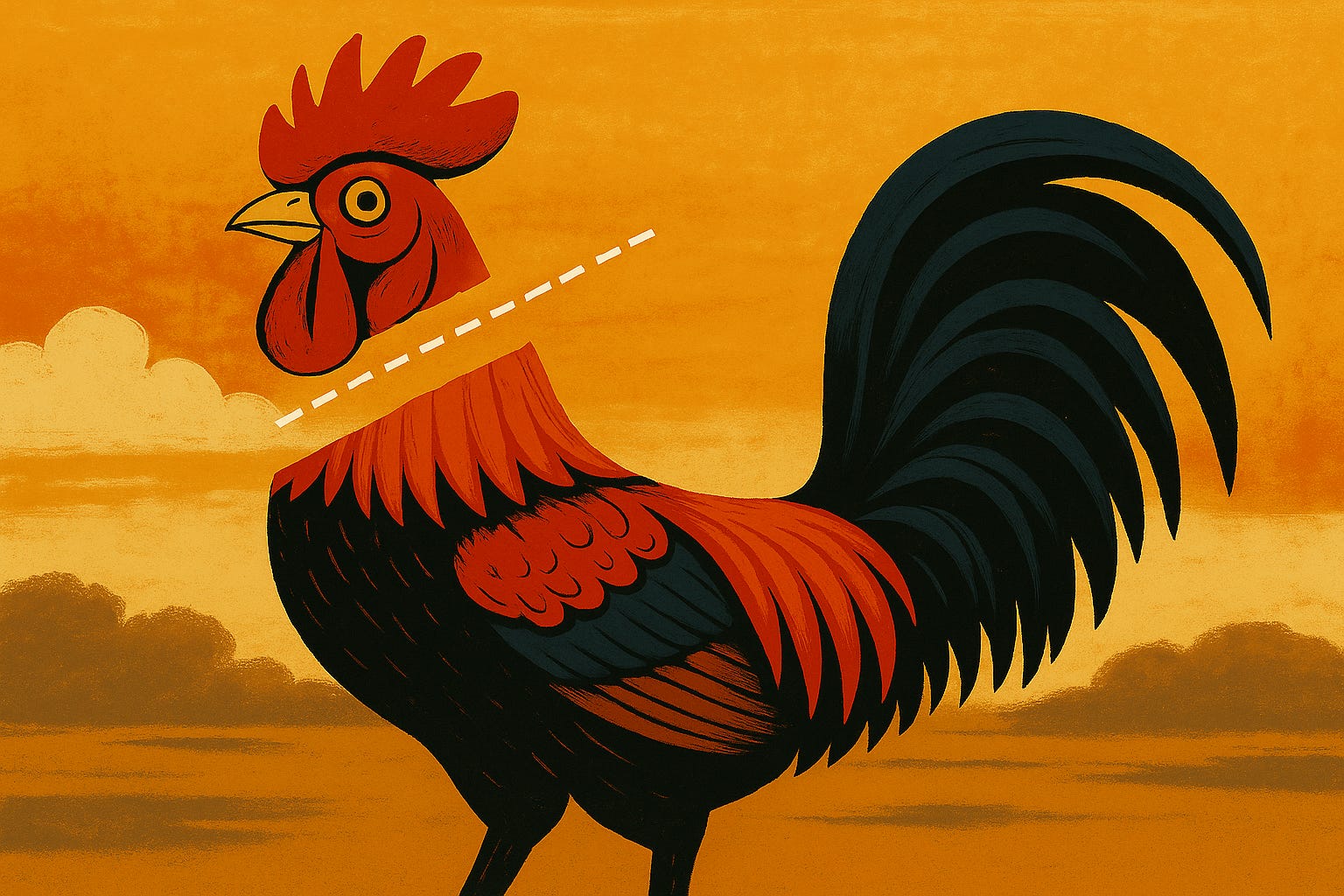
There he was—in the yard just to our right. Strutting. Peering. Pecking. Occasionally letting out a confused murmur: “Er-er-er…”
He wandered up the concrete steps, then back down under the tree, pecking aimlessly at the dirt. He stared up at the bright blue sky as if waiting for a signal.
“Why a rooster?” my wife asked. “Pandemic puppies, sure. Even cats. But a rooster? If they’d gotten a hen, at least it could lay eggs.”
“I don’t know,” I said. “But it needs to stop being so vocal.”
That night, the rooster kept talking to himself, possibly planning tomorrow.
I don’t know when I fell asleep. But I did.
The next morning, he woke us before the Robin Chats could.
“Today,” my wife said, “we need to do something about this rooster.”
“What is there to do?” I said. “Maybe he’ll just… fly away. Roosters can fly, right? It’s not a high wall. Maybe he’ll learn he can fly and just leave.”
By afternoon, with no great escape in sight, I messaged our landlord, asking if the neighbor might keep the bird in their front yard—just something to muffle him.
But truthfully, I’d started talking to him. The rooster. Our antagonist, sure, but also our comic relief. Maybe even our companion. He was, in a strange way, more alive than anything else around us.
Later that night, our landlord texted back.
“No problem with the rooster,” he wrote.
“Just spoke to the neighbor. It’s ok.”
Whatever that meant, my wife seemed satisfied. She fluffed her pillow and turned off the light.
Under the mosquito net, I dreamed of the rooster. He walked through empty streets in New York. He crossed Shibuya Crossing alone. He stood in Wembley Stadium, utterly still, waiting for something, anything, to begin.
He never broke eye contact—one eye locked on me, fixed and unblinking, as he moved through the emptiness.
He seemed to say, I can do this all if I wanted to. But you can’t.
I woke to his call.
“Cock-a-doodle-doo!”
I grabbed my phone and texted back:
“Sorry, just to clarify—what exactly did ‘it’s ok’ mean? He’s still crowing.”
I didn’t expect a reply anytime soon. Toronto is seven hours behind.
The rooster and I continued our morning conversation, until we didn’t.
“Hey,” I said later, “Have you noticed? It’s been quiet. Do you think they let him go?”
“Maybe,” my wife said. “Maybe they moved him to the front yard.”
“Well, I’m glad. I hope that’s all it was.”
Still, even without his voice, I couldn’t stop thinking about him.
“I’m going to the balcony to check,” I said.
“Why?” she asked. “He’s free now. You shouldn’t care anymore.”
I looked. No rooster. Just the neighbor’s house help, washing up in a bucket.
I sat quietly. The silence felt heavy. I thought about what it meant to be caged. About how much I had wanted him to go. About how badly I had wanted to go myself.
My phone buzzed.
It was the landlord.
“Rooster is dinner 😃”
I set the phone down. Slowly.
“RIP, Rooster,” I whispered.
He wasn’t just noise. He marked time. A creature moving while everything else stood still.
Annoying, yes—but unfiltered. Present. Alive.
Unapologetically himself.
We were trapped.
But the rooster?
He was free.
No rules. No curfews. No one watching. He had wings. He had a way out.
And still, he stayed.
Loudly. Absurdly. Stubbornly, he stayed.
He had freedom, but no idea what to do with it.
We had none, and yet we knew exactly where we’d go if we could.
I looked back toward the neighbor’s yard. The house help was still scrubbing. The water, I noticed now, was tinged faintly red.
As I stood up to go downstairs to tell my wife, I muttered under my breath.
“You could have flown. You really could have flown.”
Subscribe for more essays and unexpected dispatches from life abroad. As a vegetarian, I haven’t harmed a rooster in over 15 years—though this one may have already been on the menu.
If you’d prefer to support through photography, I also sell prints. And if you spot a photo in a story that you like and isn’t listed, just reach out. I’m happy to do special runs at no extra cost.
Poor guy. RIP rooster indeed