


We’d been outside the Marrakech airport for all of five minutes when our driver t-boned another van in the parking lot. My stomach winced.
We hadn’t even managed to get into the car. My wife and I were standing next to the van with our bags when he pulled forward without looking and drove the nose of his van straight into the side of another. The two men burst into shouting. Five minutes later, the other driver abandoned the argument and jogged off to fetch his guests.
You could imagine their faces when they wheeled their suitcases up to find the van they were meant to climb into still lodged in an accident.
It was not how I’d pictured the beginning of this trip. I had quit my job earlier that week, yet the three-month notice meant I’d still be logging in for a company I’d already begun to leave behind. What was meant to be a simple vacation had become a reset —a place to think about what came next. I wanted space to imagine building something of my own. It felt, for the first time in a long while, like the moment to try.
Instead, I was standing in a parking lot watching men argue in a language I didn’t understand, and an uneasy sense that the trip was already going sideways.
Our Airbnb host, Judith, had insisted on arranging the pickup.
“Taxis never know where to drop you outside the medina,” she’d written. “My driver will take care of you.”
Technically, he still hadn’t taken care of us. We had yet to set foot inside his vehicle.
Eventually, he called a friend, who arrived in a different vehicle and whisked us into town. The first driver stayed behind with the wreck and the unlucky couple. At least it would make for a good travel story. Just a hit to the side before we’d even started.
By the time we reached the medina, the discomfort in my stomach was still hanging on. I told myself it was nothing, probably last night’s dinner, too much spice, and too little sleep.
Judith was waiting at the medina entrance: a British artist in linen and a scarf, the kind of person who had come to Morocco once and never left.
“Sorry my driver got busy and couldn’t pick you up,” she said, lighting a Marlboro Red as we shook hands. “Did you wait long? At least he called his friend.”
I thought about explaining that he had, in fact, picked us up, in the sense that he had driven into another car on our behalf, but decided against it. We trailed her through a maze of alleys to her riad.
Inside the courtyard, the riad revealed itself: restored tiles, natural light, and a damp cool in stark contrast to the dusty heat outside. A lone parrot eyed us from its cage, bright and suspicious.
“They can eat meat, you know,” Judith said, nodding toward it.
“I hadn’t the slightest idea,” I said, as if this were something I wondered every day.
“There’s also a cat around here somewhere,” she added, exhaling smoke. “If you see her, her name’s Nigiri. She might not be around much, though. Last night, she left a mess of blood and guts all over the sitting room sofa. I couldn’t tell if she’d killed something or miscarried.”
She shrugged and turned. I looked at my wife.
“This is your room,” she said finally, stopping at a door on the ground floor. “There’s no handle, so just put the padlock on from the inside when you go to sleep. You’re welcome to use the courtyard and the roof. I’ve got a dog up there, a Husky. Don’t be alarmed if he barks when you come up. There are some birds and a turtle up there, too.”
We nodded, noting my lodging choice was looking more like a zoo.
“Oh, and my printer’s shot. I’ll need your passports later, once I sort it. Enjoy yourselves.”
Inside the room, the ceiling light glowed a dim, hospital-fluorescent white. I flicked the switch on and off a few times, as if more light might suddenly appear.
“It’s alright,” I said.
“If you say so,” my wife replied, already half-turned toward the courtyard.
“At least you sleep on the right side of the bed,” I said.
“Why does that matter?”
“Because of who’s on mine.”
A black cat was stretched across my pillows, eyes half-lidded, fur hopefully licked clean from whatever bloody incident had taken place the night before. As I approached, Nigiri lifted herself with the weary effort and brushed against my leg on her way out.
We dropped our bags and went out into the medina.
I’d wanted to come to Morocco for years. I’d read my way through its myths: Tangier in the days of Paul Bowles, cities full of writers and misfits, somewhere between Europe and Africa, tradition and invention. I imagined Marrakech as a place where I could wander and start sketching out what the next version of my life would look like now that I’d stepped away from a job that had been slowly grinding me down.
My last months at work had been a kind of low-level siege. My boss seemed to be yelling all the time. People quit. The ones who stayed were left juggling their work and whatever the latest crisis happened to be. When I finally gave my notice, I felt less triumphant than hollow.
Instead, the city came at me before I’d had time to breathe.
We spent our days dodging motorbikes and carts in the narrow alleys, pressed against walls while scooters screamed past, the smell of exhaust mixing with dust and spices. Shops spilled into the streets with lanterns, rugs, and home décor items that initially held interest but repeated the more you walked. From every doorway came the familiar sing-song pitches—Hello! You buy? Just look!—a relentless catcall aimed at our wallets. One morning, heading out before the shops opened, I watched workers unload cardboard boxes stamped with Chinese characters—Shenzhen Jinhui Trading Company, Guangzhou Minghua Gifts Limited.
We walked, we ate, we drank coffee, and we sat on rooftop terraces with lovely views. I kept telling myself to enjoy it, that the discomfort I was feeling was from the city, not my stomach.
By the fourth day, however, it was still bothering me. I’d been taking the over-the-counter pink tablets I always travel with, the kind meant to soothe everything, but they weren’t touching this. I kept waiting for any sign of improvement that never came.
The next morning, we were due to head into the Atlas Mountains for a hike, something I was starting to realize might be ridiculous with my nagging condition. I asked Judith which local medicines we should look for at a pharmacy.
“Oh, there are a few things that may help,” she said, rattling off names and gesturing with her cigarette.
“And bring your passports by later. I got a new printer and need to photocopy them for the records.”
That evening, after dinner, I took the passports to her. She rested her cigarette on the ashtray, inserted the first one, and held up a ballpoint pen from the table.
“This,” she said. “This is why my printer ‘broke.’ It was stuck in there. I only realized when I went to throw it away. I guess I have two printers now.”
The page slid out, my face in grayscale.
“Oh—one more thing,” she said. “A French film crew is filming here on Friday. They’ll be using the courtyard for lunch and makeup. They shoot a lot in Marrakech, you know.”
I nodded, unsure what to make of it.
The Atlas Mountains rose blue and white to the south, their snow-capped peaks hiding the Sahara on the far side. We’d wanted to get out of the city’s intensity, to feel wide space and cold air and, given the first few days, remember why we liked traveling in the first place.
We hiked along dusty tracks above small villages, past terraced fields and the occasional goat. The air was exactly what I’d been craving. My stomach eased a little, or maybe it was just the distraction.
Over lunch, looking at the mountains, we tried to make sense of Morocco.
“Do you think we expected too much?” I asked. “Did we read too many books about some other version of this place?”
“I don’t know,” my wife said. “But it’s both of us.”
I frowned. I had imagined a place buzzing with energy, but with quiet riads and rooftops to sit and think clearly about what came next. Instead, I was drinking extra water and carrying pills around.
“I think the fresh air is helping,” I said. “I just can’t shake this sickness.”
I tried to tell myself it was nothing, the way I always do. Whenever I get sick, I measure it against what my mother went through. But even that small trick wasn’t working anymore.
By the time we were driven back to Marrakech, the city’s noise felt harsher. We had only two days left. It didn’t seem like enough time to salvage the trip, but it felt like too much time to spend in my body.
“How are the mountains? How are you feeling?” Judith asked when we stepped into the riad.
“Great—and not great,” I said. “But it’s fine.”
That night, I tried to go to bed early, as though sleep could fix something that medicine hadn’t touched.
“You’re really hot,” my wife said, pressing her hand to my forehead. “Have you had a fever?”
“I don’t think so,” I said, and closed my eyes.
A few hours later, I woke up with a jolt.
I was drenched in sweat and shivering, my body confusing temperatures. When I tried to stand, the room blurred, and I nearly collapsed on the floor.
“Help me,” I called, voice unfamiliar even to me.
My wife got me to the bathroom, where I stayed for the rest of the night, hunched over, squatting, shaking. I told myself it was just a stomach bug and that if I could get it “out,” I’d be fine, but the pain in my side had sharpened to something that didn’t feel like food anymore.
“Do you want me to get Judith?” my wife asked. “Do we need to go to a hospital?”
“I don’t know,” I said. I thought about the hospital in Kigali a few years earlier, and how much that had scared my wife. We were living there at the time, and it was just food poisoning. But the casual way they handled my blood, and the string of small payments my wife had to make, one for the IV, another for the next bag, another just to keep the process going, had felt scarier than the illness. I thought about being cared for in a place that, to this point, had not given me a good impression. And then, selfishly, I thought about our flight home on Saturday—just over thirty hours away. If I could just get on that plane, I told myself, everything would be easier.
At some point in the morning, the courtyard outside our room filled with French voices. The film crew had arrived. While I continued to clutch the toilet, I could hear them setting up tables for their lunch, those rolling conversations that needed no translation. Two completely separate days were unfolding through a padlocked door.
My wife kept going in and out, getting water, bananas, new medicine to try, anything she thought might help. Every time the door opened, the courtyard noise rushed in. I tried to sleep.
“They’re still out there eating,” she said, closing the door behind her. “It’s already 4 o’clock. They might keep going all day.”
The hours blurred, and somewhere in that haze I felt my mother with me —she died of breast cancer when I was fifteen— and I could see her again in those last months, her quiet endurance, the way she held on.
By dawn, I knew this wasn’t going to pass. It wasn’t food poisoning; it didn’t behave like anything I recognized. I’d spent half the night checking symptoms on my phone, scrolling through worst-case scenarios, the way you’re not supposed to. Everything pointed to appendicitis.
When my wife began packing our bags the next morning, I finally said it out loud.
“I think I have appendicitis,” I told her.
“What do you mean, you think you have appendicitis?”
“I mean, I think that’s what this is. I looked it up. The symptoms match. I didn’t want to scare you last night, but I need you to know before we leave. If it is, it’s serious.”
She stared at me for a second, processing the gap between a “stomach bug” and where we were now.
“OK,” she said finally. “OK.”
When Judith walked us to the taxi, she helped us negotiate a fair price —100 dirhams— and told the driver in no uncertain terms where we were going. It was the last 100-diriham note we had on us.
At the airport, when we got out of the car, he demanded 150.
My wife, who almost never raises her voice, snapped.
“We agreed one hundred,” she shouted. “One hundred. That is what you’re getting!” throwing the bill on the trunk.
I leaned against the car, helpless. The anger in her voice was really about the night she’d just lived, the helplessness of watching someone you love come apart on a bathroom floor.
Inside the terminal, I drifted through security and passport control like a ghost. I’d managed a few bites of bread. My skin felt cold.
“You’re freezing,” my wife said. “Are you cold?”
“Yes,” I said. “I’m cold.”
On the plane, the pain in my abdomen left me hunched. I ate half a muffin and sipped water, and kept thinking two competing thoughts:
Please don’t let me die here.
And: You’re not going home. You’re going straight to the hospital.
Time becomes viscous when you need it to hurry. Five hours later, we landed in Copenhagen, cleared passport control, and took the train across the bridge to Malmö. It felt obscene to go home just long enough to shower, but I couldn’t face the hospital without it. I had no idea what I was in for.
We’d lived in Sweden for four years and had barely used the healthcare system. Walking into the emergency room at Skåne University Hospital felt like stepping into a process I knew existed but had never had to navigate.
At the front desk, a man looked up and asked what was wrong.
“I think it’s my appendix,” I said. It was the first time I’d said it to anyone other than my wife.
He nodded coolly. “Okay. Stomp your right foot for me.”
I lifted my leg and brought my heel down. A wall of pain shot through me so intensely I almost doubled over. He didn’t need me to say anything.
“Okay,” he said. “Have a seat.”
Five minutes later, I was in the back, peeing in a cup, being settled on a gurney. A nurse appeared at my side.
“Have you ever taken drugs?” she asked.
“What?”
“Sorry—painkillers. I’m going to get you morphine.”
“But no one’s even examined me yet.”
She shrugged. “There was blood in your urine. You need this.”
When the morphine hit, I realized just how much pain I’d been in all week, walking through souks and hiking in the Atlas with what I was learning was essentially a ticking bomb. A warmth spread through me.
Everyone asked the same question.
“And why did you wait to come in?”
“I was in Morocco,” I said.
“Ah,” they’d reply, as if that explained everything.
I was wheeled into a dark holding room where interns and nurses drifted in and out, taking blood, checking vitals, asking the same questions. My wife, I assumed, was somewhere in the waiting area and being updated. She wasn’t. Only when I asked about her did someone realize the woman sitting alone outside was connected to me. They brought her in close to one in the morning.
An intern explained the plan: they hoped to remove the appendix laparoscopically, two or three small incisions, and I’d be home in a day. My wife asked me to text when I was heading into surgery so she could come back.
Around three a.m., they wheeled me into a pre-op room. Morphine humming in my veins, I drifted in and out until a team of three nurses appeared. One of them, a man named Karim, banged my bed into the wall as they turned a corner.
“Sorry,” he muttered.
The fluorescent lights streaked overhead as we moved down the corridor. For the first time, I felt the cold, hard fact of what was about to happen.
The operating room was bright and freezing, a refrigerator full of people. A woman leaned over me.
“Have you ever had anesthesia before?” she asked.
I told her I hadn’t.
On the other side of the table stood a bald man with small, watchful eyes. He didn’t speak; he just kept his gaze fixed on me, steady and alert, as if he were monitoring something only he could see.
“Alright,” the woman said. “I’m going to put this over your mouth. Just breathe normally. Deep breaths. Think good thoughts. You don’t want to think of anything unpleasant here. You really don’t.”
I wanted to tell her that saying that was the fastest way to make someone think of nothing but unpleasant things, but she was already counting.
“One,” she said. “Breathe. Two. Breathe. Three…”
I was walking alone through a medina I didn’t recognize.
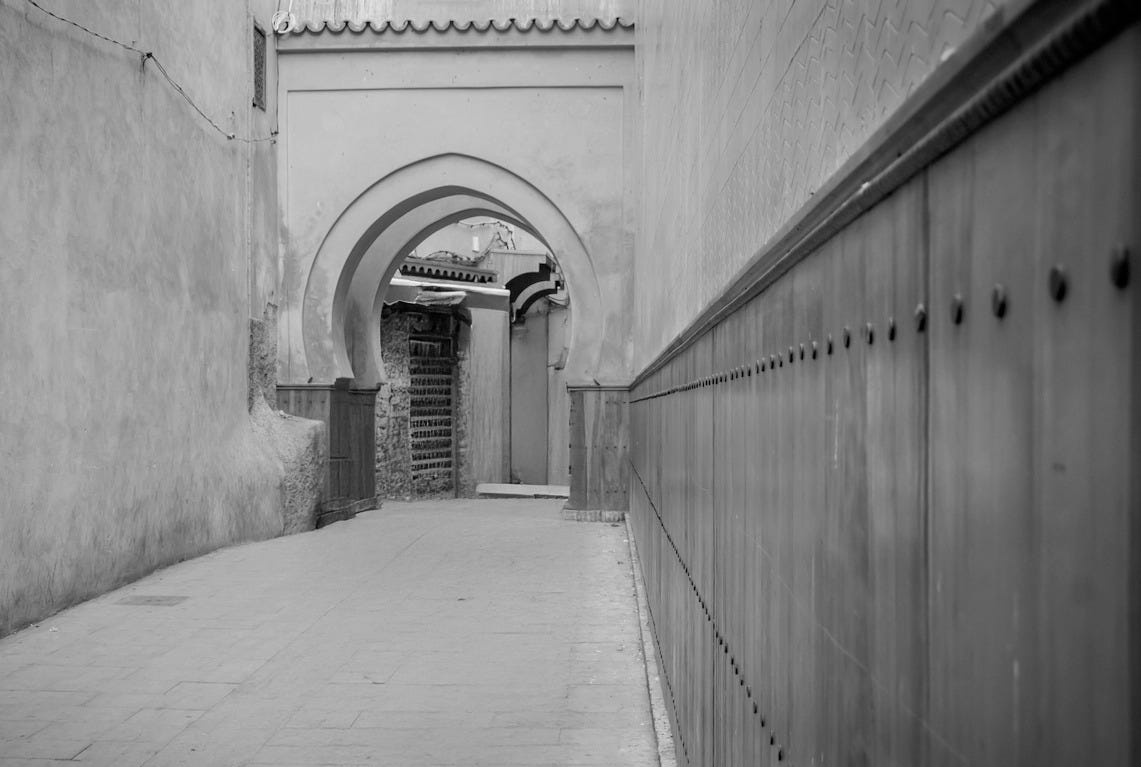
The alleys were narrow, the stone walls thick and gray —nothing like the warm, dusty umber of Marrakech. This place had no color at all. Every door was shut. Metal shutters hid whatever shops once lived there. It was cold in a way no real city ever is.
Above me, a hawk circled. I couldn’t hear its wings, only feel the air shift as it passed over. It moved with the patience of something that had been watching me for a very long time.
I took turn after turn, but every path ended in stone. The medina folded in on itself like a maze made of memory. I wasn’t afraid, exactly, but I had the sense that choosing wrong would matter.
I kept walking.
Somewhere in that gray tangle, I thought of my mother.
Something in the air told me she could be here, close enough to find, so I started searching.
I don’t know how long I wandered before I saw a bench outside a closed riad door. It felt familiar, though I’d never seen it. I sat and looked up. The hawk was still circling, drawing wide, deliberate loops above the empty streets.
When I turned my head, my wife was sitting beside me.
“What are you doing here?” I asked. “You’re not supposed to be here.”
“I know,” she said. “But you need help. You don’t have to go through this by yourself.”
We sat together in the cold.
“You were looking for your mom, weren’t you,” she said.
“Yes.”
“But you know you can’t find her now. Not here. Not like this.”
“I know,” I said. “But I want to. Even just for a little while.”
She stood and held out a hand.
“Come on. This way.”
We walked side by side down another alley. Slowly, the walls began to warm—from gray to rust, then rust to red, as if the stone itself were remembering color. The temperature rose with it. Ahead of us, a bab appeared.
“Here we are,” she said.
I turned toward her, but she was gone.
Only the open bab remained.
I stepped through it alone.
When I opened my eyes, I was in a room that was bathed in daylight.
The bald man with the small eyes — the anesthesiologist, I realized — came over and asked if I was in pain. I said I wasn’t. I asked if my wife was here. He looked confused and said he was sure I’d see her soon.
“Great,” I said. “When can I go home?”
I don’t remember what he said.
I was wheeled back to the same shared room I’d been in before surgery, near the end of the corridor, with a view of buses and cyclists moving through a sunny winter morning.
Not long after, a woman with shoulder-length gray hair and sharp glasses appeared at my bedside and started speaking rapid-fire Swedish.
“English, please,” I said. My brain wasn’t up to translation.
“Ah, yes,” she said, switching without hesitation.
She studied her clipboard.
“I see you have lived in Sweden four years,” she said. “You have no medical history here.”
“That’s right,” I said.
“OK,” she said, tapping her pen. “You had an appendectomy. You waited a long time to come in. They had to convert to open surgery, so you will stay a little. You need rest, and you are on OxyContin.”
I asked about my wife, and she looked puzzled.
“Your wife is not here,” she replied bluntly. “You will have some nurses by, and physical therapy will also stop by to get you out of bed.”
I thought back to the medina of gray and how she had disappeared. I closed my eyes to rest.
I woke to my wife squeezing my hand.
“I came as soon as I saw your text,” she said. “But they wouldn’t let me up. Visiting hours start at eleven, so I had to go all the way home and wait. And they said I can’t stay past seven tonight.”
“It’s okay,” I said. “I’m not going anywhere.”
I asked her for my phone — I needed to email work before the drugs took over. It was Sunday, and I had to let them know I wouldn’t be logging in on Monday. I typed a quick message: Emergency appendectomy. Will be out. Will update when I know more.
A little later, a nurse came by to check on me. She was already turning to leave when I asked if I could get a doctor’s note.
She stopped. “What do you mean, a doctor’s note?”
“For my job,” I said. “It’s an American company. They’ll need something showing I’m actually in the hospital.”
Her lips tightened in a brief, puzzled frown.
“Okay,” she said finally. “I’ll have the doctor write you a letter.”
We’d moved to Sweden for my wife’s job, and on my side, everything was by the book –taxes, residency, and healthcare. But I still worked for an American employer, and because they weren’t a Swedish company, they didn’t have to follow Swedish sick-pay laws. Their own policy offered no sick leave at all, so the last of my vacation days were disappearing into a hospital bed.
The first day blurred into a cycle of painkillers, brief visits from nurses, and the slow horror of realizing how little my body could do.
Lunch was announced, but we didn’t know that you had to go down the hall for it. There was no way I could move, so my wife brought something back. I managed a few spoonfuls of yogurt.
I tried sleeping, but the drugs made my thoughts stutter. My mind would fire the same fragment every few seconds, like a CD skipping, impossible to escape. I asked to be put on other drugs. They said they could switch me to a pill form, but I absolutely needed the painkillers. I didn’t know how right they were.
I had a catheter and a drainage bag that filled faster than anyone liked. When the physical therapists arrived, they announced cheerfully that they would help me walk. They rolled in a walker with padded armrests, expecting progress. Even getting out of bed was excruciating. I could barely stand before collapsing back onto the mattress, stunned by how far I was from the person who had hiked in the Atlas Mountains just days earlier.
My wife stayed by my side through the afternoon. At one point, I woke to find her quietly weeping, still holding my hand. I squeezed back, and the two of us cried together.
What would become clearer over the next few days, once we finally understood the medical terms and extrapolated on the natural brevity of Swedes, was just how close things had come. That awful night at Judith’s, the one with the fever, the vomiting, the pain so radiating out from my abdomen, was the moment the appendix had burst.
When that happens, the infection either spills freely through the abdomen or, if the body is lucky, it walls it off with a barricade of scar tissue and inflammation, trapping it in one place. Mine did that, forming a sealed-off abscess: contained, but full of infected fluid. When they operated two days later, they had to remove the appendix and open that abscess. The drainage bag afterward, the one filling faster than anyone liked, was the aftermath of all that.
It wasn’t the simple “appendix out, go home tomorrow” thing anyone had been hoping for.
When my doctor came by the next morning, she seemed optimistic but firm.
“PT noted you didn’t walk. You asked to be off the drip painkillers. All of these help you,” she said.
“I know,” I replied. “I just can’t.”
“Well, you’ll be out in a few days, so you need to make progress.”
A few days. But the pain, the swelling, and the steadily filling drainage bag all pointed elsewhere.
The next morning, with a bit of energy, I checked my email. My boss had replied to my message with a brief get well. A few messages down was one from my boss’s daughter, who didn’t even work at the company. Before the trip, my boss had me post the listing for my replacement on LinkedIn, where I was the admin. Now, from my hospital bed, barely thirty-six hours after surgery, she wanted me to forward all the applications that had been received as soon as possible, give her access to my email and accounts, and flag any other “urgent” messages.
I closed my phone and tried to sleep.
The nurses were the constant.
They moved through the ward with a kind of practiced urgency, answering alarms, calming someone’s rising panic, reappearing before I even realized I needed them. Karim, the same nurse who’d accidentally rammed my bed into the wall on the way to surgery, turned out to be one of the gentlest people I’d ever seen at work. I’d always respected nurses, but watching them here constantly on their feet, handling pressure, made me want to get better for them as much as for myself.
Four or five days in, a new problem emerged. I was eating small amounts, but nothing moved. The doctor explained that my intestines were likely stunned from the infection and the surgery. The gut has its own nervous system; when it experiences enough trauma, it simply shuts down.
“We can’t send you home until things start working,” she said.
On the sixth day, everything went the other way.
I was sitting in a chair when I suddenly vomited what felt like everything I’d eaten all year. The force of it ripped through my abdomen. I wanted to scream, but then Karim appeared, already pulling gloves on, already moving. He cleaned me, the chair, the floor, unhurried and unfazed. I don’t think I’ve ever felt more helpless or more cared for.
The next day, when the problem reappeared, they offered a failsafe. They threaded a tube down my throat in front of a small group of medical students. At that point, I didn’t care who watched. I just needed relief, some pressure lifted, some sign that this ordeal was going to end.
The tube didn’t stay in long. Nothing much came out, and it was impossible to sleep with it. I just prayed my body would remember how to work.
After a full week in the hospital, it was time to change the bandage. My wife was there when Karim came in. I still hadn’t looked at the wound.
“Do you mind if I look?” my wife asked.
I told her to go ahead and take a photo. I couldn’t stomach the idea of seeing the wound in real time, but some part of me knew I should see it eventually.
When Karim peeled the bandage back, my wife’s face went white. She didn’t say anything, but she didn’t have to.
After he left, she stared at the photo on her phone, zooming in and out.
“Do you want to know anything?” she asked.
“Just the basics,” I said. “Be brief.”
“Well, the surgeons did a good job,” she began. “It should heal well. But…it’s big.”
“How big?”
“Thirty staples,” she said. “It goes from your groin up past your belly button.”
I closed my eyes and let the information settle.
It struck me then how disproportionate it all was: this tiny, finger-sized organ, the afterthought of anatomy, and the long metal zipper that now ran down my body. Something small and ignored had been quietly festering for days until it demanded attention in the loudest possible way.
It didn’t feel that different from my life.
There was the job I’d been pretending to tolerate. The slow accumulation of things I hadn’t dealt with. The grief for my mother, twenty-four years old but still sharp enough to catch me off guard.
All of it had been sitting there, walled off and unattended.
Then my body broke its own seal, and everything I’d boxed away came spilling out at once.
On the eighth day, the doctor said she might discharge me. My drainage bag had finally slowed to a stop. I’d gone to the bathroom on my own. I’d walked loops up and down the corridor, my wife at my elbow, the physical therapists satisfied that I could move without falling apart.
“Maybe this evening,” the doctor said. “We’ll see.”
I called my wife and told her not to rush over as I might need some new clothes to wear home.
Around 6 p.m., without ceremony, I was cleared to leave. No dramatic forms, no billing conversation. A nurse handed my wife a sheet with the prescriptions they’d called in.
Standing up to put on my clothes, I realized my sneakers didn’t fit. My feet were too swollen. The elastic waistband of my sweatpants dug into my abdomen. I shuffled down the hallway, a man held together by staples.
Outside, my wife helped ease me into the back of the taxi as gently as she could. As the hospital receded, I felt the first flicker of relief.
Home was harder. Hospital beds are built for broken bodies: They rise and tilt and offer grab bars and buttons. Ours was low to the floor, and our Scandinavian sofa was even worse. The only place that didn’t hurt was one of the dining-room chairs –the same mid-century set my mother once sat at.
So that’s where I stayed: in that chair, moving as little as possible, watching the dim winter light change through the window and cataloguing the ways my body had become unfamiliar. Opening a cupboard hurt. Reaching for a book hurt. Standing in the shower hurt.
Under the hot water, I looked at my swollen, pale abdomen. I thought of my mother, how many times she’d stood under a shower after chemo, letting the water hit a body that no longer felt like hers. The memory arrived quietly, but with the force of everything I’d been avoiding.
I thought about my job, the one I was still technically employed at. I thought about the email from my boss’s daughter, and the polite bafflement of the Swedish doctor when I’d asked for proof I wasn’t faking this. I thought about that gray medina.
And for the first time, it felt like the rupture inside me wasn’t the only thing that had burst — the rest of my life, the parts I’d kept sealed off, had started leaking through too.
It was only once I was home that I told family. When I finally had the energy, I texted my father: that I’d had an emergency appendectomy, that I was recovering, that I’d call when I was stronger.
His reply came quickly. Brief, perfunctory. A bare acknowledgment with none of the small human phrases that usually accompany news like this. No how are you, no glad you’re okay, nothing. Just a message that landed with a soft thud and didn’t move.
I stared at it longer than it deserved.
I thought about reaching out to friends, but the idea felt stranger than it should have. Distance had reshaped things quietly. People I once assumed were permanent had become occasional names in my phone. Busy, full lives organized around milestones and rhythms I no longer shared. They all had kids now, whole worlds built around schools and weekends and group chats I’d never naturally belong to. Some part of me had walled off what that meant, the way the abscess had walled off infection, but sitting there in my apartment, it became clear what else had been quietly building pressure inside me.
I set my phone down. The noise I’d lived in for weeks, the nurses moving fast, the monitors beeping, even the distant sounds of the medina of Marrakech were gone. My wife was back at work. The apartment was quiet.
I closed my eyes and thought back to the gray medina. No matter how hard I focused, I couldn’t put myself there again. I opened my eyes.
My body was healing, slowly. The rest would take longer.
A month later, the hospital bill arrived: the ER visit, the emergency surgery, eight days in the hospital, the nursing care, the physical therapy, and the meals. The total came to the equivalent of about $112.
My vacation days, meanwhile, were gone. 🏥
A year later, I’m publishing this on the anniversary of the surgery, the scar now a pale railroad track from my navel to my groin. It’s changed as I’ve healed, but it hasn’t disappeared.
Since then, I’ve left the job completely. I’ve been trying to build the life I’d hoped to think about in Marrakech, one reader at a time. It isn’t guaranteed, but it feels more alive than anything I left behind.
If you passed me on the street now, you wouldn’t know any of this. Most of my friends still don’t. How do you even bring it up? We all carry scars that don’t show. One of mine healed because of the staff at Skåne University Hospital, and I am forever grateful to them.
The appendix is an afterthought, something that doesn’t serve a purpose. Mine nearly killed me. It also, in its brutal, indifferent way, forced me to think about my life in a way no quiet week in Morocco ever could.
Scott, I held my breath through this — the van, the riad, the gray medina, and then that pale railroad track down your abdomen. The way you braid the abscess with all the sealed-off parts of a life (the job, the grief, the distance with people) is devastating and so true; sometimes the “afterthought” is what finally forces everything into the light.
I love how much care and gratitude you give the nurses and the Swedish system, and how you let this be both a near-miss and a beginning. Grateful you’re still here to tell it — and to keep building that more alive life, one reader at a time.
💛 Kelly
This was so intense, even just to read. I knew from the start what was wrong. Not because I'm a doctor, but because I had appendicitis on the way home from a holiday in France when I was 10. I recognised the feeling of malaise as well as the sickness. I was much luckier than you because a policeman at a service station my mum asked for a doctor sent us straight to the hospital. They operated immediately. What a scary ordeal you had. Bless you.