


We had been living in Kigali for only a few months when our first long holiday weekend rolled around.
“Where do you want to go?” I asked my wife.
“What is there to do?” she said.
“We can go on safari.”
She tilted her head. “Sure, that sounds nice.”
I began researching how, exactly, one “goes on safari.” To my uneducated surprise, I learned you don’t need a tour operator at all.
“We can just drive our own car,” I told her. “It’s called a self-drive safari.”
“And that’s safe?”
“Perfectly safe. Provided we don’t take our current car, at least.” Our current car had a habit of breaking down after twenty minutes and came with a gas tank that leaked if filled beyond halfway. To ease her nerves, I promised to rent a 4x4.
“But what about the animals?”
“We won’t get out of the car, of course.”
“And where would we stay?”
I showed her photos of Akagera Game Lodge, its newly remodeled rooms glinting across my laptop screen.
“Okay, let’s do it.” A little luxury went a long way.
I sweetened the deal further: the park employed local guides in training who could join us in the car to help with spotting and navigation. We would get independence without being totally left to our own devices.
The night before departure, a rental company dropped off our 4x4. We walked around the vehicle with the agent, noting its condition.
“Any plans with the car?” he asked.
“Just heading out of Kigali, exploring a bit.”
“Alright. Just bring it back with three-sixteenths of a tank, like it is now.”
“Three-sixteenths. Got it.”
I hesitated. “Is it okay if I fill it all the way up before we go? Anything I need to know about the tank?”
He gave me a strange look, and for a moment, I worried this one had a hole in it too.
The next morning, we wound eastward out of Kigali, the road curling through green hills.
“What do you think we’ll see?” my wife asked, gazing out the window.
“I’m not sure. They have a lot of the Big Five, but we’ll have to see what shows up.”
“I hope we see an elephant. I would love to see an elephant.”
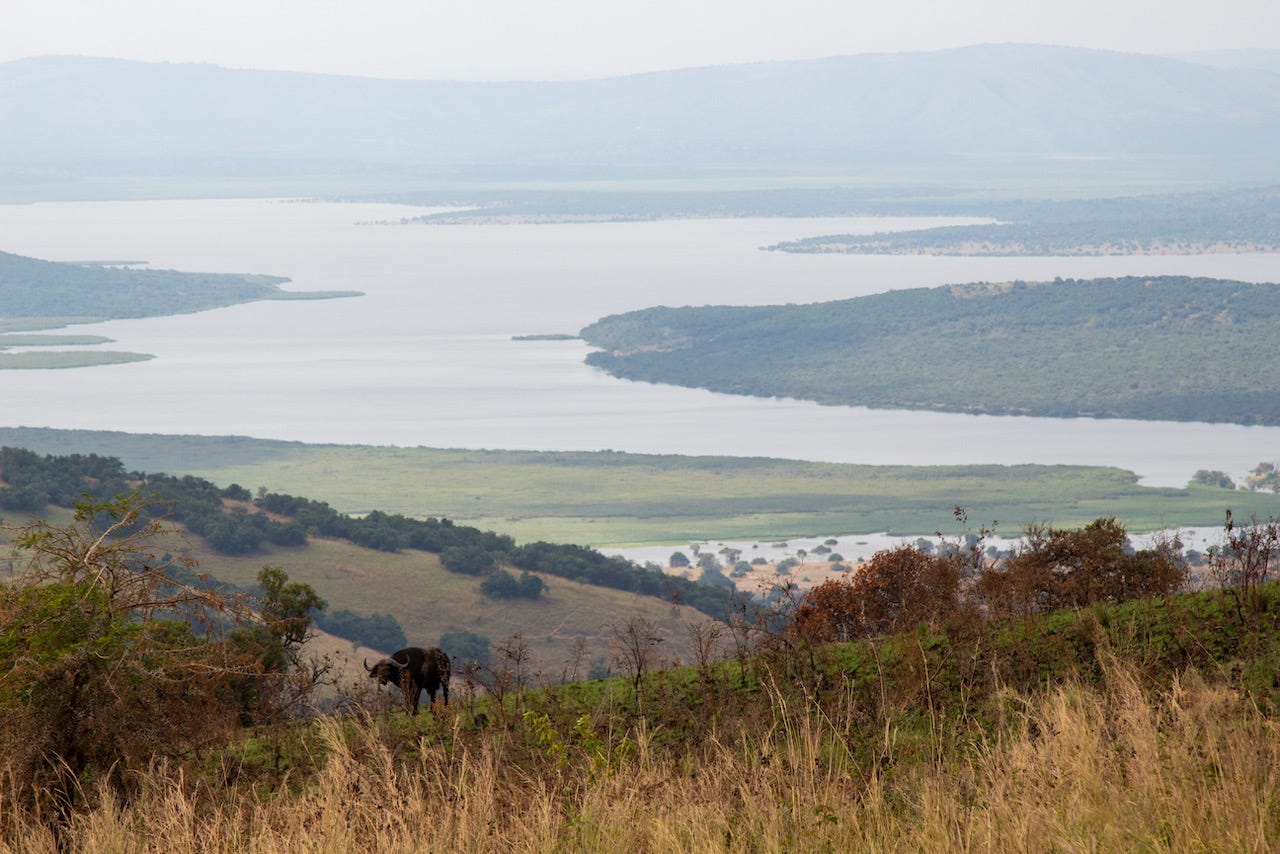
Akagera National Park spread out across Rwanda’s eastern border with Tanzania, more than 1,000 square kilometers of savannah, lakes, and hills. Once devastated by poaching and resettlement after the genocide, the park had been revitalized over the past two decades and was now home again to lions, rhinos, and thousands of other species. It is managed by African Parks and is one of Rwanda’s great conservation success stories.
Akagera’s revival under African Parks is among Rwanda’s most remarkable conservation achievements.
We reached the southern entrance, paid our fees, and received a briefing from the ranger.
“The roads are marked on this map. Please stay only on these roads. It is against the rules to be out after dusk unless you are on a sanctioned night safari. Be back to the lodge well in advance of sunset.”
I assured him we understood. We had a night safari booked that evening and a guide arranged to join us in the car the next morning.
That first afternoon, we checked into the lodge and got our first taste of the park. After dinner, we set out for the night safari. Almost immediately, we spotted a leopard slinking through the grass, then hippos and other nocturnal creatures. We went to bed buzzing for the next morning.
We woke just before daybreak, grabbed a samosa each for the car, and went to meet our guide.
Her name was Solange. She slid into the back seat of the 4x4 without much ceremony, and we set off.
“Turn around,” she said a few minutes later. “There’s a pride of lions that way.”
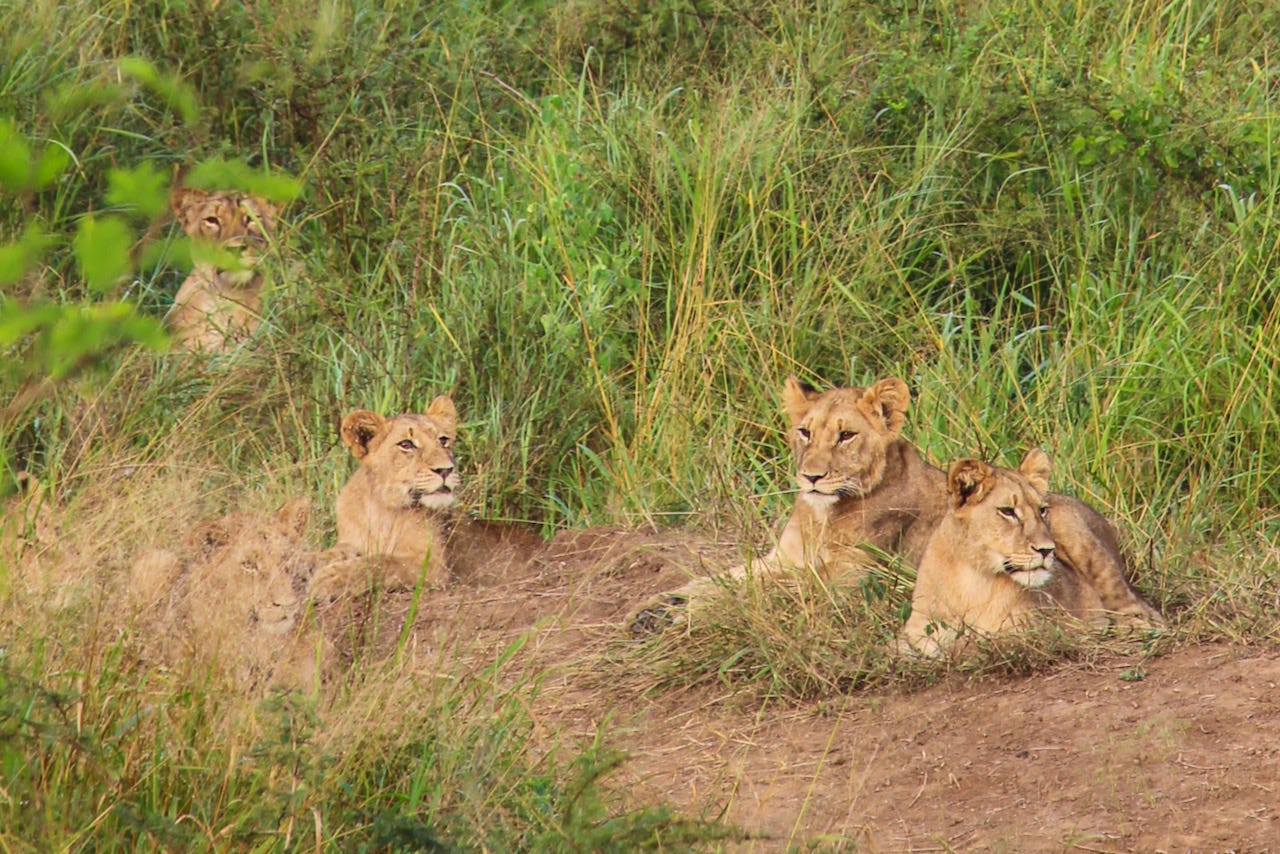
Sure enough, an hour later, we were sitting in the golden light of morning, watching lions stretch and doze in the tall grass. It was a perfect beginning —majestic, cinematic, exactly the kind of scene people imagine when they think “safari.”
From there, we ticked off more sightings: giraffes, zebras, antelopes. Solange’s WhatsApp kept her updated in seemingly real time, a far more efficient system than the chalkboard of chalk-dust notes I had admired at the ranger station.
She was sharp-eyed, too, though not one for indulging tourist enthusiasm.
“Wow, there are so many impalas,” my wife said.
“You’ll get sick of them,” Solange replied flatly. “They’re everywhere.”
Later, a bird darted in front of our car, tail flicking.
“Kind of cute,” I said. “What is it?”
“A francolin. It’s basically the chicken of Africa. Nothing special”
“Ah, but does it taste like chicken?” I said, trying to validate my find.
Solange didn’t miss a beat. “It’s meat.”
We carried on.
Despite the clipped responses, we were enjoying ourselves immensely. “This is the way to do it,” I told my wife. “Why cram into a safari truck when you can choose your own pace and stop when you want?”


By late morning, we had driven far north, away from the lodge. The sun had turned hot, the dirt tracks rougher. Solange, usually glued to her phone, suddenly told me to stop.
“Go back. Take that road,” she said, pointing out the window.
I looked where she pointed. A sign marked “29” stood in the grass, but the “road” was nothing more than two faint tracks threading through waist-high grass.
“Are you sure?” I asked.
“Yes. I think there are elephants there. Quickly!”
So I turned, hit the gas, and immediately regretted it.
A hundred meters in, the car dropped with a sickening thud. The undercarriage slammed to the ground, and the engine died.
“Fuck,” I muttered.
My wife’s face had gone white. I tried restarting—thankfully the engine caught—but reverse, forward, rocking the wheel… nothing worked.
Solange finally looked up from her phone. “It’s stuck.”
“I have to get out and check,” I said.
Solange finally looked up. “It’s not safe to get out here.”
But there was no other way. I opened the door and inspected the damage. My worst fear was confirmed: not a single wheel touched the ground. The car was hung up completely, like a beached whale, the tall grass pressing against the windows so we couldn’t see more than a meter out.
Back inside, my wife whispered about lions, snakes, and whatever else might be stalking the car. I instructed Solange to make a call for help.
We waited.
An hour later, another guide appeared. He got out of his vehicle, took one look at our situation, and declared, “You’re really stuck.” Then he left.
I turned to Solange. “That’s the help you called?”
She shrugged. “If we call the truck, you’ll have to pay.”
I tried to keep my voice calm. “Yes. That’s fine. Please call the truck.”
Another hour passed before a game-counting vehicle pulled up with three staff members. They arrived with no tools—just clipboards. After a short huddle, they delivered their verdict.
Solange nodded as if vindicated. “It’s stuck.”
At this point, it was clear Solange had no plan. I called the lodge directly, which finally connected us with a woman at the park’s main desk. For the first time, someone sounded like they grasped the seriousness of the situation. She was honest, too: the recovery truck would take at least two and a half hours to reach us.
So we waited again. The heat grew unbearable. If I turned off the engine for even five minutes, the car became an oven. We rationed the last of our water.
Four and a half hours after bottoming out, a proper recovery team finally arrived —a truck with twelve men carrying shovels, pickaxes, and axes.
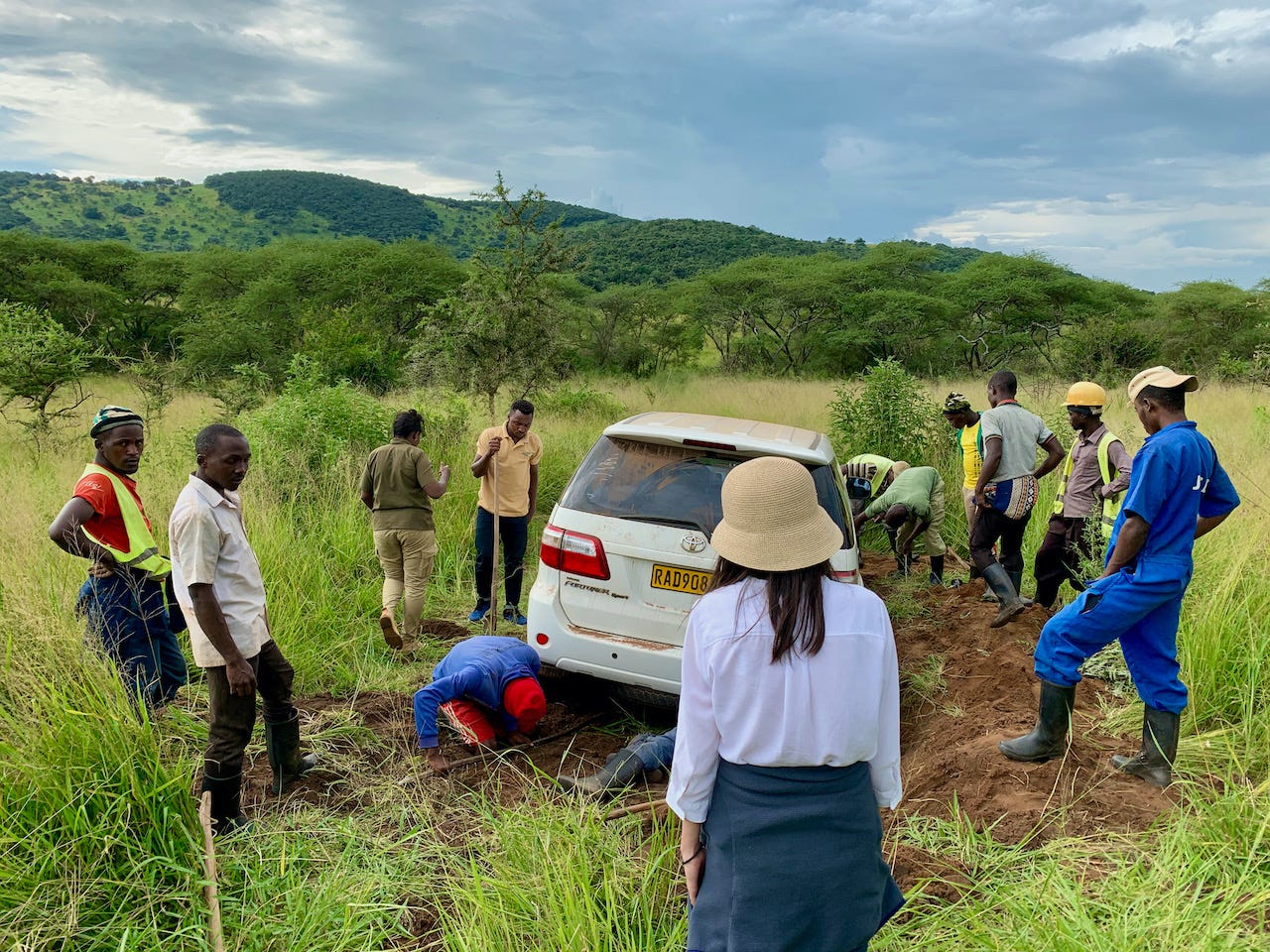
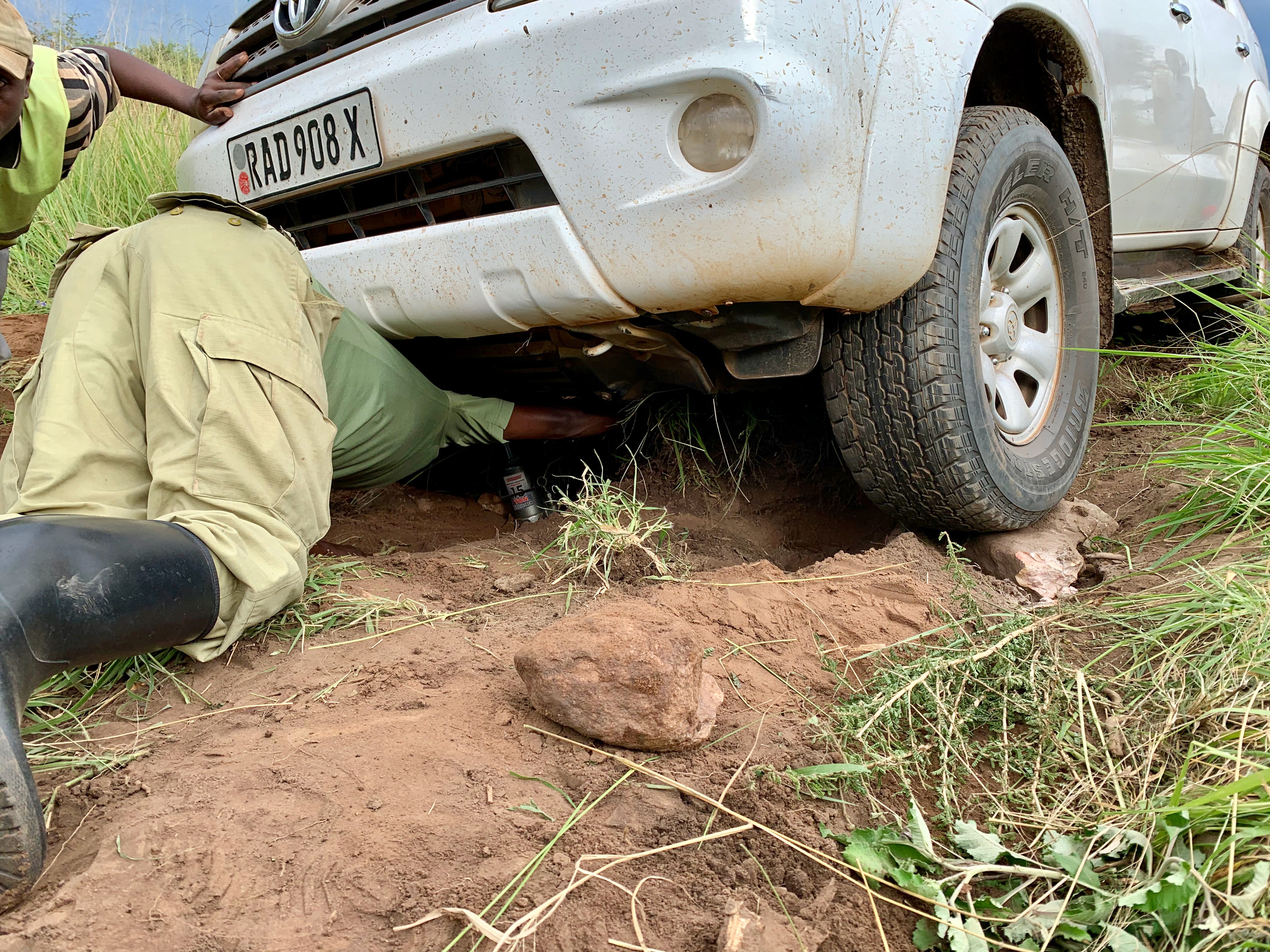
We got out of the car and stood in the grass while they went to work. Some went to cut down a nearby tree to use as a ramp or lever. Two men dug out the front, others the back. Soon, a couple of them slid underneath the suspended vehicle, hacking away at the soil by hand.
My wife looked at me. “The car is going to kill one of them.”
She wasn’t wrong. If they dug too much, or if the others removed too much soil, the whole thing could drop. I had visions of being responsible for crushing someone in the middle of a national park.
I stepped in. “You, dig here. You, stay clear until they’re out from under.” Somehow, through a mix of coordination and luck, the car was freed an hour later. I reversed gingerly back to the main road, the car was now filthy, and the undercarriage possibly damaged.
Solange climbed into the backseat without comment. My wife and I exchanged a look. We were twelve hours into the day, running on very little water and food, and a lot of adrenaline. Worse, the sun was already slipping down the sky. Sunset was thirty minutes away, and we were still three and a half hours from the lodge.
I gripped the wheel and drove as fast as I dared, bouncing over potholes in the lowlands. Birds startled from the grass. Francolins, those so-called “chickens of Africa,” no longer scurried politely across the road —they launched into panicked flight as we barreled through.
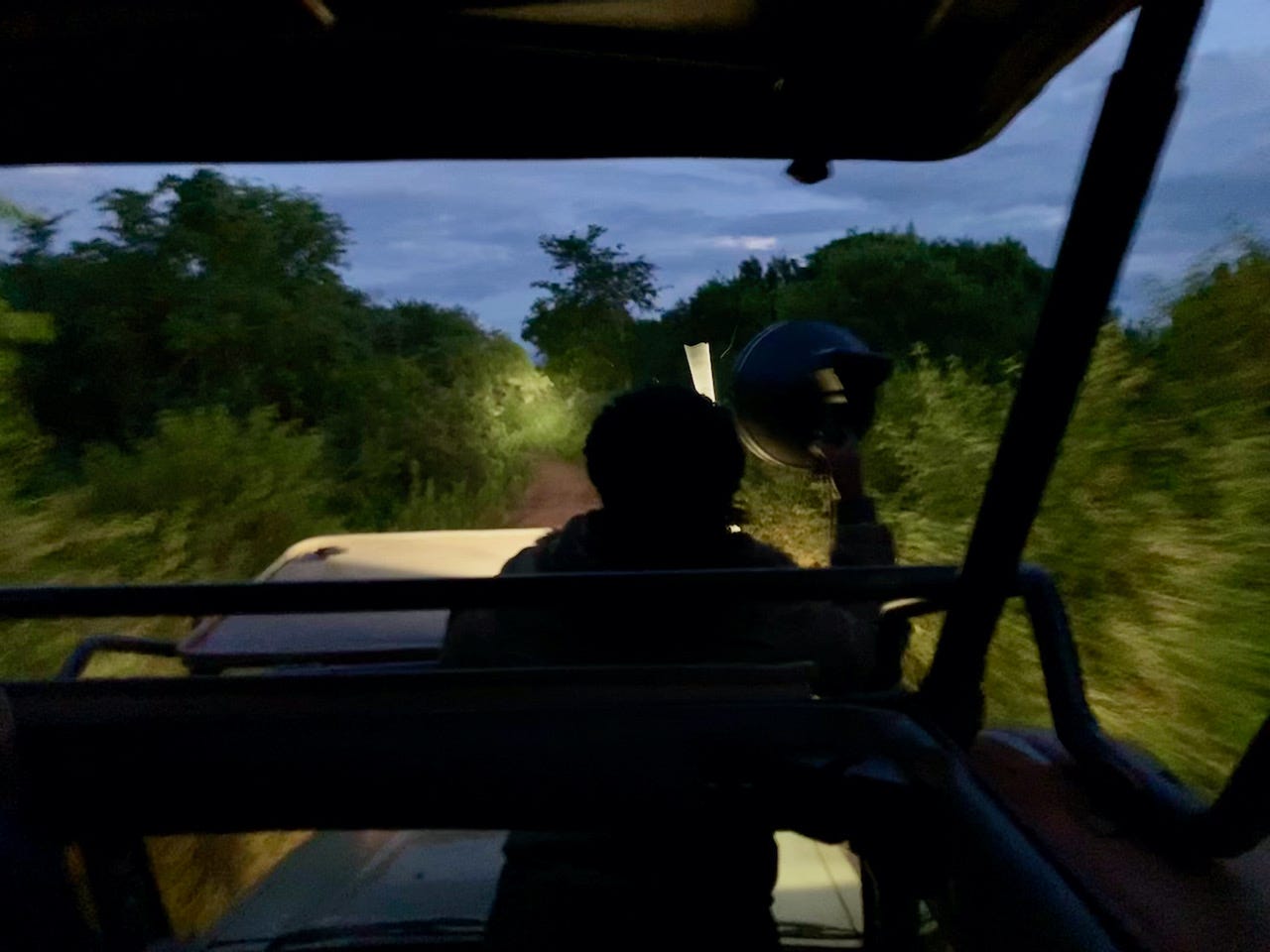
The park was darkening quickly. My headlights cut two narrow beams through the black, carving a path ahead. For a moment, it felt almost peaceful, broken only by the occasional flash of an owl gliding across the night.
Then the light changed.
As I rounded a corner, the beams diffused into a gray haze. At first, I thought it was fog. Then I realized the shape was solid.
“Solange, do you know where we are? This doesn’t look right—”
She looked up from her phone, froze, and then shouted: “GO! GO! GO! GO!”
I slammed the accelerator just as the haze turned. A massive bull elephant swung its tusks toward us. The car bucked over potholes, the wheel rattling in my hands.
From the back seat, Solange’s mantra began: “Oh my God, oh my God, oh my God.”
I kept my eyes forward, refusing to look left where the elephant must have been closing in. For all I knew, it was inches from my door.
Two hundred meters later, Solange screamed again. “Turn right!”
I yanked the wheel. The car skidded off the track and lurched to a stop.
“Are we clear?” I yelled.
“Yes, yes—go this way. Fifteen minutes back to the lodge.”
Those fifteen minutes felt like an eternity. We saw nothing—no owls, no antelopes, no glowing eyes from the bush. Just the steep road ascending through darkness until, finally, the lodge lights appeared.
We dropped Solange at the ranger station. She didn’t apologize or say goodbye. Instead, she reminded us, “Be sure to stop tomorrow and pay the seventy dollars since you got stuck.”
Since I got stuck.
Too exhausted to argue, we parked and rushed into the dining hall before service ended at nine. Tourists in clean clothes helped themselves to seconds of bread-and-butter pudding while my wife and I sat silent, covered in sweat and dust, looking like we had crawled out of a war zone.


The next morning, we did a final loop in the car, which now looked like it had been deployed to Fallujah. Despite everything, it was a joy. The wide savannah, giraffes striding through the grass, zebras flicking their tails.
By afternoon, we headed back to Kigali, stopping to have the car washed on the way. That night, the rental agent came to collect it.
“How was the car?” he asked.
“Oh, fine,” I said.
He peered at the fuel gauge. “I see it’s only at one-eighth. I gave it to you with three-sixteenths.”
“Close enough, right? Hard to get it exact. I did wash it for you, though.”
He nodded. “You’re right. It’s okay. Thanks, I appreciate it.”
We shook hands, and he disappeared into the night. 🐘
Postscript
Since that first safari, my wife and I have gone on countless others, many of them self-drives, and we cannot recommend the experience highly enough. A few hours stuck in the bush did nothing to change our minds.
Whenever possible, we hire local guides to join us for a day or two. It supports nearby villages and adds insight you’d never get on your own. Akagera itself is managed by African Parks, whose work across the continent has been transformative, and what they’ve achieved in Rwanda is remarkable.
This story is, admittedly, a travel disaster. But it should never dissuade you from going. People make mistakes. I have made many myself over the years. Self-drive safaris remain one of the most rewarding things you can do in travel, in my opinion.
And one final note: if you ever run into an elephant, especially a bull elephant at night, never do what we were told to do. The roar of an engine can be perceived as a threat or challenge, especially by a bull elephant, and may provoke a charge. The safest move is usually the opposite: stay calm, dim or switch off the headlights, stay quiet, and back away slowly if you can. I’m sure our guide was acting out of instinct, but it’s worth knowing the difference.
If you liked this, there's more where it came from. Nothing to Declare opens a window somewhere new every week —travel essays, photography, cultural observations, and books worth reading. Once a week, sometimes more. Free to subscribe.
If you’d prefer to support through photography, I also sell prints. And if you spot a photo in a story that you like and isn’t listed, just reach out. I’m happy to do special runs at no extra cost.
Wonderful story (and, although stressful, the perfect intro to a self drive in the bush).
Having grown up in South Africa, I have countless stories just like it. But that’s what makes it all so unique — anything could happen and there’s something special about having to be totally self reliant (which is not the case in other places in the world!).
Get to Botswana next if you can!
What a story! I had no idea you could do a self-drive safari, I've only done the safari tour kind. Your photos are amazing!