


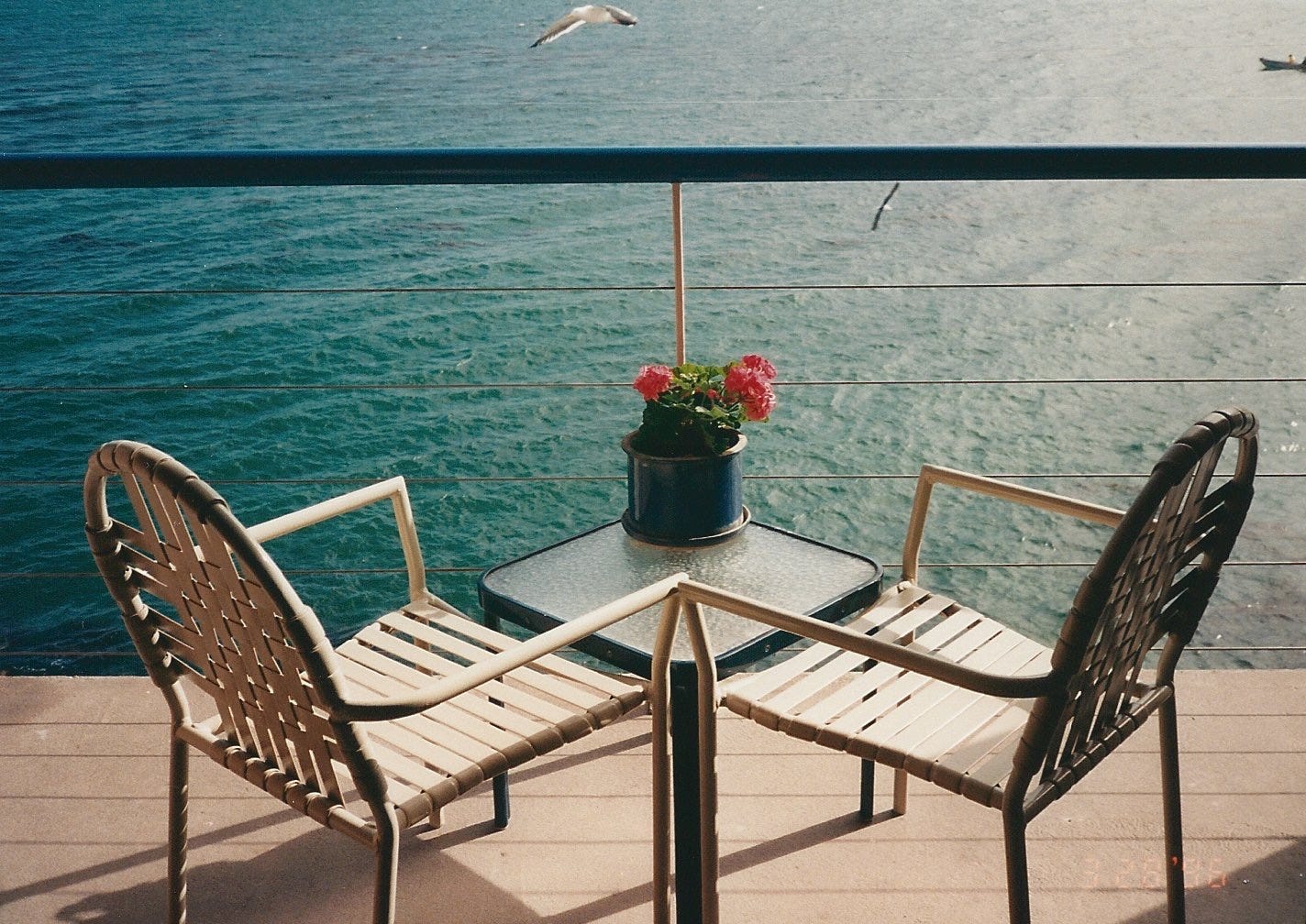
My mother died of breast cancer when I was fifteen. For the entirety of my childhood, she shot rolls of film and had them developed the way everyone did then. For the first few years, she put them into albums sorted by year, but then life kept happening, faster yet with the birth of my sister, so the envelopes stacked up quicker than she could sort them. When she started chemotherapy, she began bringing a duffle bag of them to her appointments. At first, she was still trying to build the albums. Later, as she lost the feeling and dexterity in her fingers, she wrote only the places and dates on the outside of the envelopes, so that somebody would know what was inside them.
About ten years later, before I moved overseas for work, I decided to scan everything. It took a long time, but I got them all done, and when I finished my family’s, I did my grandparents’ which also included anything that predated them, and then an aunt and uncle’s. I have never once regretted the hours spent hunched over a scanner archiving something like 40,000 photos. I can look at photographs of my mother whenever I want to. But it was a different time back then, and what I was scanning was the entire photographic output of several lifetimes.
A few weeks ago, I was in Hong Kong, and having a coffee in my hotel room while deciding whether to bring my camera out. Somewhere in the indecision, the question itself struck me as an interesting thing to ask other people, so I put it on Notes, closed my phone, and went out.
A lot of people replied.
I was surprised by how many said this is already how they travel, that they have done it for years and do not find it difficult. I trust people with their own answers, particularly because I have traveled with family and friends who might take at most a handful of photographs across an entire week and do not appear to have missed anything by it. However, this is not really a representative sample. These were people who chose to answer a question on a platform built on reading, which is close to the opposite of other platforms that fill your feed with vacation photographs. I also suspect that some people viewed this as a question with a right and a wrong answer. I don’t.
Around 1.95 trillion photographs will be taken this year, which comes out to about 5.3 billion a day.1 At the peak of film photography, the world managed an estimated 75 billion in a year. Borrowing from the language of climate overshoot, we pass the entire annual output of the peak of the film era now around the fourteenth of January, and that date arrives earlier every year. Who are these all for?
“Why if you are not going to post could you not take pictures or videos for your memories? I don’t have social media except this so I never post holidays. I still want to commemorate the trip. That said, not being able to would not change anything. I would still go.”
In my haste I had typed a question that was really two, and B. Scott Chapman is right; they are not the same thing at all.
A study by Diehl, Zauberman, and Barasch2 found that photographing an experience makes people enjoy it more, because hunting for the shot makes you look harder at what is in front of you. They also found that it has a limit. When the thing in front of you is already holding your attention, the benefit goes away (think concert pictures and videos).
The results get even worse once you add a future audience. Shooting with a plan to share raises self-presentational concern, and people photographing to ultimately share it somewhere else had a worse time than people photographing for themselves.3
I had ultimately decided to take the camera and walked the route I have walked many times before to the Foreign Correspondents’ Club, where I had work to do. On the way, I photographed some women cleaning produce in an alley and a few buildings I have more than likely shot before. There was nothing there I had not already seen.
I ate surrounded by framed photographs and articles, most of them somebody’s assignment from a decade or two ago. My camera was in the bag next to me. I opened the Substack app while waiting for the check, and the replies had come in faster than I expected.
I found myself nodding along and replying in agreement because every answer that came in sounded right to me.
“Some of the most blissful moments traveling were marveling at the beauty and wonder before me without interrupting or spoiling the moment to take a picture. I keep those moments in my memory bank years later.”
As many more like these came through, I thought of the handful of trips I took without a camera and how much I still can remember about them. Brad Yonaka had also done both but emphasized the impact of time.
“I would say it is both good and bad. Good in that I was more focused and free to enjoy what I was doing, and kept a better journal. Bad in that there is no visual left for me to refer to. Not a big deal at first, but as the years pass, those visual references get fuzzier.”
Which made me wonder what it is he wants back, and what I would want back after that amount of time had passed. Karl Plesz had already started doubting the pictures themselves.
“I’m at the point now where I look at past photos of vacations and think, “How is this any different from the thousands of other pictures someone took of this exact spot?”
I have taken plenty of those. Josh Murray put it more bluntly, asking whether the question meant going to Paris and not taking twenty photos of the Eiffel Tower that I would never look at again. I think where photographs have been useful to me is when they bring back a person I met somewhere or something specific that happened, which is what I imagine Brad would like to hold on to. I have never gone back to a picture of the Eiffel Tower, but I have gone back to a picture taken on a family trip outside of a TGI Fridays in New Jersey.
When my mother took that picture, she had no idea if it would actually mean something in the future. But it clearly meant something to her in the moment.
In 1825, the United States Post Office opened a dead letter office, which started as a room in Washington for mail that could not be delivered and could not be returned. By the end of the century, more than twenty thousand pieces passed through it every day. Every piece that ended up there had been meant for someone.
In my mother’s lifetime, film made every photograph a decision — whether today was worth bringing a camera along, and if it was, which moment was worth the shot. She did not know which of them would end up mattering or if any would be any good. But it was a physical thing, and she had every reason to assume it would outlast her.
In October 2005, Facebook became the first major platform to offer unlimited photo storage. Every photo site before then still put a limit on how much you could upload, one of the last things keeping any of the old selectivity in place. After that, there was far less reason to choose or sort.
In college, I would bring a point-and-shoot to a party and probably upload the photos to an album the next day. My mother used to order double prints on special occasions and hand a set to my grandparents or mail a few of them to a friend. On Facebook, the equivalent was a tag –the photograph appeared in someone else’s profile. After a while I deleted my account and with it all the photos from the web. A friend joked with me afterward that ninety percent of his ‘photos of him’ disappeared overnight, which was also a pretty accurate description of what had happened.
Then the iPhone arrived in 2007, and you no longer had to decide whether to bring a camera anywhere again. I kept taking photographs after that, including on my phone, but I stopped doing much of anything with them. Soon thereafter, Instagram replaced the album with a feed, meaning photographs were now something you put out to stay visible. Then in 2011, Snapchat let them disappear, and once a photograph could vanish after being opened, it changed from documentation to conversation. In less than a decade, a photograph went from one thing to several things at once and without much in the way of barriers, which is why the question I asked is so laced with connotations.
Some of the replies traced that progression in a single answer.
“I used to take lots of photos. Then realized I never looked at them. I don’t care about posting them to impress others and I don’t care about looking at them again most of the time. Now I take a few of family and that’s about it unless it’s something really impressive.”
But not everything about that progression is a loss.
“Never post it, sure. No photos or videos at all, no. As someone with aphantasia4, the only reliable way to remember what it was like in the place I visited is by looking at what I captured.”
— Jeremy
What kept surfacing, without any additional prompt, was family as the thing that changed the answer entirely and was likely the driving force behind my mother’s work.
“Before becoming a mom, absolutely! After... I really treasure having photos and videos of my little one as they discover the world.”
— Teri
Then Dr. Amber Hull went somewhere I hadn’t.
“One of the most luxurious recent experiences I had was at a silent, phone-free spa in Whistler called Scandinave. Phone free parties and social gatherings are also becoming more popular. As are silent meditation retreats. I see this as a new luxury market.”
She is not wrong, and the fact that she can identify it as a market tells you how much everything has changed. Not needing to document your life has become, somehow, evidence that you've made it. As many of the commenters pointed out, that used to be more or less how everyone lived.
The question and the replies that followed have been banging around since I returned from my trip. I thought I was asking something simple, but I realize it was about something else entirely.
A few years ago, I was best man in a wedding. My wife was there, although she was not standing up herself. Professional photographers worked the entire event, and everyone around us had phones out for most of it. After going through the shared iCloud album and the professional photos, we realized that not a single photograph of the two of us together existed. I can still see the dress she was wearing and the way she did her hair, which is what the people who said they carry only their memories would call enough. It probably is. But it is a strange thing to realize that somebody who takes photographs as part of their job did not end up with one of himself and his date.
Of all the photographs from that day, the only one that seemed to be missing was ours.
My mother could not have known that the envelopes she was labeling would end up with me, or what any of it would come to mean to the rest of the family and me. She wrote the dates and places on the outside so that somebody would know what was inside. But she did it as her health declined because she clearly felt it was worth it. She had somebody.
I do not know why I keep shooting. Without children, I do not know where my photographs will ultimately go. The only thing I can do is put them somewhere while I am here to do it; maybe that is all I can do. There is no dead letter office for any of this.
Another 5.3 billion were taken today.
If you liked this, there’s more where it came from. Scott Monaco opens a window somewhere new every week —travel essays, photography, cultural observations, and books worth reading. Once a week, sometimes more. Free to subscribe.
https://photutorial.com/photos-statistics/
Diehl, K., Zauberman, G., & Barasch, A. (2016). "How Taking Photos Increases Enjoyment of Experiences." Journal of Personality and Social Psychology, 111(2), 119–140
Barasch, A., Zauberman, G., & Diehl, K. (2018). "How the Intention to Share Can Undermine Enjoyment: Photo-Taking Goals and Evaluation of Experiences." Journal of Consumer Research, 44(6), 1220–1237.
Aphantasia is a neurological condition in which a person cannot voluntarily visualize mental images. Coincidentally, last week, Michael Jensen published a personal account of learning he has the condition.
A fascinating and thought provoking article. The statistics are interesting.
I often wonder what becomes of the innumerable photos taken every day by almost everybody.
I use my photos as notes or a sort of aide memoire. They become very useful when I am writing about tra el and history.
Profound essay on the meaning of documenting our lives. I used to do this much more rigorously when I was younger and had more time on my hands- I kept scrapbooks filled with paper artifacts of events and people in my life. I am glad I did and sorry that I did not keep up this practice, or take more photos when I was younger. Now of course I have the opposite problem. With a phone in my camera I take way too many.
I am old enough to remember sitting in paneled basements and watching Kodak carousel slide shows of Aunt Tilly's trip to Bermuda. Believe me, social media is better!
It's always a conundrum what to do with photos and family memorabilia when inheritors don't care or when one doesn't have inheritors. It's something we discuss quite a bit in the family history community here on Substack. (For those interested in preservation, @Kathy Stone is a good person to follow.)
Another thing I always think about is how taking a photo will often shape my memory of a person or a place (not a person or place I know well, but more peripheral people and places I only visited a few times). I have many memories of people and trips that have faded because the photo holds that place. I wish there were a word for this phenomenon.