


We lived in Rwanda then, and like most people lucky enough to have a car, we used it to explore. Kigali was orderly and calm, and on weekends, the roads out of it became our way to stretch out. We’d pack a few things —drinks, some snacks, and head for the lakes, the mountains, or Akagera National Park, where we could drive ourselves around, surrounded by giraffes, elephants, lions, and hippos.
We loved those weekends. Not just for the views or the wildlife, but for the rhythm of it, the sun, open roads, and Amadou & Mariam playing through the Bluetooth speaker in the car, since the car was too old to connect to a phone. Rwanda was one of the safest countries we’d ever lived in. We’d pass villages where people carried water on their heads and children who waved at our dusty windshield. We’d wave to the banana boys—teenagers pedaling single-speed bikes stacked high with bunches of bananas for the market—and to the cyclists training for the Tour du Rwanda. It felt like peace.
That weekend had been one of those slow safaris, bouncing through dry roads in Akagera, windows down, sun too bright. We were heading home that morning, tired but relaxed, tracing back the narrow red trails to the paved road that would carry us west toward Kigali. The route cuts through a string of dusty towns, each more like a suggestion than a place. We were coming out of one of those, just a handful of buildings, when two men in police uniforms stepped onto the road.
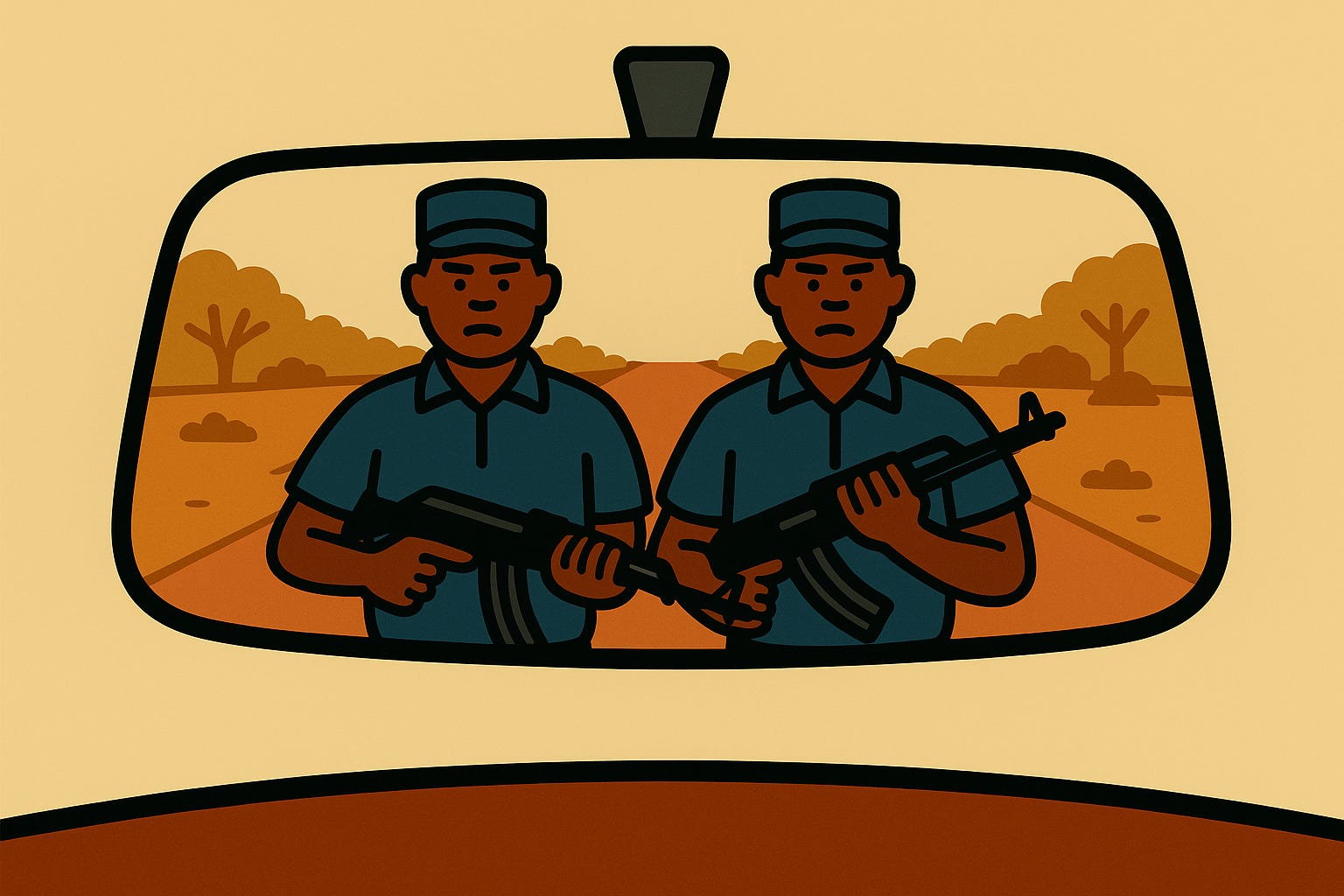
They didn’t wave like officers usually did, or stand beside a checkpoint or cone. They were just there. Their uniforms were clean. Each carried an assault rifle—the standard South African–issued R-4s used in Rwanda, and held them low, with both hands, in a posture that didn’t feel routine. Not slung over the shoulder. Not resting. Gripped.
I slowed instinctively. We were used to checkpoints, especially after enduring one of the longest lockdowns in Africa for the pandemic. Most were quick back then, like the one at the end of our street. Show your ID, say hello, and drive on. I pulled to a stop in the center of the road. The dust rose behind us like steam and began to settle in the early morning heat.
One man came to my side, the other circled around to my wife’s door. They didn’t say anything at first. Just peered into the car, not at us, but through us, one to the other.
I said, “Good morning,” with a polite nod.
The officer beside me gave a shallow nod but still didn’t meet my eyes. “Where are you going?”
“To Kigali,” I said. “We live there.”
He paused, then looked to the other man, who hadn’t said anything. There was something strange in the silence, in the way neither of them seemed interested in us, only in whatever silent conversation they were having across our laps.
Then the man on my side said, “You will drive us to Kigali.”
Just like that.
My wife shifted slightly. It felt like someone had sparked something in the silence, and we were all waiting to see what it would become.
I looked straight at him. It wasn’t defiance, just the only thing I could think to do. I kept my face calm. My mouth moved before my brain had caught up.
“I’m sorry,” I said, “we need to stop in Rwamagana first. We’re visiting a friend for lunch. If we don’t get there soon, they’ll be worried.”
I smiled. Not warmly, but politely. The kind of smile you give at a visa checkpoint or a business lunch when you don’t know who’s in charge. It wasn’t the truth —we didn’t have anyone waiting in Rwamagana— but I needed a reason. Something small and believable. Something to remind them we were people with plans and connections. Not just a ride.
The man on my side didn’t nod. He didn’t say anything. He just turned slightly to his partner. I did too. I gave the smallest nod I could manage, like a person who genuinely did have somewhere to be.
The second man exhaled through his teeth, like steam. He didn’t look convinced. Just tired. He lowered his rifle slightly, more from fatigue than trust.
“But what does protection look like when you’re flagged down in the middle of nowhere by two armed men, and you don’t even know what they want?”
“Okay. You go then.”
I said thank you, though I’m not sure why. My foot was already easing slowly onto the gas. And then we were moving. Not fast, but just fast enough to make it harder to change their minds.
In the rearview mirror, I saw them standing in the red dust we left behind. Their figures were becoming blurred by the dust rising from the road. Still watching. Still holding their guns.
I didn’t say anything for the first few minutes. Neither did my wife. The road twisted slightly, then straightened. A group of children waved. She reached over and took my hand.
“What was that?” she said. “That didn’t feel normal. I was scared.”
I kept my eyes on the road. “It’s okay. It happens sometimes. They probably just didn’t have transport. It’s fine.”
But nothing about it felt fine to me.
The way they never met our eyes. The way they held their rifles. The way the air itself had thickened when they made the ask, as if we’d wandered into a paper-thin fold between this world and another one just a few degrees off.
I didn’t tell her what I really felt. Not until much later. That moment had scared me, too.
Not because I thought something terrible would happen, but because I had no idea what I could’ve done if it had. I had promised, years before, to protect her. I'd stood beside her and vowed it. But what does protection look like when you’re flagged down in the middle of nowhere by two armed men, and you don’t even know what they want?
That drive back to Kigali was quiet. Not heavy, just quiet. We stopped in Rwamagana anyway, ate a rolex —a Ugandan street food staple made from a rolled chapati filled with eggs and other toppings— and watched the parking lot where locals laughed, children played, and tourists disembarked for their bathroom break, like nothing had happened.
And nothing had, really. We were fine.
But still, sometimes, I think back to that moment. The way they looked past us. The way the air thickened. I trust this place. I’ve grown to love this place. But in that one flicker, I realized that love doesn’t give you control. It doesn’t make you immune to misunderstanding, or soften a moment that doesn’t explain itself.
It’s a strange thing, living abroad. You learn a lot about trust. About compliance. About when to assert yourself, and when to smile and nod, and find your exit later. You fall in love with countries—their landscapes, their people, their rhythms—but that love never guarantees you understanding. Or safety.
At the time, I didn’t know what to make of it. Only later did I learn that in some rural areas, officers without transport sometimes flag down private cars for rides. And maybe that’s all it ever was. But in the moment —without explanation, without eye contact, without any sense of routine— it felt like something else entirely.
If you enjoyed this story, consider subscribing for more writing on travel, culture, and the moments that stay with us. If you already subscribe, thank you —please consider a restack or a recommendation!
If you’d prefer to support through photography, I also sell prints. And if you spot a photo in a story that you like and isn’t listed, just reach out. I’m happy to do special runs at no extra cost.