


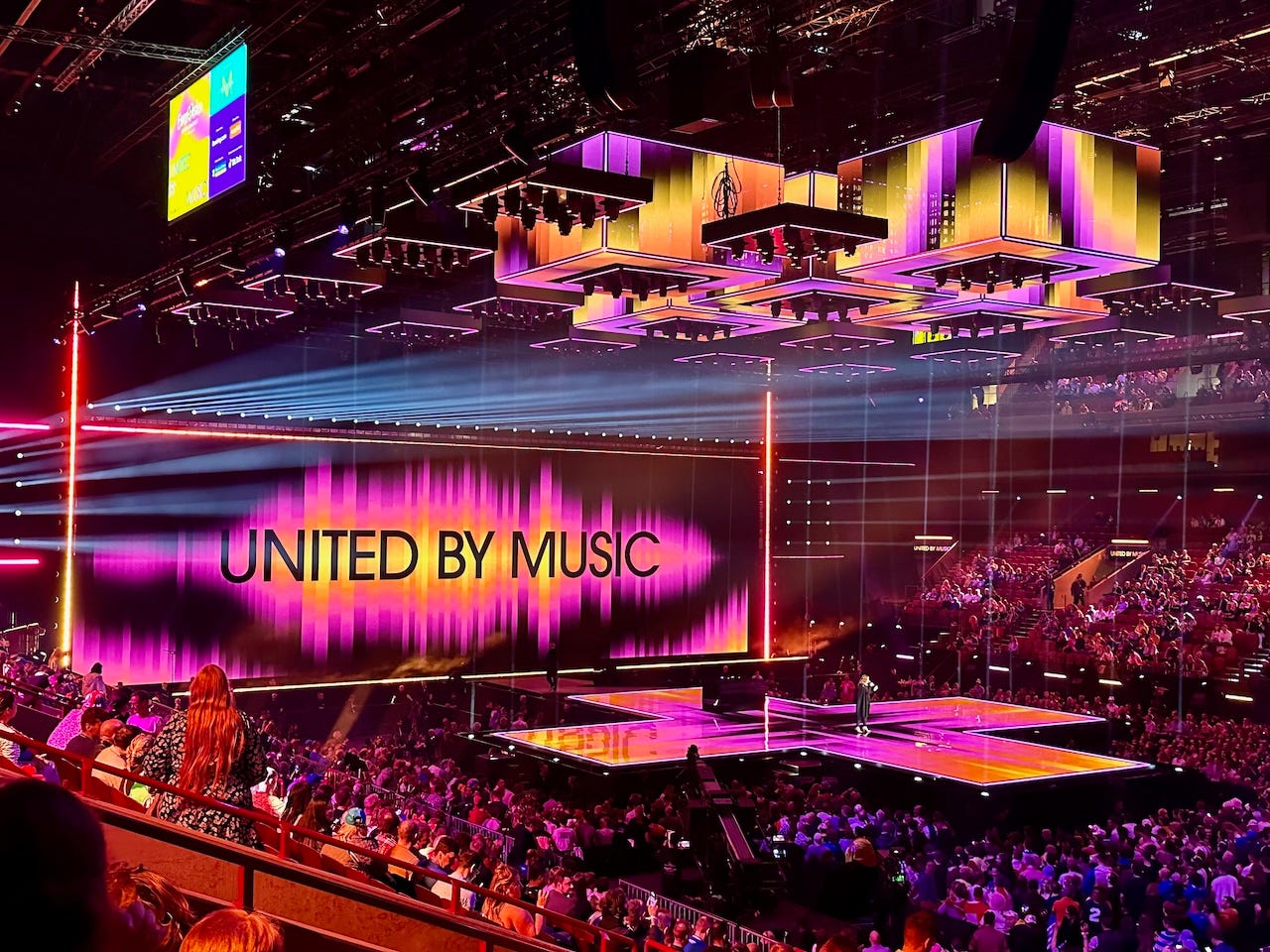
When I first moved to Sweden, I only had a vague sense of what Eurovision was. I knew it was some kind of European talent show that had been going on for a long time, and that it was almost certainly not for me. As a new resident trying to learn as much as I could about Swedish culture, I gave it a shot. Sweden has won Eurovision seven times, tied with Ireland for the most in the contest’s history, and Swedes take the contest very seriously. I was hooked within twenty minutes.1
Here is what I did not understand about Eurovision from the outside: it is the single largest live music event in the world. Close to forty countries each send one act to perform a single song —three minutes, no longer— on one stage, and nearly two hundred million people watch it live. Every televised singing competition Americans have ever cared about —American Idol, The Voice, X Factor— descends from this thing. But none of them come close to its scale or its stakes, because none of them are asking entire nations to compete against each other. ABBA came out of Eurovision, and Celine Dion won it representing Switzerland. In more recent years, acts like t.A.T.u, Loreen, Duncan Laurence, and Måneskin have all been notable after the competition. It is campy and overproduced and emotionally manipulative, and I mean all of that as a compliment. The whole thing is built on the idea that pop music can bring forty countries together, and the insane part is that it works.
The EBU has always maintained that Eurovision is non-political. The rules explicitly say so: No political content in songs, no political messaging on stage, and no political gestures from performers are allowed. This has never been entirely true. The voting blocs alone make that clear — Cyprus has awarded Greece twelve points in twenty-six out of thirty-one possible years.2 Ukraine’s Jamala won in 2016 with “1944,” a song about the Soviet deportation of Crimean Tatars that the EBU approved by classifying it as historical rather than political, a distinction that requires a certain flexibility of mind.
Then, in February 2022, Russia invaded Ukraine. The EBU initially said both countries could still compete, citing the contest's non-political nature. However, within forty-eight hours, after multiple broadcasters threatened to pull out, Russia was banned. The statement said their inclusion would bring the competition into disrepute. Ukraine went on to win that year in Turin, carried by the highest televote in Eurovision history. The viewing public across the continent voted in what felt less like a song contest and more like a referendum on solidarity. That said, the song was excellent, the deserved winner by any measure, even if its music video — filmed in Bucha, Irpin, Borodyanka, and Hostomel, cities near Kyiv destroyed during the Russian occupation — was itself not exactly apolitical.
I watched from my couch in Malmö and thought: well, that settles that. Politics had arrived at Eurovision, but it had arrived in a way that felt clean and possibly even righteous. Russia has remained banned ever since.3 Nobody objected.
The way Eurovision works, the winning country hosts the following year. Ukraine won in 2022 but could not host as the country was still at war, so the United Kingdom stepped in as the runners-up and held the 2023 contest in Liverpool. Sweden’s Loreen won in Liverpool, which meant the 2024 contest was coming to Sweden.
In July 2023, Sweden announced that their host city would be Malmö, which is my city. From everything I had experienced watching from the couch, it was going to be absolutely joyous — the costumes, the visitors flooding in from dozens of countries, the entire city given over to it. I did not even need to travel. I was elated.
Then everything changed. On October 7, 2023, Hamas launched its attack on Israel. Israel’s military response in Gaza followed, and by the time the 2024 Eurovision Song Contest arrived in Malmö, the death toll in Gaza had passed thirty-five thousand. Malmö is one of the most diverse cities in Sweden. Roughly a third of its residents were born outside the country, and a significant share of them are from the Middle East, including a large Palestinian community. These were people whose families were under bombardment. I watched my barber, who is Palestinian, seemingly age years between monthly haircuts, worrying about relatives who had nothing to do with any of it. Protests became regular. The city I loved for its openness was now hosting the most contentious Eurovision in the contest’s history, and the tension was everywhere.
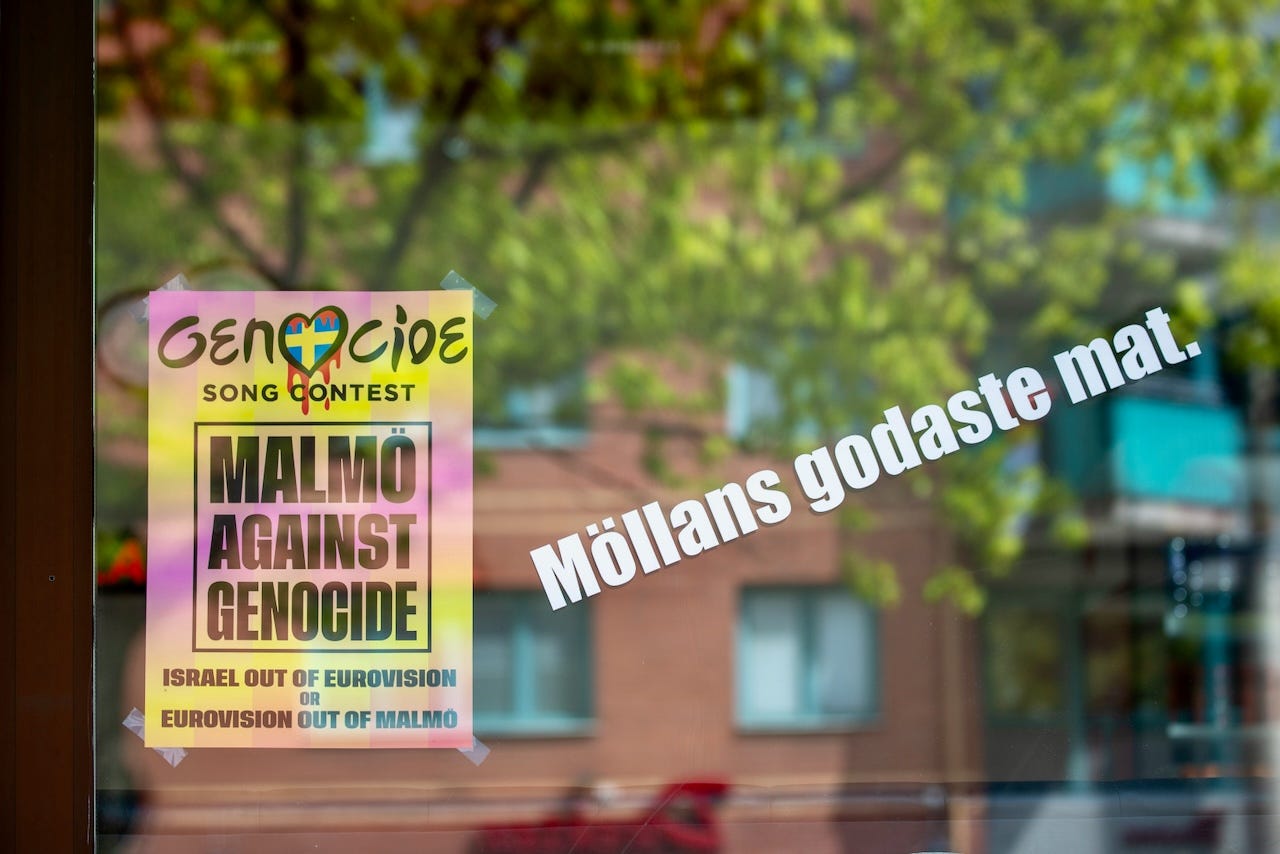
Calls to ban Israel from the contest began almost immediately. Nine countries signed a declaration demanding exclusion. The EBU refused, invoking the same non-political stance it had abandoned for Russia two years earlier. Israel’s original entry, “October Rain,” was rejected by the EBU for appearing to reference the October 7 attacks. A revised version, “Hurricane,” was cleared to compete.
I had tickets to the jury show, the Friday evening dress rehearsal, where professional juries for each country cast their votes. It is essentially the full production, identical staging and performances, before a packed arena. We had been told in advance that Palestinian flags would be confiscated at the door. This did not prevent the sentiment from getting in.
The booing began before Israel’s entry took the stage and swelled as Eden Golan appeared. It was loud and sustained and accompanied by chants of “free Palestine” that rolled across the arena. There were cheers too, and people around us trying to tell the ones yelling that it was not her fault — though whether a twenty-year-old singer sent to represent a country conducting a military campaign in Gaza is a performer or propaganda is not a question with a comfortable answer. Two dads in front of me with their young child tried to get security to remove the Dutch fans behind us, who were screaming obscenities about the contest, about Israel, about all of it. Security never left their post.
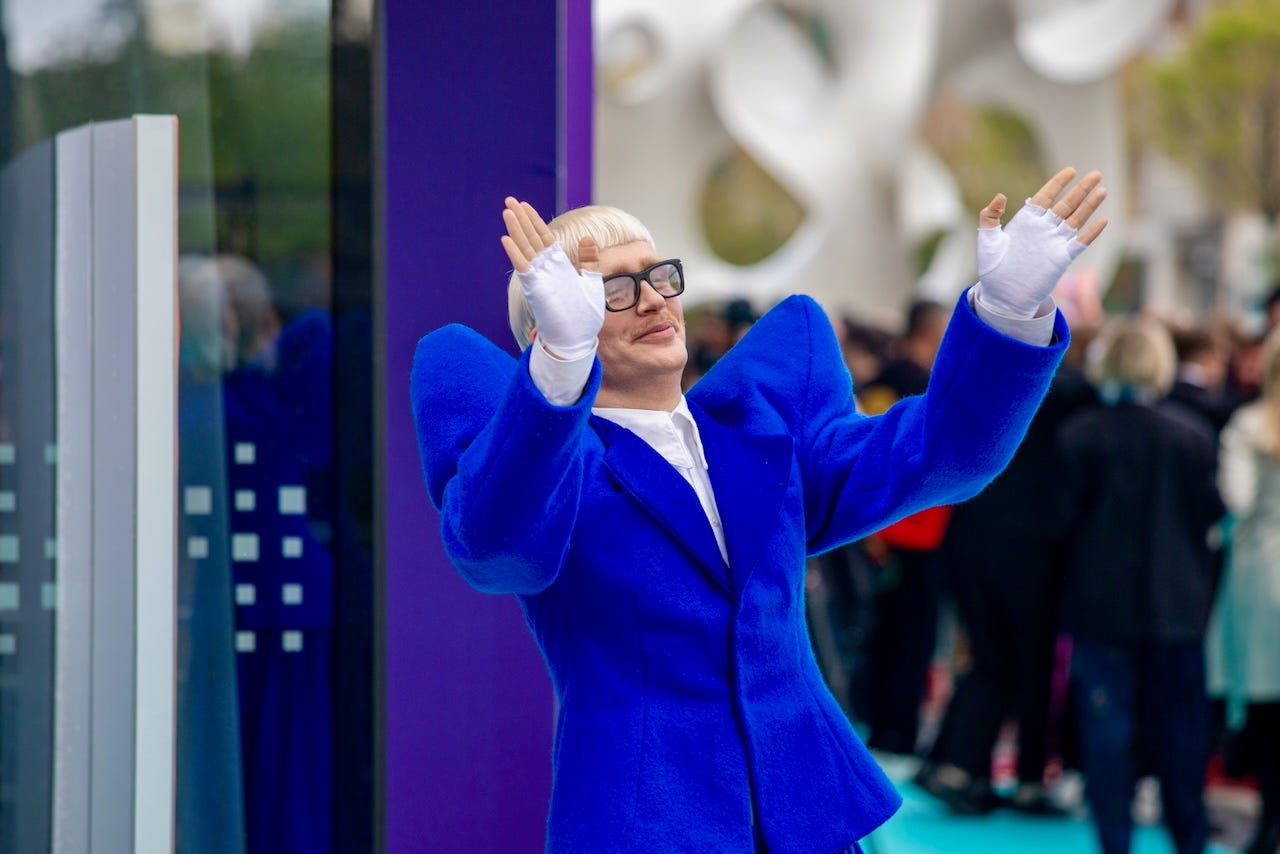
The contest was also unraveling for reasons beyond Israel's participation. That morning, the Netherlands' entrant, Joost Klein, one of the front-runners, had been pulled from rehearsals after being accused of having an altercation with a camera operator. His fate was still unknown. When his slot came later in the running order, his song played through the speakers, and his staging lit up the screens, but the stage was empty. The Dutch fans behind us, already not in a forgiving mood, only got louder.
The next night, we had friends over to watch the live final on television. Eden Golan performed again, and the audio felt completely different from what we had heard in the arena. The boos sounded almost non-existent, replaced with cheers and applause. The EBU denied any manipulation, saying the Swedish host broadcaster SVT had simply adjusted levels to even things out for TV viewers. An audio analysis published by The Intercept a year later confirmed what everyone in the arena already knew: the booing had been suppressed in the broadcast.
But there was one moment they could not suppress. Late in the show, the broadcast cut live to Martin Österdahl, the EBU’s executive supervisor, for a tradition he had performed since taking the role in 2020: appearing on camera from inside the arena to certify that the votes had been verified and deliver his catchphrase, “you’re good to go.” It was the one live, un-isolated microphone of the entire broadcast. When Österdahl appeared, the arena erupted. The boos were deafening, directed at him, at the organization he represented, and at its refusal to act. He was booed again minutes later when he delivered the Dutch jury votes himself, after the Dutch spokesperson withdrew following Joost Klein’s disqualification earlier that day. Swedish prosecutors would later find no case to answer.
Then came the voting results, and with them a different kind of problem. To understand why, you need to understand how Eurovision voting works. Viewers across Europe and beyond can vote by phone, text, or online — but you cannot vote for your own country. In 2024, each viewer was allowed up to twenty votes. Half the final result comes from this public televote; the other half comes from professional juries in each country.
Israel’s “Hurricane” received 323 televote points, the second-highest of the night, and finished fifth overall. Israel’s Ministry of Foreign Affairs later confirmed it had coordinated an international campaign to boost the public vote, reaching out to pro-Israel communities in countries across Europe and beyond. A billboard went up in Times Square promoting Eden Golan. At the time, nothing in the rules prohibited a government from running an organized cross-border voting campaign on behalf of its entry. The EBU took no action, because technically no rule had been broken. The spirit of the contest — nations competing through music, audiences voting on songs — was a different matter.


In 2025, it happened again, at a scale that made the previous year look like a trial run. The contest moved to Basel, and Israel’s entry was Yuval Raphael, a survivor of the Nova music festival attack on October 7. The Israeli Government Advertising Agency ran targeted YouTube ads across thirty-five countries, instructing viewers to cast all twenty of their allowed votes for Israel. Israeli diplomatic missions were instructed to mobilize support. The campaign received over sixty-eight million impressions, a figure the EBU’s own fact-checking outlet later confirmed. Raphael won the televote and finished second overall behind Austria’s JJ.
And in Basel, the EBU made sure the Malmö mic problem would not repeat itself. Österdahl’s live on-camera role was eliminated. The presenters delivered his “good to go” line themselves. A graphic appeared on screen confirming the votes were verified, and Österdahl gave a silent thumbs-up. It was changed because a microphone in a room full of angry people had transmitted something the EBU did not want two hundred million viewers to hear. Not everyone cooperated with the silence, however. Spain’s public broadcaster RTVE aired a message during the Basel broadcast: “When human rights are at stake, silence is not an option. Peace and Justice for Palestine.”
Multiple broadcasters demanded audits of the 2025 vote. Spain, Belgium, Finland, the Netherlands, Ireland, Iceland, Norway, and Slovenia all called for full transparency on the voting data. Twelve Members of the European Parliament wrote to the EBU demanding an independent audit. Spain’s Prime Minister Pedro Sánchez said publicly that Israel should be excluded and that the contest could not apply double standards. Three weeks after Basel, Österdahl resigned. The man who had made “United by Music” the contest’s permanent slogan, who had been its public face for five years, was gone.
The EBU’s response arrived in November 2025: a voting overhaul that halved the maximum votes per viewer, restored professional juries to the semi-finals, and added new rules discouraging “disproportionate promotion campaigns” by governments. The reforms did not mention Israel by name. Eurovision director Martin Green insisted the 2025 results were “valid and robust,” changing the rules while simultaneously declaring that nothing had been wrong with the results that prompted the changes.
At the General Assembly in Geneva, the organization framed its vote carefully. Members were asked whether the new rules were sufficient —not whether Israel should be allowed to participate. Eight countries requested a separate ballot on Israel’s participation. The EBU presidency denied it. Israel was cleared to compete in 2026.
Five countries decided that was enough.
Ireland withdrew first, calling Israel’s participation “unconscionable given the appalling loss of lives in Gaza.” The Netherlands followed, with broadcaster AVROTROS saying the decision would stand even if a ceasefire were reached. Spain, one of the contest’s founding Big Five4, pulled out next — RTVE’s chair said the genocide in Gaza made it impossible to look the other way. Slovenia and Iceland followed, with Slovenia instead airing a Palestinian documentary and film series called Voices of Palestine in its place this week.
It is the largest boycott since 1970. Thirty-five countries will compete in Vienna, the fewest since 2003, before the semi-final format existed. Nemo, the Swiss artist who won the 2024 contest in Malmö, returned their trophy in protest. Seventy-two former contestants have signed an open letter calling for Israel’s exclusion. Over a thousand artists, among them Massive Attack, Sigur Rós, Brian Eno, Kneecap, and Macklemore, signed a separate boycott letter. Germany, meanwhile, threatened to withdraw if Israel were banned, a reminder that the pressure runs in both directions. Since the 2024 contest in Malmö, Israel has continued its military operations in Gaza, launched strikes on Iran, and expanded its offensive into Lebanon. The death toll in Gaza has surpassed seventy thousand.
In years past, we would start getting excited about it here in Sweden months in advance, watching the music videos as they were released, rewatching Will Ferrell’s Eurovision movie for the tenth time. This year, we haven’t.
Tomorrow (May 12), the first semi-final of the 2026 Eurovision Song Contest opens in Vienna at the Wiener Stadthalle. It is the EBU’s seventieth anniversary edition, and it arrives in the worst institutional crisis the organization has faced.
The question is not whether politics belong at Eurovision. It is whether the EBU can keep pretending they don’t. The apolitical framing worked for decades. It does not work now, and insisting on it has cost the contest five countries, its executive supervisor, and the trust of its own membership.
I still love Eurovision. I listen to past songs from Ukraine, Czechia, Germany, Croatia, and many others in rotation, and I will watch it again. The tagline has not changed. The contest has. 🎤
The Briefing
New to Eurovision? Here are some of my favorites from the past few years. Hit play on any one of them.
If you liked this, there’s more where it came from. Nothing to Declare opens a window somewhere new every week —travel essays, photography, cultural observations, and books worth reading. Once a week, sometimes more. Free to subscribe.
If your only reference point for Eurovision is the Will Ferrell movie, Eurovision Song Contest: The Story of Fire Saga, first of all, it is incredible, and I would be shocked if it isn’t your favorite Will Ferrell movie. His wife is Swedish, and he represented the whole thing perfectly, and a song from the film was nominated for an Academy Award. My recommendation: watch a few actual Eurovision performances, then watch that movie. It only gets better. There are easter eggs everywhere.
Each country awards two sets of points: one from a professional jury, one from the public televote. Points run 12, 10, 8, 7, 6, 5, 4, 3, 2, 1. You cannot vote for your own country. The jury and televote results are combined to determine the winner.
Russia, for its part, took the ban personally. In February 2025, Putin signed a decree reviving the Intervision Song Contest, a Soviet-era Eurovision rival that had been discontinued in 1980. It was held in Moscow that September with 23 countries, mostly Russian allies. Vietnam won.
The Big Five are France, Germany, Italy, Spain, and the United Kingdom. They are the contest's largest financial contributors, who automatically qualify for the grand final without competing in the semi-finals. With Spain's withdrawal, they are now the Big Four.
I’m glad you wrote this, Scott. As someone living in Austria I began drafting and researching an article along these lines for the upcoming contest, but found it too stressful and political! Somehow you managed to give an informative, neutral overview for a charged topic. It was also nice to read about your specific experience in Sweden.
I've never paid any attention to Eurovision before, so this was an engaging introduction. Some interesting parallels here to the 1980 and 1984 Olympics, during which boycotts (and reciprocal boycotts) marred the competition, also due to an armed conflict.