


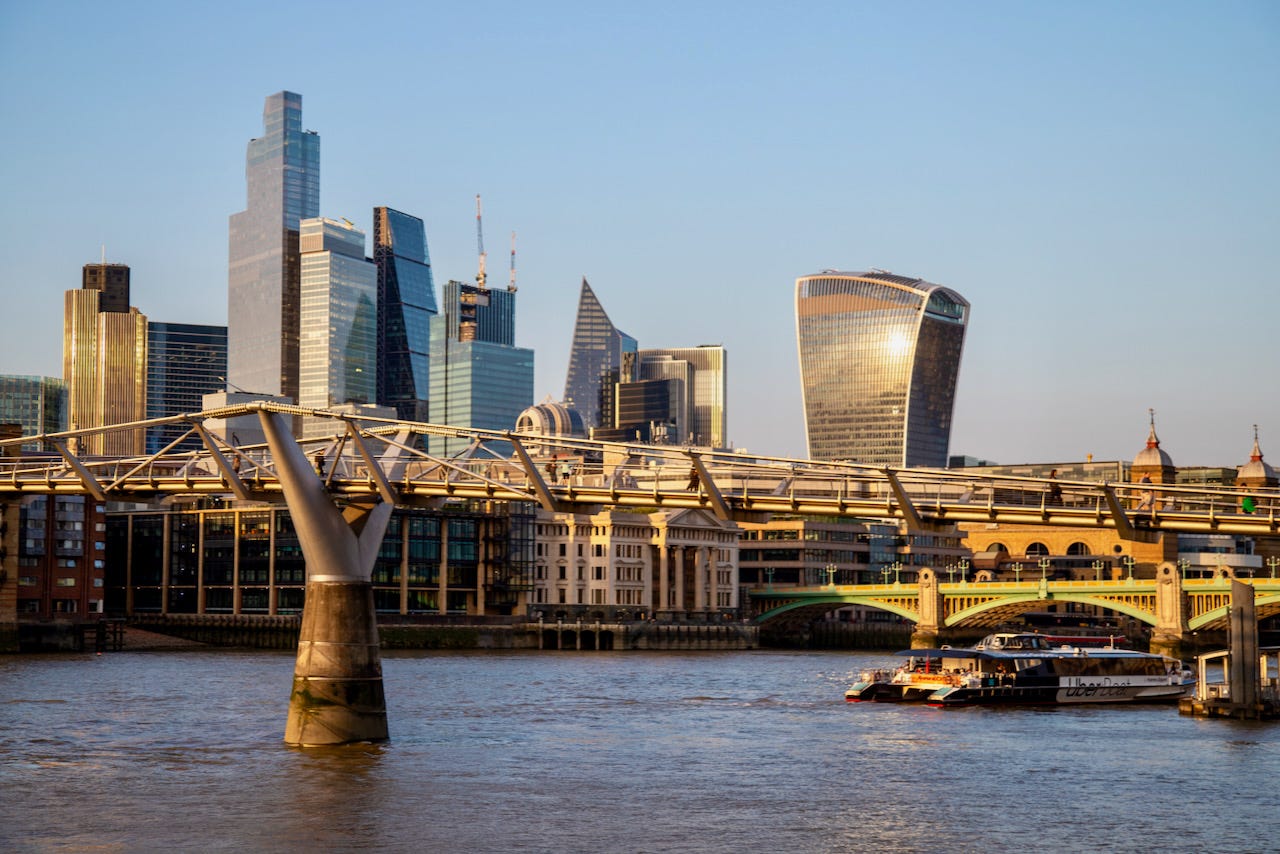
London rewards the people who show up without an agenda.
The sights are fine. I could spend a whole day at the Tate Modern. I love Wimbledon (especially the queue). The Indian food alone is worth the flight. However, when I think about London or when I read about London, I think about walking. Not to anywhere specific. And when I’m not walking, I’m in a bookshop, Daunt Books, Foyles, Hatchards, and the many small indie stores scattered through neighborhoods that don't make it onto most itineraries. You could build an entire trip around them.
What both reading about and walking around London give you is a deeper understanding of how layered the city really is. Roman, medieval, imperial, some bombed or burned out, most rebuilt. The Windrush arrivals, who came when the city needed them and were never properly thanked. Two thousand years of people arriving, staying, and changing what London means. The skyline that still doesn’t know what it wants to be.
These ten books won’t give you a tidy London. But they're a good place to start digging.


Non-Fiction
London: The Biography – Peter Ackroyd The definitive portrait of the city told not as history but as an organism. Ackroyd treats London like a character with its own obsessions and appetites. It’s enormous book.
Down and Out in Paris and London – George Orwell Broke, hungry, and working dishwasher jobs in the East End, the book is more furious, funny, and more relevant than it should be. The London half of this book is one of the sharpest pieces of social observation written about the city.
Londoners – Craig Taylor An oral history built entirely from voices (cab drivers, shop owners, migrants, city workers, and night-shift nurses). Taylor disappears and lets the city speak for itself. The result is possibly the most human book on this list, and probably the most London.
London and the 17th Century – Margarette Lincoln The century that remade the city: plague, fire, revolution, and the slow emergence of modern London from the wreckage. Lincoln is a rigorous historian who never lets the drama get away from her. Excellent context for everything else on this list.
Empireland – Sathnam Sanghera Not strictly a London book, but essential for understanding what London actually is. Sanghera traces the empire’s long shadow on British identity with a precision that is difficult to argue with and difficult to put down.
Fiction
NW – Zadie Smith Two women who grew up together on a council estate in Willesden. One gets out, one doesn’t, and Smith is ruthless about what that costs both of them. The most contemporary London book on this list.
The Lonely Londoners – Sam Selvon Selvon’s Windrush-era novel follows Caribbean migrants navigating a city that wanted their labor and not much else. The prose, a creolized English that shouldn’t work and absolutely does, captures longing, humor, and displacement in equal measure.
Small Island – Andrea Levy Four voices, two continents, one city pulling them all toward each other. Set across wartime Jamaica and postwar London, Levy’s novel is about who belongs and who gets to decide. One of the great British novels of the past twenty-five years.
The Adventures of Sherlock Holmes – Arthur Conan Doyle Baker Street and fog rolling off the Thames. This is the London that everybody knows, and you’ll find pieces of it still intact if you know where to look.
Incendiary – Chris Cleave A letter from a London woman to Osama bin Laden, written in the aftermath of a terrorist attack. Cleave turns grief into something almost unbearable, and the city is every bit as much the subject as the narrator.
The Briefing
London has over 170 museums, and most of them are free. The best way to see the city is on foot — most of London's neighborhoods are closer together than they look on the map, and you'll see more walking between them than you ever would underground. If you need a break, take a double-decker bus over the tube. Here are my hotel recommendations.
If you liked this, there’s more where it came from. Nothing to Declare opens a window somewhere new every week —travel essays, photography, cultural observations, and books worth reading. Once a week, sometimes more. Free to subscribe.


There’s a great second-hand bookshop on Coldharbour Lane in Brixton. The sort of place you can lose yourself for an hour.
Thanks Scott.
I'm heading to London next month for my annual visit, I'm going to give a couple of these a try.