


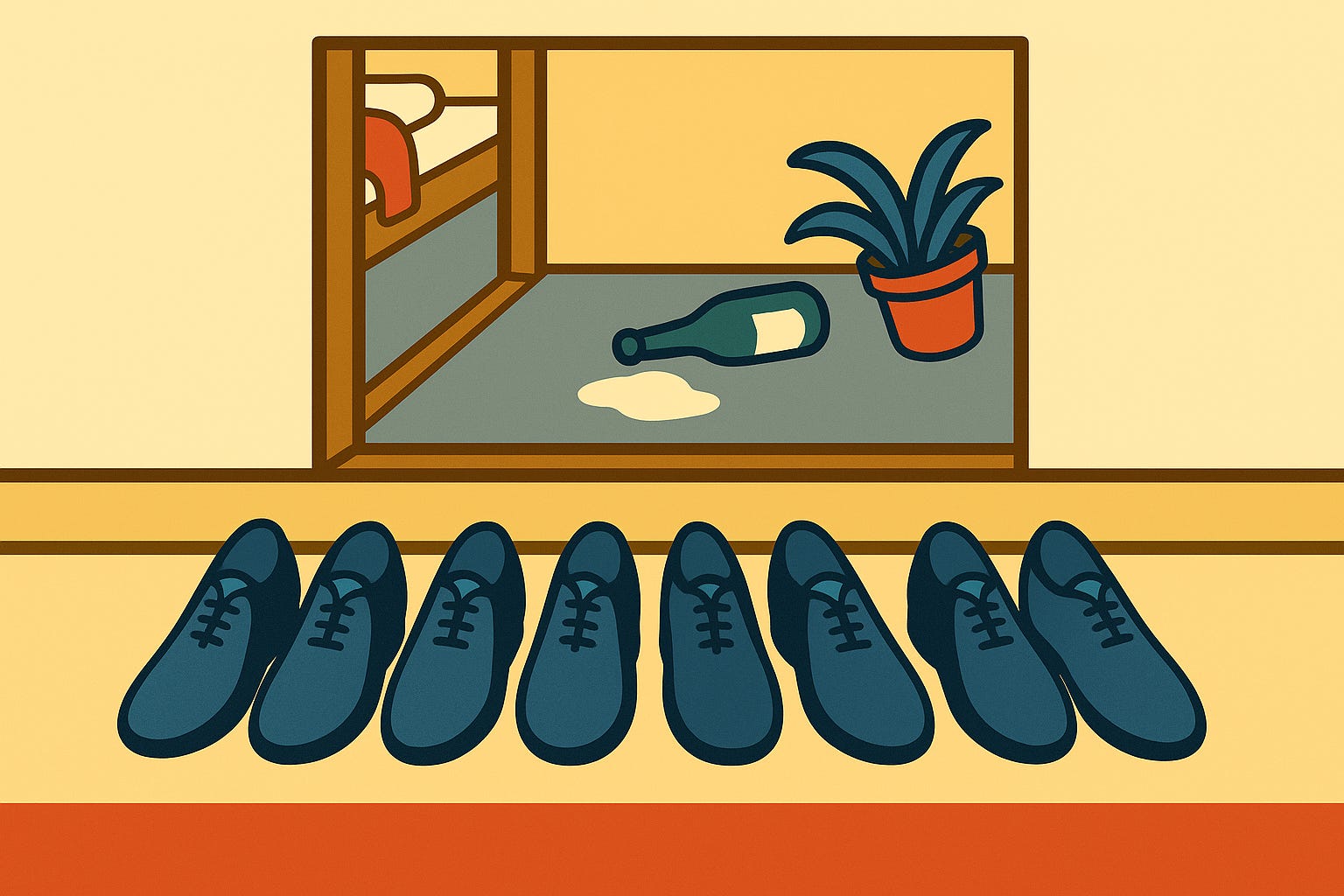
In Japan, you take your shoes off at the door. It’s a small act, but it says everything.
When I first traveled to Japan nearly fifteen years ago, I planned my route with the JR Rail Pass, determined to cover as much ground as possible. Everything I’d read about Japan pointed to hostels as the ideal base: It’s safe! It’s clean! Staying in hostels, I figured, would let me stretch both my time and budget. Like many first-time visitors, my trip began in Tokyo and moved west through Kyoto, Hiroshima, and back again.
Coming from China, Tokyo didn’t overwhelm. In fact, it felt almost like a quiet refuge. The city had a sense of calm and order that Shanghai never quite managed. After a few days of wandering the streets, I boarded a Shinkansen bound for Kyoto. The ride didn’t feel especially novel; I’d hauled myself around China for work often enough, but Kyoto was different.
I arrived at Kyoto Station in the early evening and walked toward the hostel I’d booked. Just a few blocks from the station, the energy shifted. It was peaceful —eerily so. Traditional wooden homes stood silent in the December cold, thin smoke curling from the chimneys. The streets were softly lit, punctuated only by the glow of konbini signs and the occasional muted hum of vending machines—some warm, some cold.
Eventually, I found the entrance: a wooden sliding door with a short noren curtain hanging across the top. Noren are used in Japan to signify that a business is open. More than decoration, they mark a threshold. A silent line reminding you that the inside is sacred, and you are expected to carry yourself accordingly. I ducked under it and stepped into the genkan, a lowered tiled entryway where a row of neatly placed shoes lined the wall. Just beyond, a raised wood floor gleamed with impossible cleanliness.
“Konbanwa,” a slight man at the reception desk greeted me with a bow. I returned it awkwardly and replied in awkward Japanese, “Arigatou.” He took my passport and scanned it without a word, then explained that my room was a six-bed male dorm on the second floor, accessible by elevator. He gestured through a wooden doorway and added that there was a bar if I wanted a drink. Food wasn’t served, it was already close to 8 p.m., but I wasn’t particularly hungry. I told him I didn’t mind. He bowed again. I went upstairs.
After dropping my bag, I headed down to the bar to unwind with an Asahi, one of my favorite beers. The place was nearly empty. The bartender, another slight man, maybe in his late 30s, greeted me with a bow. I took a stool at the corner, sipping my beer and soaking in the calm. The alleyways outside had already made an impression during my walk in. Narrow, hushed, a peacefulness I had heard about but had not yet experienced in Japan.
Soon, I was joined by a young Australian. After five minutes of fidgeting with his phone, he looked up and said, “Heya mate. You just get in?”
“Yeah,” I said. “You?”
“Nah, been here a day already. Great city, this Kyoto.”
“Seems like it,” I replied.
We got to talking, mostly because his sheer determination to chat far exceeded my interest in drinking alone. He was a good guy, from Brisbane, in Japan for a little over a week. Mid-conversation, he leaned in.
“You really look like someone, and I can’t quite figure it out,” he said, eyes squinting. “Don’t worry, though, I will.”
“Really?” I replied, taking a sip. “Well, let me know when you do.”
His boisterous voice soon caught the attention of others passing through the lobby. Instead of venturing out into the unfamiliar December night, a few travelers decided to stay. A New Zealand couple joined us for a round, and not long after, a girl from Germany arrived. She was quiet but observant, smiling often, offering thoughtful comments when the conversation turned to temples and train etiquette. I was glad they joined. It took some of the pressure off me and gave the Aussie more targets for his social energy.
By now, the Aussie had taken up the role of unofficial host. Between rounds of T20 cricket talk and rehashing his past few days in Japan, he was in his element. And then the Brit arrived.
He flopped onto a barstool three seats down, slapping his brand-new tome of Lonely Planet Japan onto the counter. Without missing a beat, the Aussie nodded at him.
“Hey mate. Just arrive?”
“Yeah. Just did,” the Brit replied. “Eighteen hours. Didn’t sleep a wink.”
“Oof, you must be knackered.”
“Yeah, figured I’d get a drink and hit the sack.”
Introductions followed. He said his name, but from that point on, I only thought of him as the man who looked like Moby, because, well, he did.
“Hey,” the Aussie said, turning to him with sudden inspiration, “do you think this guy looks like anyone? It’s driving me mad.”
The man who looked like Moby looked at me, then back at the Aussie.
“Yeah. Louis C.K., right?”
I blinked. Louis C.K.? At the time, I was in my late twenties. Being compared to a forty-something comedian with thinning hair and a paunch? Not exactly flattering.
“Ohhhmmyygawd yes!” the Aussie shouted. “That’s exactly right! You’re Louie, mate! A slightly younger Louis C.K.!”
I groaned into my beer. “I’m Louie,” I said, deadpan. Then, quieter, under my breath: “At least I don’t look like Moby.”
I don’t know why I stayed at the bar that night. Maybe it was warm, and outside was cold. Maybe my ego was too bruised to move. Either way, the conversations swirled around me, fast and loose.
The man who looked like Moby was now powering through his second—or was it third?—gin and tonic. For someone who claimed to have landed just a few hours ago, he already had some pretty strong opinions about the Japanese. As his uncomfortable generalizations spilled out, I started scanning for an exit strategy. But before I could make a move, he decided we weren’t stimulating enough and drifted a few stools down to strike up a conversation with the bartender and his barback.
That’s when the volume turned up. He wanted shots, and he wanted to take them with the staff. The bartender gave a small bow and declined. The man who looked like Moby waved him over impatiently.
“Oh no, no—come here. Come here,” he said, motioning with a crooked finger. Then, in offensively slow and loud English, he added, “I AM DOING SOMETHING NICE FOR YOU. THIS IS WHAT WE DO IN THE UK.”
He moved to put his arm around the bartender, like they were about to start swaying and singing football chants. But as soon as he made contact, the bartender recoiled. Visibly shaken, he bowed deeper and repeated his refusal. Still polite. Still composed.
Then things escalated.
The bartender asked him to leave. The man who looked like Moby refused. The barback stepped forward and said gently, “Please, sir, you need to go to your room.”
And that’s when the man who looked like Moby slapped him.
The room fell silent. So silent I could hear the noren curtain outside the bar fluttering in the breeze. No one moved. The staff held their composure. The bartender calmly asked him to leave once more. This time, the man finally turned and stormed out, Lonely Planet in hand.
There were quiet murmurs in Japanese behind the counter, and then the phone was picked up.
A few minutes later, the bartender came over and bowed again. “We’re very sorry for the disturbance,” he said. “The police will arrive soon.”
We assured him there was no need to apologize. He nodded, then said the bar would be closing soon, but offered us a bottle of plum wine before we left. We told him we couldn’t accept it as a gift, so we paid for what was left, fruit and all.
By the time we made it out to the lobby, the police had arrived. Eight of them. Calm, efficient, and dressed in identical navy-blue uniforms, each one moving with quiet precision. They stood erect, conferring softly with the owner to confirm the man’s room. Two entered the elevator. Two took positions at the entrance. Four slipped silently up the back stairs. No panic. No shouting. Just deliberate professionalism. And then, silence.
We lingered off the side lobby, the German girl, the Aussie, and I, plum wine in hand, waiting to see what happened next.
It didn’t take long.
A whir. The elevator descending.
Even before the doors opened, we could hear the chaos inside. Metal clattering. Plastic cracking. And then an explosion. The doors slid open, and the man who looked like Moby burst into the corridor, swinging his laptop like a weapon. Pieces of ceiling tile and mirror followed him out.
The police swarmed. In perfect, rehearsed motion, they pinned him down. He screamed the c-word with a frequency that, while not uncommon in parts of the UK, still felt jarring to everyone else in the room. He shouted WWII-era slurs with bewildering conviction and thrashed as they held him. Twice, he turned his head and spat at one of the officers.
In all the commotion, I turned to look at the German girl and the Aussie beside me, and then I saw it: a row of black shoes neatly lined up at the threshold of the entry, almost identical in size, perfectly still.
I looked back at the scene.
The violent tourist.
The cultural collision.
The chaos of entitlement.
Then I looked down at the officers’ black stockinged feet. How, even in that moment, they honored the space they stood in. Eight officers restrained a drunk and furious man, and not one of them disrespected the carpet.
Once he was finally escorted out—hands cuffed, still shouting—the officers paused to relace their shoes, each knot as neat and deliberate as everything else they’d done. We stepped outside with our bottle of plum wine.
We didn’t say much as we walked the quiet streets of Kyoto. There was no tone of “Oh man, that was crazy.” Just the hush of cold December air and the steady rhythm of the bottle changing hands.
Eventually, we came to a small park with a metal slide. The three of us sat beneath a full moon, the kind of sky that makes silence feel earned.
The German girl reached into the bottle and fished out the plum, biting into it with a wince.
“Ah, that is really strong,” she said.
It was.
But so was the calm.
And the patience. And the order. And the quiet resistance to everything that had come crashing in from the outside.
Subscribe for more stories from life abroad. The shoes come off at the door, but the drama usually barges right in.
If you’d prefer to support through photography, I also sell prints. And if you spot a photo in a story that you like and isn’t listed, just reach out. I’m happy to do special runs at no extra cost.
I don't see the Louis CK resemblance personally. I still think it's more Justin Timberlake