


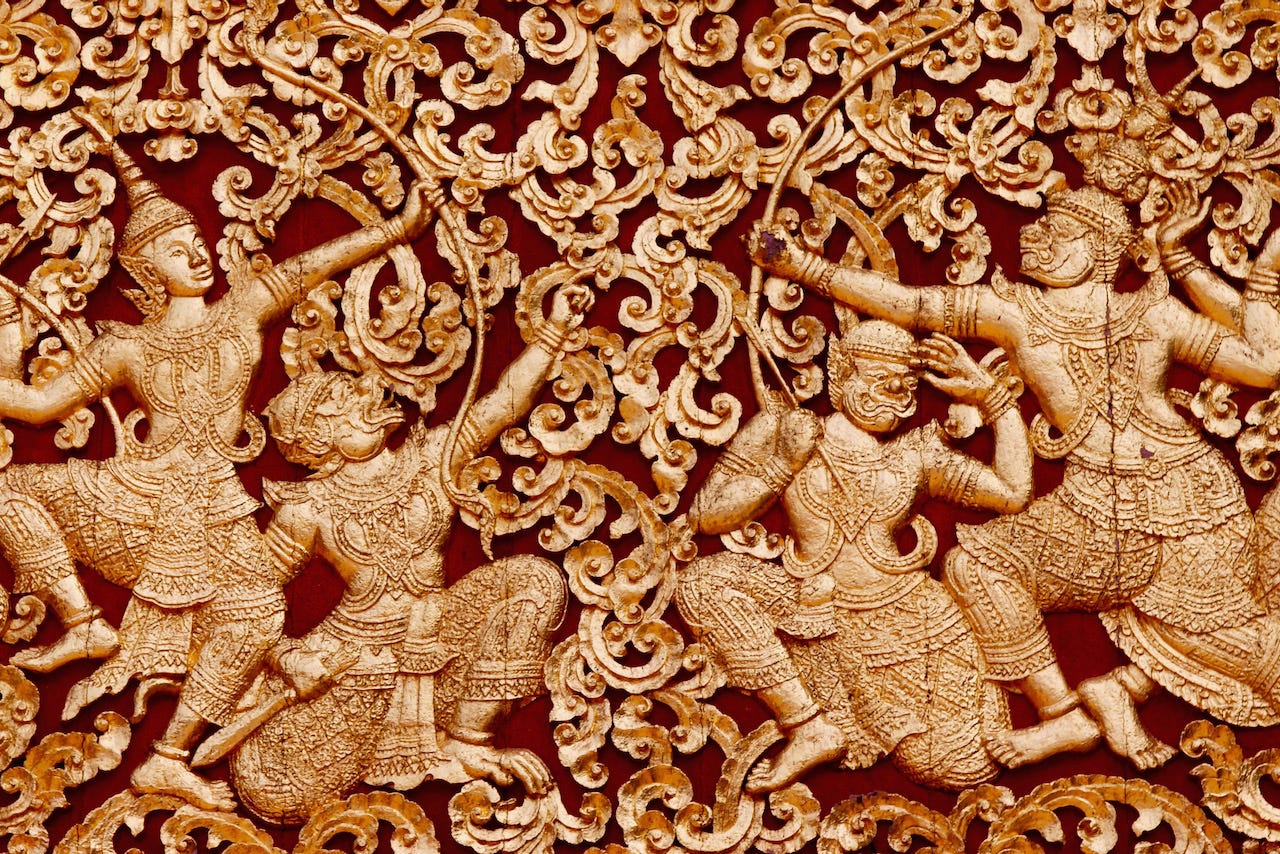
The guest house looked better online. It always does.
I’d booked the trip to Luang Prabang while in a rut. My girlfriend had just left China and flown back to the US. Her assignment in Shanghai had always been temporary. Now the prospect of a long-distance future felt daunting. I’d heard Laos was peaceful, unhurried. That Luang Prabang, in particular, had a quiet grace—temples tucked between trees, riverbanks washed in morning light. The idea of a quiet retreat, slow coffee, and a stoop near the Mekong sounded like a soft place to land.
What I got was the annex.
The check-in was uneventful. The man at the front desk smiled, handed me a brass key on a plank of stained wood, and gestured loosely behind the main building.
“You’re in the back,” he said, already turning away. He didn’t say anything else, and I didn’t ask.
The annex looked like a neighboring house that had been reluctantly absorbed into the main structure. A narrow wooden staircase led up to a short hall with four doors, two on each side, and a faded red carpet runner in the middle. The floor creaked like it hadn’t been walked on in years.
My room had no view. Just one shuttered window, a ceiling fan, and a rattan chair that looked like it had held too many damp towels and not enough people. It wasn’t offensive, just tired. I dropped my bag, changed my shirt, and walked back out into the city.
Luang Prabang moves gently. Not idle, not rushed —just unbothered. It sits between the Mekong and the Nam Khan, tucked into a curve of the land like a sleeping figure. You walk here because there’s nowhere else to be. Past temples and tamarind trees, across small bridges, through side streets where locals hang their laundry on sagging lines.
I wandered toward Wat Xieng Thong, the jewel of the city’s temples, tucked away at the tip of the peninsula. The roofs curve down like hands in prayer. Mosaics shimmer against the white walls, patterns of fire and elephants and holy trees.
From there, I drifted to Wat Mai, closer to the Royal Palace. It was larger and more active with monks moving along its walkways, heads bent, sweeping leaves, or adjusting robes. The temple gleamed, but not in a sterile way. It felt alive. People passed by and nodded to one another. Everything moved, but quietly.
That night, I sat by the Mekong with a bowl of noodles in my lap and a beer sweating onto the table. A street market was just getting started nearby. I didn’t know the occasion, if there was one. There was incense in the air, and the river was lit orange by the last of the sun.
I returned to the annex late. The hallway was quiet. Not a shuffle of feet, not a snore or television behind thin walls. Just that musty, tired scent old buildings carry. I went in, closed the door, and turned off the light. After rinsing the humidity and sweat from myself as best I could, I climbed under the covers and went to bed.
Around the time most odd things happen in the night, I woke.
Or thought I did.
The room was black. Not dark but black. No blinking light from a charger, no glow from the wall-mounted air conditioning unit. Just blackness so thick I couldn’t tell if my eyes were open. The air felt wrong. Not warm. Not cold. Just heavy a weight that didn’t sit on me but in me. As if the room had filled with something.
I couldn’t move.
I wasn’t dreaming. I knew I wasn’t dreaming. My fingers refused to twitch. My arms were dead things by my side. My chest was still, not rising. I told myself to breathe. I told myself this was nothing.
The pressure intensified. I tried to speak. My throat wouldn’t open. It was like something was pushing down hard enough to enter. There was no sound, but I felt something happening.
I told myself it would end. I repeated it. Over and over. And then it did.
First, a twitch. Then a breath. Then the slam of my own body into waking as I sat up, flipped on the light, and gasped into the thick air. There was nothing. No one. No sound.
I opened the door and looked out. Empty.
I sat for a long time, upright, arms around my knees. The fan turned slowly overhead, making no breeze. I didn’t feel scared. I felt watched. As if something had found me, just to confirm it still could. What it wanted, I had no idea.
Eventually, I went back to sleep, though I don’t remember how.
The next morning, I rose just after sunrise and walked towards Wat Sene, a smaller, quieter temple. I passed women placing out bowls of sticky rice on the sidewalks. The monks came barefoot, silent, heads bowed, accepting the offerings without a word.
Tak Bat, the morning almsgiving, isn’t a performance, though it’s treated like one by the tourists in some parts of town. But in certain quarters, away from the cameras and the tour groups, it still felt sacred. The line of monks moved like water. A rhythm of gratitude and humility.
I watched until the last saffron robe disappeared down the road, and then I sat.
At breakfast, I typed “Luang Prabang ghosts” into my phone.
I expected the first article to say, “Cam’on really?” But what I found surprised me.
In Laos, the dead don’t leave.
In Laos, the dead don’t leave. They linger. The word is phi —a term that covers ghosts, spirits, and anything that used to be human but still lives somewhere on the edges. There are phi ban, protectors of the village. There are phi pob, the kind that possess and consume. And there are phi tai hong —spirits of those who died violently, suddenly. These are the ones that don’t rest.
I wasn’t thinking about spirits before. But now I wondered what kind of place I’d slept in and what that heaviness meant.
I started thinking back more critically to that night. Not just the silence or the stillness, but the feeling, that overwhelming sense of presence.
I remembered what it felt like to lie there frozen, my body immobile, the air pressing in like it had purpose. That part, at least, had a name. I’d read about sleep paralysis before.
But it also hadn’t felt like that. It hadn’t felt detached or explainable. It had felt pointed like something had found me, and just wanted me to know it could.
The rest of the day passed slowly. Luang Prabang has a way of holding you in place without making you feel stuck. I wandered without direction. I watched boats drift. People swept the steps of their shopfronts. A dog greeted me like a stuffed animal that had been placed there for decorative effect.
By late afternoon, I walked through the night market as it began to unfold. I found out it happens every day along Sisavangvong Road. Red and blue canopies stretched down the street. Tourists in their elephant pants fresh from Thailand strolled down with beers. Craft sellers hawked their wares.
As the sky grew darker, I kept thinking about the room.
Back in the annex that evening, the hallway looked the same. But I didn’t. I paused at the top of the stairs, staring at the red carpet runner stretched across the floor like a tongue I didn’t want to step on. The other rooms were still shut. I had still seen no one else come or go; in fact, I realized I hadn’t seen the caretaker since I checked in.
I opened my door slowly, as if it mattered. The room hadn’t changed. But I had. I was bracing for something, though I didn’t know what.
What do the dead want?
I thought of the stories I’d read earlier, of phi tai hong, the spirits of people who died too suddenly, too violently to understand it. People whose death didn’t let them leave, who clung to places and people because they had nowhere else to go.
I wasn’t scared. I was unsure. And that feeling felt closer to fear than anything I’d known in a while.
That second night, I kept the lights on for longer than I normally would have. The light above me buzzed faintly in comfort. I could hear the hum of distant insects outside, but nothing else. The silence in the hallway felt sealed.
Eventually, I stood up and turned off the light.
This time, I waited. Nothing came.
The air stayed still. No pressure. No frozen limbs. Just the sound of my own breath and the slow tick of the ceiling fan trying to do its job.
I lay down and stared into the dark, willing myself not to tense.
What keeps something or someone in between?
Is it grief? Is it love? Is it a lack of faith? Is it simply the unwillingness to go?
The next morning, the light in the room seemed softer. I opened the door, and the hallway creaked in a familiar, unremarkable way. I packed my bag slowly. The rattan chair still looked like no one should sit in it.
At the front desk, the man asked if I had slept well. I said yes. He nodded like that was the right answer.
Outside, the monks had already passed. The sidewalks were being swept again. The river glinted in the morning sun.
In Luang Prabang, the sacred lives in the open, not locked in temples, but left in corners, perched on walls, tucked behind wires and potted plants. Spirit houses lean against homes. Nothing disappears. Not really.
I don’t know what happened that night.
But I still think about the weight.
And I still wonder who, or what, was trying to leave.
If you enjoyed this story, consider subscribing for more writing on travel, culture, and the moments that stay with us. If you already subscribe, thank you —please consider a restack or a recommendation!
If you’d prefer to support through photography, I also sell prints. And if you spot a photo in a story that you like and isn’t listed, just reach out. I’m happy to do special runs at no extra cost.
👀 Sounds like an intense experience. I'm glad your second night was softer.
Spirits need orange Fanta. This is a documented fact. They would have left you alone if you’d left a bowl of it outside your door.