


Los Angeles, 4:00 p.m.
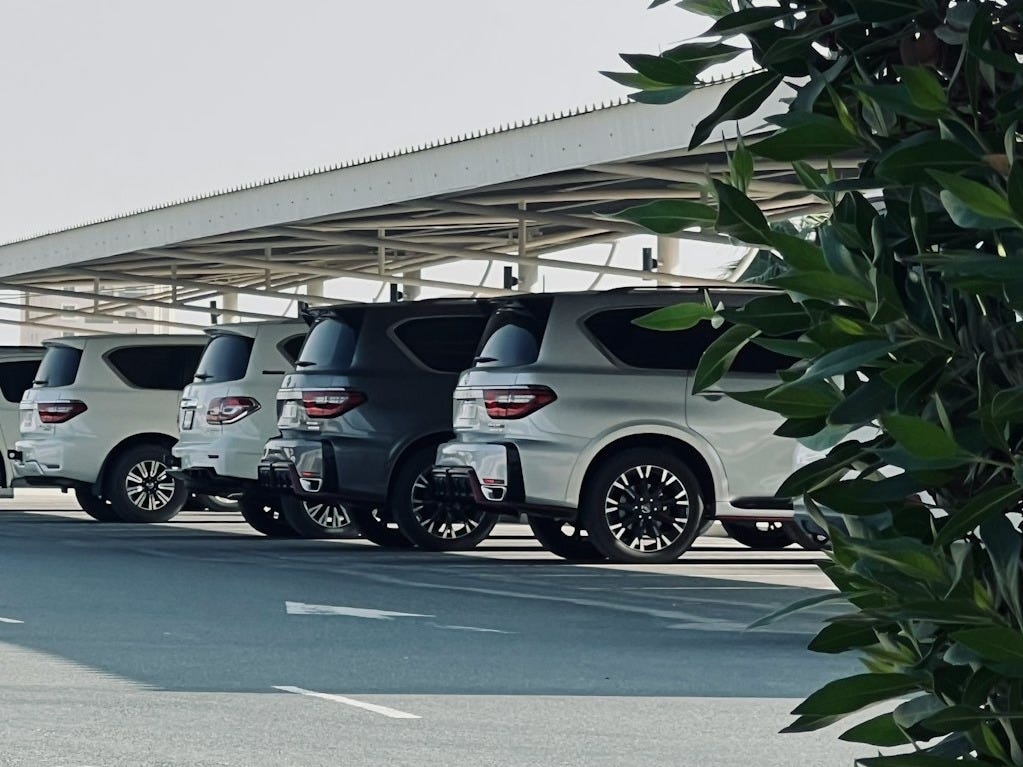
I landed at three, but since this is LA, you take a shuttle to basically Inglewood to get a car, so I am first greeted by the attendant an hour later. He welcomes me back, comments on my status, and tells me to pick any car I want from the lot. Every car on the lot is an SUV roughly five times the size of any car I have seen outside of the United States.
I go back to the attendant.
“But I reserved a compact. Do you have any compacts?”
He looks at me. Behind us, people are fanning out across the lot, running to vehicles as if they have just been told everything is free. He waves a few more of them through without breaking eye contact with me.
“It’s an upgrade, man. Just pick whatever.”
“How is it an upgrade if it probably gets fifteen miles a gallon?”
“Look, man, think about it. When you’re driving around town, who do you want people to think you are?”
Before I can answer, a Volvo sedan with Oregon plates pulls out of the washing area.
“I’ll take that one,” I say, already walking toward it before anyone else can. Behind me, I hear him exhale slowly through his teeth.
Malta, 6:30 p.m.
I booked the car for pickup at six as my flight was due in at 5:30. Landing about thirty minutes late, I stop at Burger King as I exit the terminal and carry the meal to the rental car counter, where I stand picking fries out of the bag while the man looks at my license and passport.
“You know, it’s fifty euros for after-hours pickup,” he says without looking up.
I stop chewing. “What? It’s 6:30, and my flight was delayed.”
“Well, this desk closed at six.”
“Sorry to have kept you, but I can’t imagine I’m the last person arriving tonight.”
“Oh, you’re not. I’m here until 8. There are more flights coming in,” he assures me. “So, did you want the insurance too, or can I charge for a five-thousand-euro deductible? Wait, sorry, 5,050. Gotta include that after-hours fee.”
We walk out into the garage to inspect the car, which is a small white Hyundai, just as I booked online. He opens the door and says aloud, “Only 723 kilometers, full tank. You’re good to go.” I get in and look around. The car is new, with two no-smoking stickers on the dashboard but no screen or USB plug. It does have hand-crank windows and a push-in cigarette lighter, though.
Bucharest, Romania, 2:15 a.m.
I exit the terminal and message the rental car company. A young man wearing a hoodie in a black van flags me down and drives me to a facility near the airport, which, at two in the morning, looks like somewhere you are taken specifically to not be found. He sits down at the desk and takes my passport, license, and credit card. He completes the paperwork and sticks the card in the credit card reader before pulling it out quickly and looking at it.
“Wait, you don’t have a credit card with raised numbers.”
“What do you mean, raised numbers?”
He runs his finger over the card. “It should be like buda buda boom. Look at the rental agreement; it’s in our terms.”
“You just put it in the chip reader.”
“We also need raised numbers.”
“I don’t think I’ve had a card with raised numbers since 2015.”
“Then you couldn’t have rented with us since 2015. Anyway, I can override it if you purchase our insurance.”
“And how much is that?”
“A hundred and fifty euros a day.”
I booked with this company for one reason: they are the only one that will let me drive to Moldova. So instead of driving to Moldova after Bucharest, I fly to Moldova for less than one day’s insurance, and then I fly back. Now needing a car for the rest of the trip, I go to another company. The man there completes the paperwork and inserts the chip card into the reader. He tells me the machine won’t take it, but I get no email or text about a declined transaction. I call my bank. My bank says no charge was attempted, and I relay this to the man.
“I definitely tried,” he says. “You saw me.”
“My bank says you didn’t.”
“I tried. I cannot rent you the car unless you cover it with our insurance.”
“And how much is that?”
“Two hundred euros a day.”
It’s raining as I walk out to see if the one next door has a car. The office is dark, and the door is locked, so I call the phone number on the door.
“Do you have a reservation?”
I recognize his voice, and I look back at the other rental car company and see him standing up inside on his cell phone. I take an Uber across town and rent from someone else.
Izmir, Turkey, 8:40 a.m.
The phone rings five times before someone answers.
“Hello, I landed, and the reservation says to call this number. I’m standing outside door C. Where are you?”
“OK, I will be right there.”
Fifteen minutes pass, and my phone rings again.
“What are you wearing?” he asks.
“A white hat. I’m right outside door C.”
“I don’t see you. I’m at door four.”
“There is no door four. It goes A, B, C.”
“There is no door C. It goes one, two, three, four!”
We go back and forth like this for a while. I hand my phone to a Turkish man standing nearby and ask him if he can help me. He listens for about thirty seconds, nods a few times, says something in Turkish, and hands the phone back to me.
“You might need to book a new car,” he says. “That man is in Antalya.”
Antalya is five hundred kilometers southeast; the rental car company logged the booking at the wrong location. I hire another car in the terminal and set off.
Lisbon, 8:00 a.m., Good Friday
We wake up before three in the morning in Copenhagen to catch the flight. Four hours later, we land in Lisbon and walk out to the curb, where we are told a van will be circling. Sure enough, the van is there. The man asks for the last name.
“Monaco.”
He flips through a stack of printed sheets, finds the name, crosses it off, and looks up.
“By the way, there are no cars.”
“What do you mean, there are no cars?”
“There’s a glitch with the computer. There have been no cars since the day before yesterday.”
“Couldn’t you have let us know?”
“Well,” he says, “now you know.”
I go back into the terminal to try the other companies. Every rental car counter at the airport has a line full of families and is completely out. It is Easter weekend in Portugal, after all. We take an Uber an hour and a half north to the hotel. When we check out a few days later, we Uber all the way back to the airport and rent from someone else for the remainder of the trip.
Sapporo, Japan, 12:45 p.m.
The staff at the rental office are so organized that the entire process takes about ten minutes. They hand me the keys, a little binder of paperwork, and a black-and-white photocopied map of the surrounding blocks with three gas stations circled on it. There are also cartoon bears drawn on the map. I am told to refuel at one of these three stations before returning the car and to keep the receipt. I am so enamored with the check-in process that I forget to take a single photo or video of the car.
The car looks like a block of tofu and drives like one too. The screen does not work with my phone, so before leaving Sapporo, I stop at a Daiso to buy a phone clamp for 300 yen. A few days later, pulling into another Daiso parking lot, I feel the little block of tofu jiggle. I get out and find a scuff on the underside of the front bumper. I have no idea whether it was there when I picked it up or if I just did it. I spend the rest of the trip convinced I am going to inconvenience these impossibly gracious people with additional paperwork.
On the return, a woman greets me with a deep bow and a smiling face. She walks around the car once. She does not mention the scuff. The only disappointment is that she does not even ask for my fuel receipt.
Skopje, North Macedonia, 11:15 a.m.
Somewhere in Bulgaria, I first notice the tire pressure light on the dashboard. It never actually loses pressure, but when I look at the tire, I cannot tell if it’s a nail or a metal tire plug. I am heading back through North Macedonia anyway, so I bring the car in.
The man in the parking lot could not be more helpful. He looks at the tire, shrugs, and tells me to go inside. No problem, he says. They will just swap the car.
Inside is a different experience. The young man at the desk does not get up.
“It’s a nail. A hundred and fifty euros.”
“You haven’t seen it. Can you come look at it? It looks like a repair plug. It might have been there before I got the car.”
He does not move. “A hundred and fifty euros.”
“Can I at least get a damage report for my insurance?”
“If you want a new car, I’m charging your card right now.”
I think of my plans in Kosovo, so I relent. “Fine, but I need documentation for the charge.”
“You’ll get it.”
He charges my card. I take the new car and leave. The report never arrives. When I return the second car at the end of the trip, the man at the desk looks confused. He cannot find the charge in the system. Over the next six weeks, I email and call somewhere between six and ten times. What eventually comes back is a refund. They ultimately decide it is easier to give me my money back than to create a document for me to get my money from someone else.
Kigali, Rwanda, morning
When I lived in Kigali, my own vehicle was not built for longer trips like self-drive safaris. When I needed one that was, I sent a WhatsApp message to a man I knew. He came to my house in the morning with the car. I gave him a wad of cash, and he gave me the keys before hopping on the back of a motorcycle taxi. There was no counter, paperwork, or insurance questions. When I got back, I would message him, and he would pick it up without asking many questions.
If you liked this, there’s more where it came from. Scott Monaco opens a window somewhere new every week —travel essays, photography, cultural observations, and books worth reading. Once a week, sometimes more. Free to subscribe.
I don't know why I'm laughing. Some of these cut way too close to the bone.
That Rwanda system takes the cake!
This made me laugh and I’m sorry you had to cut so many stories. I’m not quite so professional as you, so I rambled through all my stories when I attempted a post like this a few months ago: https://accidentallyaustrian.substack.com/p/rental-car-roulette-12-years-of-not