



Why Go Looking for Chinese Restaurants?
Because there’s a certain kind of Chinese restaurant that exists almost everywhere — from Argentina to Zimbabwe — and it’s almost always worth finding. This guide is about those places: the ones that serve Chinese food first and foremost to Chinese communities abroad. You’ll know them by the Lazy Susans, the laminated menus, and maybe a kid bent over their math homework at the register.
I’ve eaten in some of these restaurants myself, but most were uncovered through a patchwork of sources: reviews, recommendations, and online platforms in Chinese/English/local languages. The point isn’t to crown anything “authentic” — I’m not Chinese, and that judgment isn’t mine to make. It’s simply to highlight where you can find a good Chinese meal anywhere in the world. To my knowledge, this is the first attempt at a true global guide.
Restaurants that make the list earn a lantern 🏮 and a pin on the map. What does the lantern mean? It means that if you are in the area, you should absolutely have a meal there. They were selected based on a completely scientific, confidential, and accurate process. But I am always open to your suggestions of locations to check out, so please add them in the comments.
The one ground rule, though, is straightforward: the menu must be Chinese at its core. If a place is serving sushi, pho, or heaven forbid, burgers on the side, it usually doesn’t make the cut. The exception: when it’s the only notable option in a whole country or region — survival sometimes requires compromise.
Some countries end up with dozens of lanterns, others just a single one. Either way, each lantern marks a restaurant worth finding: good food, run by Chinese cooks, that won’t burst your budget.
For a fuller reflection on what these restaurants mean —as cultural anchors, as survival strategies, as bottom-up globalization— see my earlier essay, The World’s Most Successful Brand Isn’t a Brand at All.
This guide is organized by continent, with each region published as a separate post and linked through the navigation bar below. One note: China, Hong Kong, Macau, and Taiwan are excluded. They're already well covered, and they are the roots. This list is about everywhere else.
AFRICA | ASIA | EUROPE | OCEANIA | NORTH AMERICA | SOUTH AMERICA
AFRICA
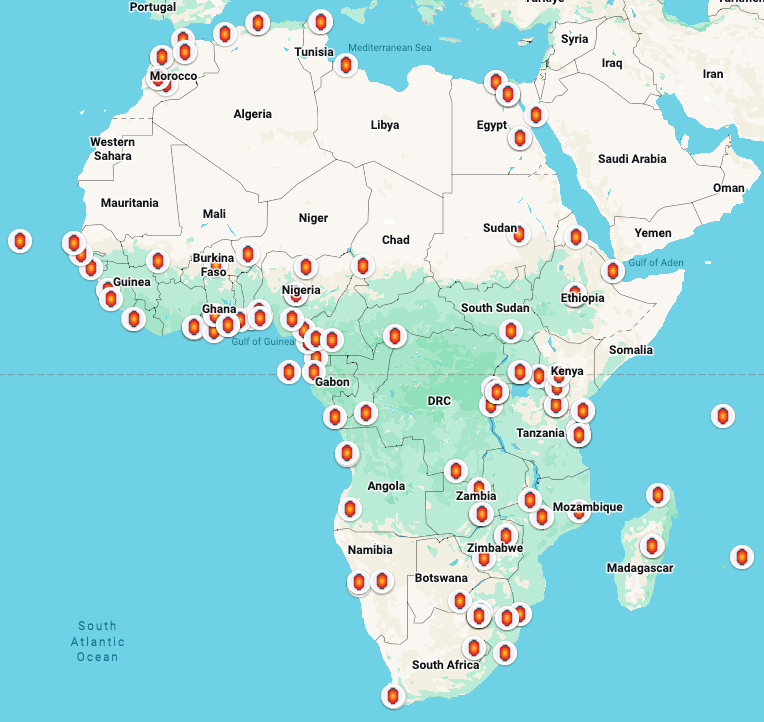
Chinese restaurants can be found almost everywhere in Africa, from the savannahs to the deserts. While the continent doesn’t have the depth of Chinatowns you find in North America or Europe, the scale of Chinese investment, construction, and student exchange has created a surprisingly dense network of eateries. In total, 169 restaurants across Africa made this guide, spanning nearly every country. Only a few nations (Comoros, Mauritania, and Somalia) are not represented.
View the Scott Monaco Guide: 中餐 Africa Map
Top Countries:
🇿🇦 South Africa 🏮 x10
South Africa hosts one of the continent’s largest Chinese communities, shaped by multiple migration waves from historic settlers to newer arrivals (notably from Fujian) since the late 1990s/2000s. Johannesburg’s Cyrildene on Derrick Avenue is widely recognized as the city’s current Chinatown.
Try: Swallows Inn or Chong Qing Huo Guo Hot Pot Restaurant
🇪🇬 Egypt 🏮 x11
Egypt has become a hub for Chinese students, traders, and entrepreneurs, especially in Cairo. The community’s needs have shaped the restaurant scene: you’ll find halal-friendly adaptations of northern Chinese classics alongside more traditional Sichuan kitchens.
Try: 云海肴 Sino Restaurant
🇳🇬 Nigeria🏮 x10
Nigeria has one of the fastest-growing Chinese populations in Africa, concentrated in Abuja and Lagos. Chinese construction projects, oil partnerships, and diplomatic ties have brought thousands of workers, entrepreneurs, and embassy families, creating an unusually deep restaurant scene.
Try: Chai Tang Restaurant
🇹🇿 Tanzania 🏮 x10
Tanzania’s coastal location has made it a base for Chinese contractors and traders, particularly in Dar es Salaam. Zanzibar has a documented historical Chinese presence (famously, locally made Chinese noodles became part of the island’s foodways).
Try: Great Wall Chinese Restaurant
🇰🇪 Kenya 🏮 x9
Kenya’s capital, Nairobi, has developed into a key African base for Chinese companies, diplomats, and students, which in turn has supported a strong Chinese dining scene. While many of the city’s authentic restaurants focus on Sichuan flavors, there are also hearty northern dishes and Lanzhou noodles.
Try: Chengdu Restaurant Noodles
🇲🇦 Morocco 🏮 x8
Morocco’s ties with China have deepened through trade, infrastructure projects, and tourism. Casablanca and Rabat now host a cluster of authentic restaurants that serve both long-term residents and visiting travelers.
Try: 有家餐厅
🇬🇭 Ghana 🏮 x7
Ghana’s role as a trade and education hub has brought a steady Chinese presence, concentrated in Accra and Kumasi. Restaurants like Noble House reflect both the business community and a younger generation of students and entrepreneurs.
Try: Noble House
🇿🇼 Zimbabwe 🏮 x5
Chinese investment in construction and mining has brought small but notable communities to Harare. Policy debates about this footprint are well-reported, but the restaurant scene remains a key social anchor for residents.
Try: 四季私房菜
🇷🇼 Rwanda 🏮 x5
Chinese construction and investment in Kigali have brought a small but steady community. The city’s restaurants are few in number but high in quality and serve as important gathering points.
Try: Sizzling Plates
Continue your journey below:
AFRICA | ASIA | EUROPE | OCEANIA | NORTH AMERICA | SOUTH AMERICA
Every guide in this series is free to read. The restaurant maps, your actual travel companion, are available to paid subscribers (although this Africa one is free). If this guide has been useful to you, subscribing is the best way to keep the lanterns lit. 🏮
If not, you can still support by subscribing for free and passing this piece to a friend. Every reader counts, and together we can keep opening new ways of seeing the world.
I've got one for you in Suva, Fiji. Cloud Feast. Great yum cha on weekends, regular menu all week long.
I remember my dad telling me about what he used to do on extended business trips to Europe the 90s: find the Chinese embassy on a map, and look for restaurants around it. If necessary, walk around the block ask the staff coming out of the embassy where they eat. And then, once you arrive at the restaurant, tell ask the chef to make you some of whatever they are going to cook for themselves, especially if they also serve sushi and pho.
I'm so glad it's much easier today! I've even found an authentic Cantonese food place in Lisbon making their own char siu and char siu bao.