



Why Go Looking for Chinese Restaurants?
Wherever Chinese communities have settled, and they have settled nearly everywhere, a restaurant usually follows. This guide is a running attempt to find the best Chinese restaurants in the world and put them in one place.
I’m not Chinese, and I’m not here to referee what counts as authentic. What I can do is point you toward a good meal: the restaurants that serve Chinese food primarily to Chinese communities abroad, sourced through a tangle of reviews, local contacts, and platforms in Chinese or English. I’ve eaten in some of these places myself. Most I’ve tracked down from a desk.
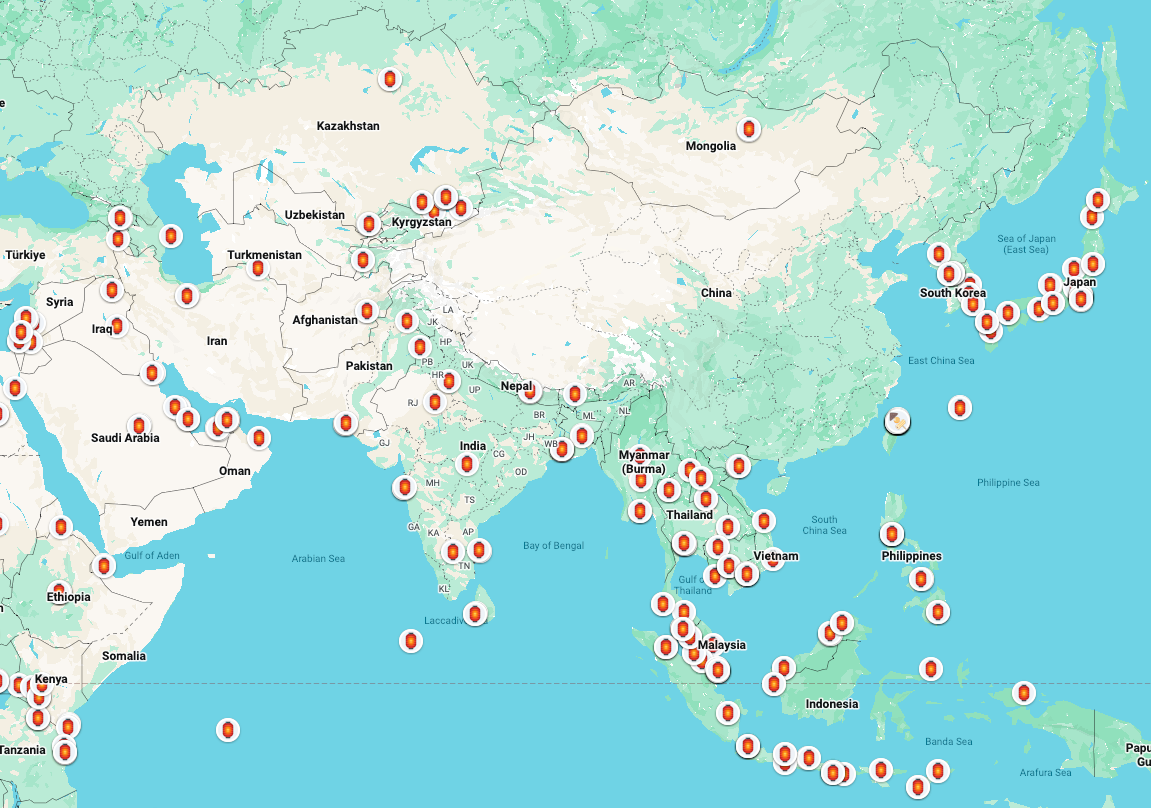
Each restaurant that makes the cut earns a lantern 🏮 and a pin on the map. A lantern means: if you’re in the area, eat here. The selection process is entirely scientific, deeply confidential, and probably accurate. Recommendations are always welcome in the comments.
One rule holds the whole thing together: the menu has to be Chinese at its core. If it’s also serving sushi, bibimbap, or describes itself as ‘fusion’, it’s probably out. The exception is when a place is the only real option for an entire country. In those cases, we grade on a curve.
Some countries can earn dozens of lanterns. Others might just earn one. The overall lantern count doesn’t measure quality as much as it measures depth.
If you want the longer version of why these restaurants matter, I wrote about it in The World’s Most Successful Brand Isn’t a Brand at All.
This guide is organized by continent, with each region published as a separate post and linked through the navigation bar below. One note: China, Hong Kong, Macau, and Taiwan are excluded. They’re the roots and already well covered. This list is about everywhere else.
AFRICA | ASIA | EUROPE | OCEANIA | NORTH AMERICA | SOUTH AMERICA
ASIA
Asia is where Chinese food first traveled and put down its deepest roots. From the world’s oldest Chinatown in Manila to hand-pulled noodle shops along the old Silk Road, the continent holds perhaps the widest range of Chinese restaurants outside China itself. In total, 282 restaurants across 44 countries made this guide. Only Yemen and Palestine are not represented. (Again, China, Hong Kong, Macau, and Taiwan are excluded)
Top Countries:
🇯🇵 Japan 🏮 x33
Japan’s Chinese food scene operates on two tracks: the historic Chinatowns of Yokohama (est. 1866), Kobe, and Nagasaki, and a newer wave of “gachi chūka,” which are unadapted Chinese restaurants run by and for China’s diaspora. Ikebukuro’s north exit in Tokyo has become a new Chinatown with food courts and an emphasis on Sichuan and Dongbei cuisine, while Nishi-Kawaguchi in Saitama has over 70 Chinese restaurants within walking distance of the station.
Try: 湖南人家 in Yokohama or 滕記鉄鍋炖 in Tokyo
🇮🇩 Indonesia 🏮 x31
Indonesia’s ethnic Chinese community of 8–10 million is the largest in Southeast Asia, and its restaurants are quiet acts of cultural survival —the community endured the 1965 massacre, a 30-year ban on Chinese culture under Suharto, and the 1998 riots. Jakarta’s Glodok neighborhood holds restaurants dating to the 1920s, while Bangka Belitung’s Hakka tin-mining community has been cooking since the 1700s.
Try: Wong Fu Kie or Pantjoran Tea House in Jakarta
🇲🇾 Malaysia 🏮 x24
Chinese Malaysians make up 23% of the population. Penang’s Hokkien hawker scene is globally famous, Ipoh’s bean sprout chicken rivalry between Lou Wong and Ong Kee is a national pastime, and Sarawak holds distinct Foochow, Hakka, and Hainanese food traditions found nowhere else.
Try: Tek Sen in Penang or Little Hainan in Kuching
🇮🇳 India 🏮 x20
India's Chinese community is small and shrinking, but it left an outsized mark. Kolkata holds South Asia's only surviving Chinatown, centered on the Tangra neighborhood, where Hakka families have run restaurants and tanneries side by side for generations. The dawn market at Tiretti Bazaar still sells char siu bao and fish shumai to a dwindling but devoted community. In Mumbai, Ling's Pavilion, run by the Ling family for 75-plus years, is arguably the best Chinese restaurant in the country.
Try: Golden Joy Restaurant in Kolkata or Ling’s Pavilion in Mumbai
🇹🇭 Thailand 🏮 x14
Bangkok's Yaowarat is one of the great Chinatowns of the world, and its oldest kitchens have been cooking over charcoal in the same shophouses for more than a century. Phuket's old town is based on a different story. Hokkien tin miners arrived 500 years ago, married locally, and built a food culture you can't find anywhere else. In Chiang Mai and Hat Yai, the restaurants are smaller and the crowds thinner, but the woks are just as seasoned.
Try: Tang Jai Yoo or Laoteng in Bangkok
🇰🇷 South Korea 🏮 x14
Korea’s Chinese food story begins with Shandong immigrants who arrived after the 1882 opening of Incheon port and invented jajangmyeon, now a national comfort food. Incheon’s Chinatown, the peninsula’s only official one, still has restaurants descended from that founding era. In Seoul, a second layer has emerged: Daerim-dong, where ethnic Korean-Chinese from northeastern China serve lamb skewers, hand-pulled noodles, and malatang in a neighborhood where Mandarin flows as freely as Korean.
Try: Sinseung Banjeom in Incheon
🇻🇳 Vietnam 🏮 x13
Vietnam’s Hoa (ethnic Chinese) community numbers roughly one million, concentrated in Ho Chi Minh City’s Cholon district, a Chinatown founded in 1679 by Ming Dynasty refugees. Cholon’s dim sum parlors and Cantonese roast shops operate at a scale matched by few cities outside China. Hanoi has developed its own Chinese dining scene with Hong Kong–style and northern Chinese restaurants, while Hoi An’s ancient Chinese assembly halls mark centuries of Fujianese and Cantonese trading heritage.
Try: Dim Tu Tac in Ho Chi Minh City or Minh Ky in Hanoi
🇵🇭 Philippines 🏮 x13
The Philippines is home to Binondo, founded in 1594 and widely considered the world’s oldest Chinatown. Nearly all Chinese Filipinos trace their roots to Fujian’s Hokkien community, and their food influence runs deep. Beyond Manila, Davao’s 44-hectare Chinatown with four formal archways and Cebu’s heritage restaurants reflect a Chinese-Filipino community spread across the entire archipelago.
Try: New Toho in Manila
🇸🇬 Singapore 🏮 x10
In a city-state that is 74% ethnically Chinese, the challenge isn't finding Chinese food, it's curating it. Every hawker center, kopitiam, and food court has Chinese dishes worth eating. That abundance is exactly why this is the shortest list relative to the size of the scene: the lanterns here mark restaurants where a specific regional tradition has been preserved with unusual care, not the only places worth visiting.
Try: Chui Huay Lim Teochew Cuisine or Putien
🇦🇪 United Arab Emirates 🏮 x9
Dubai’s International City China Cluster is the Gulf’s largest concentration of Chinese restaurants, built to serve tens of thousands of Chinese traders, construction workers, and entrepreneurs. The scene ranges from hole-in-the-wall Sichuan canteens to Lanzhou hand-pulled noodle shops to high-end hotel restaurants. The UAE’s Chinese community is transient and trade-driven, but the restaurants it supports are as authentic as any in Asia.
Try: Liu Gui Xiang Catering in Dubai
🇰🇭 Cambodia 🏮 x8
Cambodia’s Chinese community has been present since the trading era and survived the Khmer Rouge period, during which ethnic Chinese were disproportionately targeted. Phnom Penh’s Central Market area and riverfront hold Cantonese and Teochew restaurants that serve both the remaining community and a growing number of Chinese investors and tourists arriving through Belt & Road projects.
Try: Emperors of China in Phnom Penh
🇰🇿 Kazakhstan 🏮 x7
Kazakhstan sits on the modern Silk Road, and its Chinese restaurants reflect that geography — Uyghur-influenced noodle houses in Almaty, Dungan (Chinese Muslim) home cooking near the Kyrgyz border, and new mainland Chinese restaurants serving workers on Belt & Road infrastructure projects. Astana and Almaty both have visible Chinese dining scenes shaped by trade, diplomacy, and the ancient routes that first connected these regions.
Try: Lanzhou Noodle in Almaty
The full map. All 282 restaurants, pinned and ready, is below.
For more places worth traveling for the food, see Food & Cuisine.